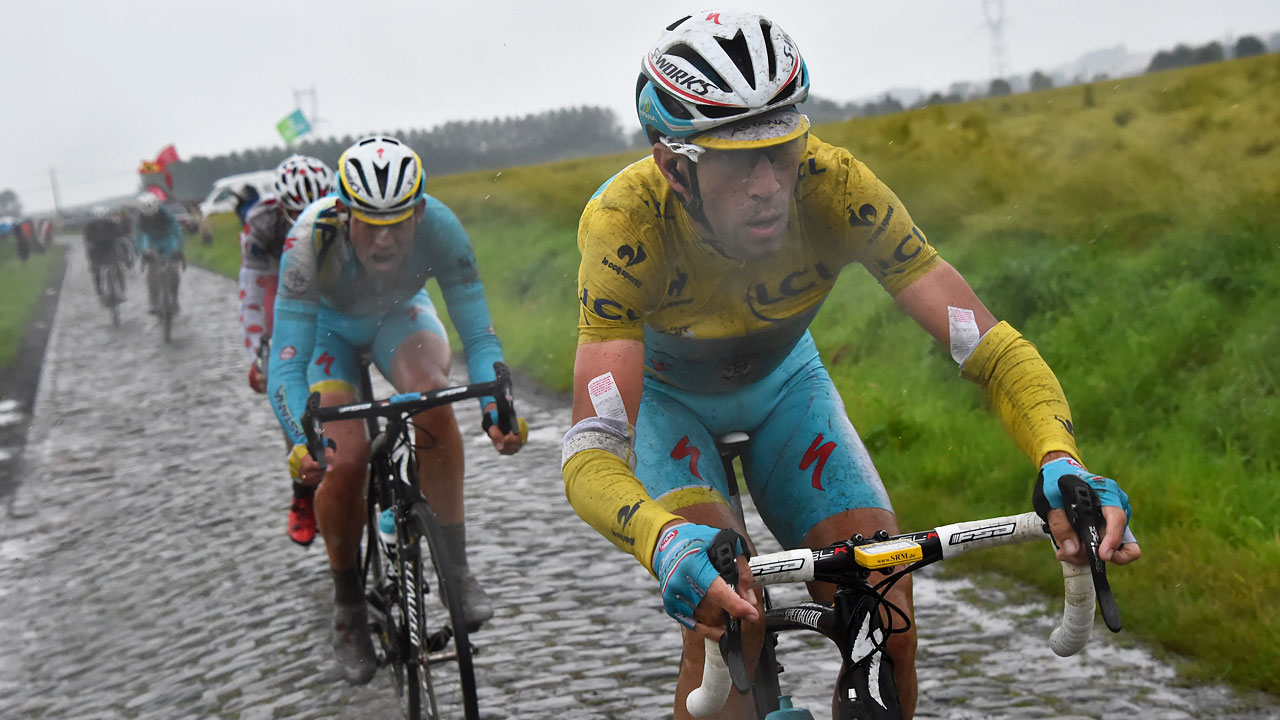

The cobbles did it. Sort of.
Wednesday’s shake-up of the Tour de France was not just the literal jouncing over the cobbled roads used for Stage 5. By the end of the 152km stage, the leadership of the Tour de France was much more secure for Italian Vincenzo Nibali (Astana). The two top contenders as predicted by many ahead of the race ended up down — Alberto Contador (Tinkoff-Saxo) dropped well back from the Italian while Chris Froome (Sky) crashed for the second day in a row, and withdrew from the event.
While the cobbles have been the characteristic continually brought forward when describing the stage, much of what happened occurred on paved roads, not the pavé.
Anticipation and anxiety over cobbled sections of road are part of the magic offered by the Spring Classics such as the Paris Roubaix where cobbles are very nearly a rule, and not an exception. The ancient roads have helped shape the cyclists riding over the pavé into strong, hard, and determined individuals. So challenging are the Spring Classics that the Paris-Roubaix is also known as the Hell of the North.
Riders in the Tour de France are no less resilient, but strength manifests differently. To sustain the effort of racing three weeks of stages, competitors must learn to mete out their effort. Lighter-built athletes excel in the mountain passes of the Alps and Pyrenees, perennially home to stages of the Tour. Weather in the summer months is generally better than a European spring, when rain conspires with dirt and cobbles to help form the demanding character of early-season races.
Specialists in one type of race rarely excel in the other, though there are exceptions.
It’s understandable then that racers accustomed to stage racing expressed concern over the inclusion of cobbled section in the 2014 Tour de France. Every team had fair warning of the road ahead, with months to prepare. By the time the stage arrived, every member of the peloton simply had to do their best in facing the challenge.
Anticipation and anxiety came to the fore on Wednesday’s stage. All through the first week of the Tour de France, riders have worked to stay at the front of the peloton, not so much in a battle to win, but in an effort to stay in front of crashes that seem to sprinkle through the first week of the Tour, when tensions and excitement are high.
In much the same fashion, knowledge of the pavé ahead triggered a strong desire to be at the front of the peloton before arriving at the cobbled sections. Manifest in high speeds for flat roads — up to 50km/h in places — the peloton dashed and scrambled like prey trying to escape a chasing predator, only to nearly be caught in an ambush ahead.
Froome went down, his second crash in as many days, on a roundabout before arriving at the cobbles. His injuries were so bad he became the first defending champion in over 30 years to abandon the race, victim of the particularly excitable nature of the peloton.
Contador survived the day’s stage, but lost a great deal of time. By the end of Thursday’s stage, he had recovered lost ground, but still sits over two minutes back from the leader. In a race where many pegged Contador and Froome to be the two main contenders, the Spaniard expressed regret for Froome’s retirement from the race.
Even the yellow jersey was not immune to the ravages of cobbled roads. Nibali crashed, but recovered and finished the stage third on the day, coming out with huge gains in the general classification. Nibali’s teammate Jakob Fugelsang rests just 0:02 back of the Italian champion. Cannondale’s Peter Sagan retains both the green and white jerseys, and is now 0:44 back from the lead. Finishing the race in the yellow jersey has been Nibali’s target for the 2014 season. With both Giro and Vuelta titles already in his list of palmarés, the Italian knows how to manage the pressure of being at the front of the classification, and the cobbles have helped him get a foothold over the rest of the field.
With so much racing left, there is much that will change as the Tour changes its nature and heads into the mountains. However, in knocking out the defending champion, and knocking down his chief rival the roads used each spring for the Hell of the North have helped to shape the rest of the 2014 Tour de France.