The Individual Time Trial is a showcase of power and skill of each competitor in a cycling Grand Tour. Rather than racing as part of a peloton, riders leave the start line on intervals with a singular strategy — to go as fast as possible, without any interference by other riders. They are the stages that can make or break pursuit of the overall event victory.
Unlike pedalling in a peloton, time trial stages offer no rest for the riders. Drafting and support from the domestiques within the group are set aside in favour of skin suits and bicycles shaped by wind tunnel experiments. Time trailing is a skill separate from sprinting, or from climbing. Those who are strongest in the discipline will use time trial stages to their advantage in a chase for the leader’s jersey.
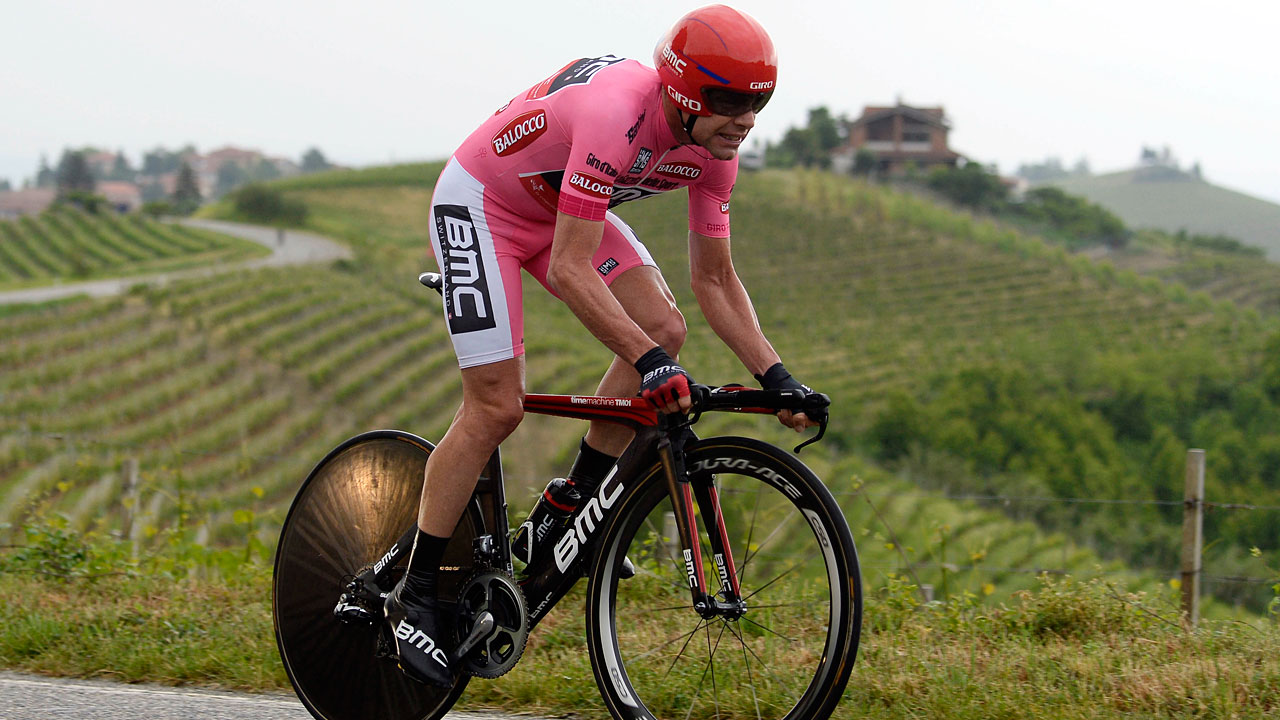
The format is simple. Each rider races against the clock on a relatively short course — typically less than 50km long. Hunching forward on special aerobats meant to support a rider’s forearms, the body curves into the most aerodynamic shape possible. The helmet extends back from the front of a competitor’s head to a fine point, helping air smoothly travel over the rider’s back.
Legs pump the pedals to turn massive gears for often as much as an hour. The best time trialists pace their effort to balance a fine line between all-out speed and just enough endurance. A rider should cross the line completely spent, just as the perfect race car lasts just to the finish line.
The time trial is so unique, that certain riders focus their efforts on the discipline. Canadian Svein Tuft is an eight-time Canadian time trial champion. Tuft had hoped to make his mark on the Stage 12 time trial, but nagging injuries from last week’s crash held him back. Despite this, the Canadian was the first over the start line today, sitting last overall in 174th position, and crossed the finish line as the 106th fastest.
Fellow Canadian Hesjedal is less of a time trial specialist, but riding uninjured, finished 20th on the day.
Thursday’s stage was meant to be an advantage for Cadel Evans, who expected at minimum to maintain his lead, but ideally build on his margin. However, the Australian had a terrible day, obviously looking off the pace, occasionally drifting wide out of corners and even ending up off the road completely. A massive push over the final few kilometres helped stop the hemorrhage of time, but it was too little, far too late. Evans dropped 1:34 to rival Rigoberto Uran.
“Incredible, what a surprise,” said a breathless Uran. “I didn’t think I would win it. What a great day for my team and myself. We did a lot of work over the winter, especially on the time trial.”
One of the most challenging aspects of the time trial is to maintain focus. Although shorter than a regular stage, a time trial is so specific in the demands on a rider that lapses in concentration can be detrimental to the effort required to win. A race is completely alone on the bike, with no teammates to offer support, no peloton to joke with.
As Evans lost time, the team car following behind would have offered up information via radio. Evans would have known he was struggling by experience alone, but would have heard that reinforced through his earpiece. As the kilometres ticked down to the finish, Evans would have known he’d lost the leader’s jersey well before crossing the finish line.
That knowledge was plain on Evans’ face as he crossed the line, a mix of pain and bewilderment at his failure to produce what was expected of the veteran.
Evans will have a chance to race in one more time trial at the Giro, on Stage 19. But at less than 27km long, Evans and BMC will have already had to get the Australian closer than his current deficit of 37 seconds to Uran.
To do so, Evans will need to remain competitive in the mountains, not only with Uran, but with other GC riders who have been waiting to get to the steep second half of the Giro to make their move.