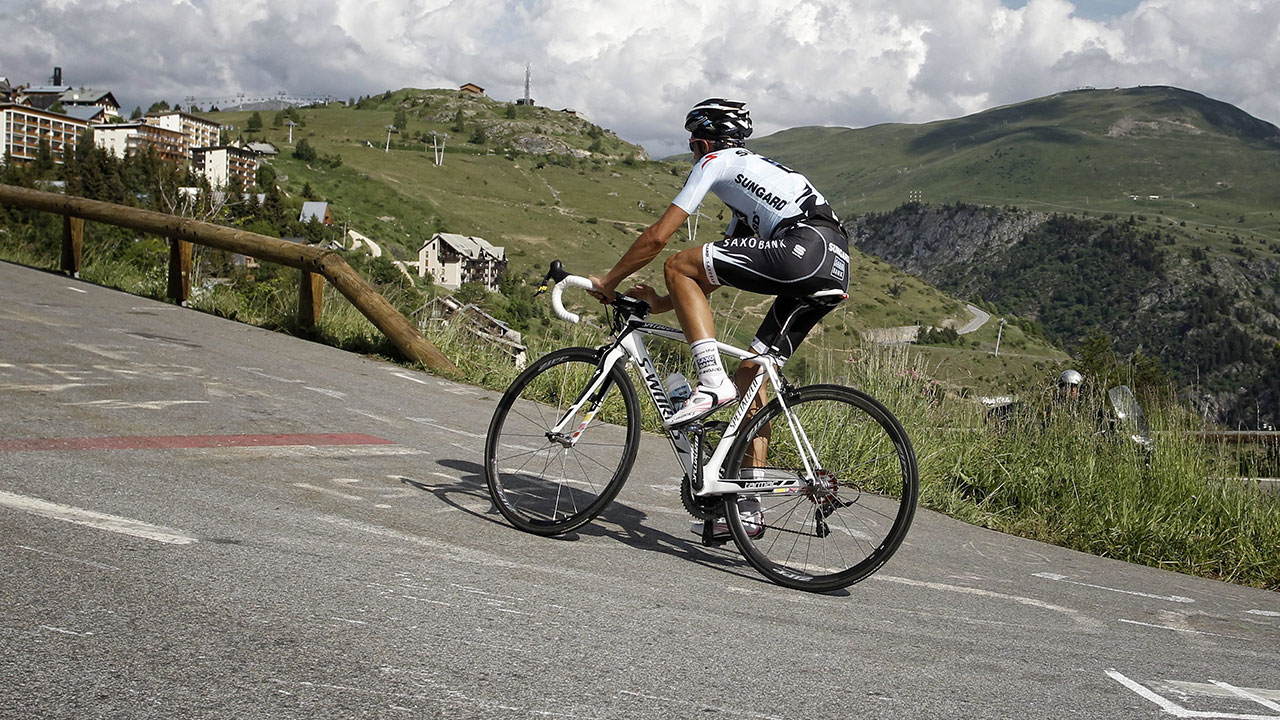
It is very rare that a competition’s setting is more compelling than its participants, but Saturday morning at the Tour de France is likely to be an exception.
Stage 20 will be the last chance for Chris Froome’s rivals to try and close down his commanding lead, but perhaps more importantly it will be another opportunity for the race to showcase its signature mountain: Alpe D’Huez.
Be sure to watch the peloton take on Alpe D’Huez live on Sportsnet at 8:00 a.m. ET / 5:00 a.m. PT.
A climb seldom becomes a household name, but Alpe D’Huez combines sheer scale, storied history and frenzied fans to be arguably the best place for a cycling stage on earth.
Here’s a look at what makes the ascent so special:
The Vital Statistics
Length: 13.8 kilometres
Average Gradient: 8.1 per cent
Highest Gradient: 13.1 per cent
Altitude: 1,850 metres
Hairpins: 21
Appearances in the Tour: 28
Profile:

Alpe D’Huez is long, but there are longer climbs like the Col de la Croix de Fer that the pelaton will ride up earlier in the day. It is steep with an 8.1 per cent average gradient, and even though there are steeper ascents, it’s the combination that’s deadly. Also factoring in to the degree of difficulty are the momentum-killing hairpins that are quite literally around every corner.
The road to the top of this mountain is the stuff of legends, but it’s the history that keeps the Tour coming back almost every year.
The Spectators
As the legend of Alpe D’Huez has grown, so too has the number of spectators in attendance each year. Hundreds of thousands of cycling fans line the slopes each year and they infuse the stage with an unmistakable energy, but they also add an element of danger for the riders as they’ve been known to get too close.
In 1999, Italian rider Guiseppe Guerini was hit by an overzealous fan trying to take a photograph. Despite the accident, he recovered and won the stage.

More recently, cyclists have gone on the offensive against members of the crowd they felt were disrupting their rides. Four years ago, Alberto Contador had no time for spectators too close to the middle of the road, and in 2013 Tejay Van Garderen had his own run-in with an unruly fan.


Generally speaking the audience behaves itself, but it wouldn’t be surprising to see at least one incident on Saturday.
The History of the Alpe D’Huez
The names that have been victorious here are some of the sport’s all-time greats, like Fausto Coppi, Marco Pantani and Bernard Hinault. Riders who add their names to that list put themselves on the map in the cycling world like Frenchman Christophe Riblon did in 2013.
Alpe D’Huez itself is a ski resort that was used for bobsleigh events during the 1968 Winter Olympics. In 1952, the Tour de France visited for the first time with Coppi taking the victory. At that point, the mythology surrounding the mountain began to build as it was the first Tour de France with motorcycle camera crews to document the action. It was also the first mountain-top finish in the race’s history.
The Tour wouldn’t return there until 1976, but since that time, Alpe D’Huez has been a staple. This year will be the 27th time it has been featured in the last 40 editions.
Each hairpin on the climb now is named after one of the previous winners on the mountain as a nod to its rich history.