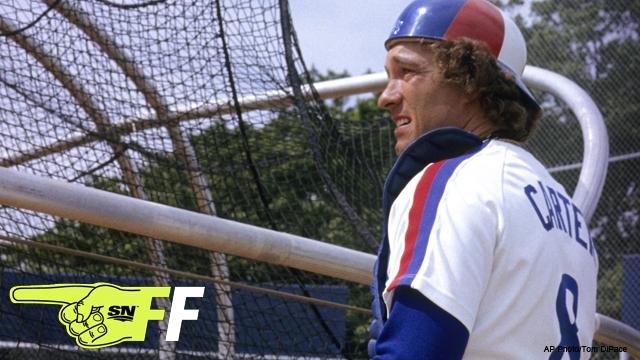

BY MICHEL GONZALEZ – FAN FUEL BLOGGER
On Thursday, February 16th, the news hit every Canadian baseball fan like a ton of bricks. Gary Carter, the “Kid,” had lost his battle against cancer after nine months.
We had all been bracing for this moment. Still, news of Carter’s passing Thursday was too awful to comprehend. He was only 57 – decades stolen from a kind, gentle man who deserved better.
Since Carter’s passing was announced, people from all walks of life, fans, reporters, columnists, former teammates and former opponents have commented on the Hall of Famer. Oddly enough, no one had the slightest negative to say about either the man or the player.
 Have your say: Have an opinion on the news of the day? Better yet, want to become a Fan Fuel blogger? Email us here. | Cherry is right, Leafs need toughness
Since that fateful day, everyone has brought out Carter’s career statistics. Everyone mentioned that he practically revolutionized the way the catching position was played. Yet no one mentioned how hard Carter worked to learn a new position. Remember that when he broke into the Majors, he was a right fielder. I even remember being at old Jarry Park with my grandfather when Carter chased a fly ball, crashed into the wall and ended up bruising three ribs. By the way, the ball was an obvious home run and Carter had absolutely no chance to catch it but that play was a sign of how the rest of his career would be; always hustling, always playing at 200 miles per hour as if every out was the last play of his life.
Many saw his friendliness and huge smile as an act. Many considered him a hot dog who pandered to the cameras. Many even said the Kid never saw a camera he didn’t like. It drove some people nuts that Carter played every day with the joy as if it were the opening day of Little League. But those who thought all those things are the first ones to forget that he was one of only two non-Francophone players to bother learning French during his tenure in Montreal.
It seems like a small detail, but it showed the attachment he had to a city that revered him. His faith, his love for his family and his love for the game helped him navigate through all the excesses during his days with the Mets. In a way, Carter was ahead of his time. He knew way before everyone how to treat people.
Gary Carter didn’t grow up. He got older, that was noticeable. His body, his swing, his game, they all changed. But he didn’t grow up. He never seemed to lose his enthusiasm, his zeal. He seemed to love playing baseball to the end – and not love it in some vague, distant way, but love it the way a kid does, all out, like it was the first day of spring training.
Carter was the face of the franchise and the face of Montreal for many years. He was one of the first players to come out of a productive farm system that would later produce names like Andre Dawson, Warren Cromartie, Larry Walker and countless others. But no matter how many all-stars that farm system would produce, Montreal baseball fans always felt a personal connection with Carter because he was one of them.
He never felt he was better than the fans because at the root, he was a fan himself.
No matter where his career took him, whether it was to New York, San Francisco, Los Angeles or back to Montreal, Canadian fans always showed their appreciation towards a man who cared deeply for the community that first embraced him.
From a personal standpoint, I too have a Gary Carter memory I’d like to share with you. In 1985, my best friend Martin and I were two aspiring journalists, two young schmucks learning the ropes in the media business. In August of that year, we had passes granting us access to the Expos and the visiting team’s locker rooms. Following the game, we asked Carter for a few minutes so we could conduct an interview. The meeting was brief -about five minutes- but we were amazed that a superstar like the Kid would give the time of day, much less an interview to a couple of kids who weren’t even from a major media outlet. Carter was his usual self: affable, loquacious, polite and always had a smile on his face.
Twenty four hours after Carter’s passing, I called Martin and I reminded him of details about that interview we conducted. We were both soon overcome with memories and were amazed how just a few minutes with a down-to-earth superstar had an impact on a couple of kids.
I also exchanged with a former high school friend of mine and we both recalled where we were and what we were doing when Carter was traded on December 10th, 1984. He recalled how he did the unthinkable, turning the TV off during Monday Night Football and shutting out his beloved Raiders. He stormed over to a friend’s house and they talked about their hero for hours. Meanwhile, I was driving around and about to go down a steep, slippery snow-covered hill when I heard about the trade on the radio. I was so stunned by the news that I remember almost driving into a lamppost instead. To this day, almost 30 years after the fact, I still remember the lamppost and the trade every time I drive by it.
There were similar stories shared throughout the province of Québec and even perhaps throughout Canada. From those who knew Carter personally, played with or against him, and even those who had no connection whatsoever, the bond was universal.
This was one of those darker signposts we pass during the course of our lifetimes, the ones that succeed in aging us. Carter departs with the legacy of a champion, but also with a heartbreaking asterisk:
He, like most good people, died too young.
Rest in peace, Kid. Thank you for the memories.
Related read:
More Baseball: Jays spring training player preview