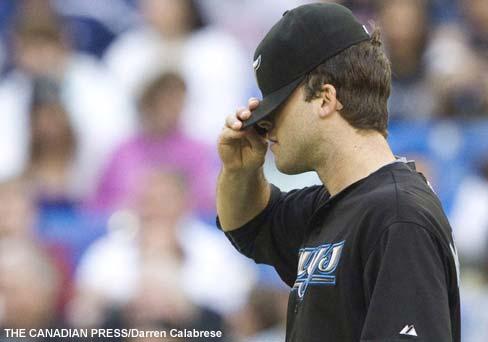

A year ago, Brandon Morrow looked like a rising ace with the Toronto Blue Jays. He had successfully transformed from a late-inning reliever to one of the most exciting starters in baseball.
Morrow finished last season with a career-high 10 wins along with 178 strikeouts and an opposing average of just .248. To get a better idea of Morrow’s performance take a look at the leaderboard for hurlers with at least 145 innings pitched last season when it comes to strikeouts per nine innings:
| 2010 K/9 Leader Board Amongst Pitchers with at least 145 Innings Pitched | |
| NAME | Strikouets per nine innings pitched |
| Brandon Morrow | 10.9 |
| Tim Lincecum | 9.8 |
| Jon Lester | 9.7 |
| Yovani Gallardo | 9.7 |
| Jonathan Sanchez | 9.5 |
At the moment, Morrow is just 2-4 this season through 10 starts. His ERA has ballooned to 5.63 thanks in large part to the nine runs scored against him by the Red Sox on Saturday.
If you’re thinking that Morrow has simply lost his dominant stuff, think again. Here’s a look at this season’s K/9 leader board for pitchers with at least 10 starts:
| 2011 K/9 Leader Board Amongst Pitchers with at least 145 Innings Pitched | |
| NAME | Strikouets per nine innings pitched |
| Brandon Morrow | 10.9 |
| Matt Garza | 10.3 |
| Cliff Lee | 10.1 |
| Clayton Kershaw | 10.0 |
| Tommy Hanson | 9.6 |
What’s remarkable about this leader board is that Morrow is the only hurler to appear on the 2010 and 2011 lists. This tells us that Morrow still has dominant stuff. After all, his average fastball of 93.5 MPH is identical to last year’s velocity.
The most notable difference is that the opposition is hitting Morrow more often this season. After hitting just .248 against him last season, the hitters are more comfortable at the plate with a .263 batting clip.
To better identify why Morrow is suddenly more hittable, let’s break down the opposing batting average against each of his pitches:
| 2010 | 2011 | |
| FASTBALL | .288 | .289 |
| CURVEBALL | .286 | .500 |
| SPLITTER | .311 | .1000 |
| SLIDER | .141 | .229 |
As you can see, Morrow is succumbing to a greater rate of hits against all of his pitches this season. However, that may be more of a symptom than the source of the issue. Morrow’s greater issue may be his lack of variety in his pitches.
Last season Morrow’s curveball and splitters made up nearly a quarter of his pitches. This season, they make up just 5% of his pitches. Even though both pitches were amongst the most hittable of Morrow’s last season, the very fact that he mixed them with his top pitches, made his fastball and slider less predictable and, therefore, more effective.
Here’s a look at Morrow’s pitch patterns in 2010 compared to 2011:
2010 Pitch Patterns:

2010 Pitch Patterns:

As you can see, the opposition has a better idea of what’s to come against Morrow this season compared to 2010. This has nothing to do with the young hurler tipping his pitches, but instead a lack of variety.
Finally, perhaps the greatest bellwether for Morrow’s performance is whether he gets ahead on the opposition by throwing strikes. Check out the opposing batting average based on count:
| Brandon Morrow’s opposing batting average based on count | ||||
| Ball 0 | Ball 1 | Ball 2 | Ball 3 | |
| Strike 0 | .458 | .250 | .250 | – |
| Strike 1 | .450 | .474 | .400 | .571 |
| Strike 2 | .083 | .190 | .206 | .000 |
As you can see, Morrow’s best pitch isn’t a fastball or slider. His best pitch is strike two. Once he reaches two strikes in the count, the opposition hits just .153 against him.
So in evaluating Morrow’s performance so far, the good news is that he is every bit as dominant this season as he was last season based on stuff alone. There are, however, some adjustments that have to be made.
Morrow has to do a better job of mixing up his pitches and he has to get ahead in the count. If he can master both aspects of his game, he will become more than a one-dimensional strikeout artist. He’ll become a winner, which is exactly what the Blue Jays could have used this weekend.