
When NFL fans look at the statistics during and/or after games, they often see impressive numbers from Aaron Rodgers, Demarco Murray, and Wes Welker. While the fascination is usually on total yardage and touchdowns, there are other statistics that are more telling for a player’s success.
Aaron Rodgers, Quarterback, Packers
NFL leaders in yards per pass attempt: (yds/PA)
1) Aaron Rodgers 9.6
2) Tom Brady (NE) 8.6
3) Matt Schaub (HOU) 8.5
If there was a single statistic to define a quarterback’s value, yds/PA may very well be it. This is an efficiency metric that identifies how many yards you can expect for every passing play.
The all-time high in a full season belongs to Sid Luckman with 10.9 yds/PA back in the 1943 season. Otto Graham who twice averaged double-digits for yds/PA follows Luckman.
In the last 50 years, Kurt Warner boasts the best single-season high when back in 2000 he averaged 9.9 yds/PA. The Packers Aaron Rodgers isn’t very far behind this season with 9.6 yards per pass attempt.
There are several factors to explain why Rodgers is so good this season. A large part of his success lies within the Packers receiving corps, which is deep and athletic. Getting the ball into the hands of speedsters James Jones, Greg Jennings, and Jordy Nelson often results in plenty of yards after the catch.
Furthermore, Rodgers connects on a league-high 72% of his passes and rarely turns the ball over. Even when you take sacks and turnovers into account, Rodgers is still by far the top quarterback at racking up yards per passing play.
DeMarco Murray, Running Back, Cowboys
NFL leaders in yards per rush attempt (yds/rush):
1) DeMarco Murray 5.7
2) Ben Tate (HOU) 5.6
3) Fred Jackson (BUF) 5.5
For running backs, there is no single metric that best encapsulates efficiency or value. While yds/rush is a solid read on efficiency, it does not take into account the running back’s endurance with touches in a game. In fact, backup running backs often have a healthy yards-per-carry ratio because they only get a few touches per game and are, therefore, fresh in their limited action.
In order to weed out the tailbacks with limited carries, we used a qualifier of at least 125 rushes this season. In the top spots are rookies DeMarco Murray and Ben Tate followed by veteran running back Fred Jackson.
Murray’s efficiency has declined in recent weeks. After averaging 6.6 yards per carry through his first nine games of the season, Murray has managed just 3.4 yards per carry in the two games since.
This weekend the Cowboys take on the Arizona Cardinals, one of the better rush defenses in the NFL with an average of just four yds/rush for opposing running backs.
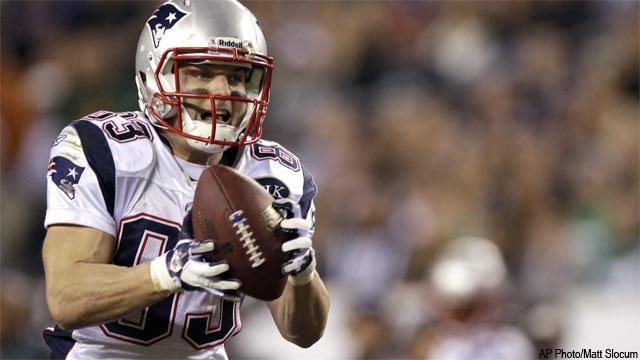
Wes Welker, WR, Patriots
NFL leaders in reception percentage:
1) Wes Welker 71% (82/116)
2) Calvin Johnson (DET) 58% (63/109)
3) Roddy White (ATL) 57% (64/112)
Wide receivers are the most dependent playmakers on a football field. They require a quarterback to throw them the ball. On that note, typically the elite wide outs are the ones that quarterbacks target the most often.
As you can see, Wes Welker is the NFL leader at targets this season. You will also note that he hauls in more than 70% of the passes thrown his way. That does not necessarily mean that he is better than Calvin Johnson or Roddy White when it comes to securing receptions. After all, Welker is used mostly out of the slot for short passes, while White and Johnson are at the ends going deep, resulting in much more difficult catches.
The purpose of the targets statistic is to demonstrate that Welker will remain one of the more consistent performers as long as Tom Brady continues to look his way 10 times or more per game. Welker plays a vital role in the Patriots passing game and for that reason is in the midst of a historic season.