VANCOUVER — As far as missed opportunities go, this one was a doozy that leaves the Canadian men’s team kicking itself and thinking about what might have been.
Sitting level on points with Switzerland but holding the tiebreaker, Canada only needed a draw from Wednesday’s first-round finale in order to win Group B and ensure it would play a third consecutive World Cup match in Vancouver and fourth straight home game.
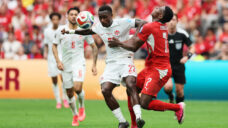
But Switzerland had other ideas and spoiled the Canadian party in recording a 2-1 victory before a sellout crowd of 52,497 at BC Place. As a result, the Swiss topped Group B with seven points, three points better than Canada, who finished second, ahead of Bosnia and Herzegovina on goal difference. Promise David came off the bench to score for the hosts.
In losing to the Swiss, the Canadians blew a chance to play their round of 32 game at BC Place on July 2 (and possibly a round of 16 match on July 7), while losing home field advantage entirely as it won’t play on home soil again at this tournament. Instead, the Canadians’ first-ever World Cup knockout match will take place in Los Angeles on June 28 against Group A runner-up South Africa.
“We so desperately wanted to continue being here and continue the momentum that has been built around the team and around the tournament in the country,” Canadian coach Jesse Marsch said in the post-match press conference.
He later added: “We wanted to be here in Vancouver, but we still have a massive opportunity ahead of us to find a way to push for the next match and find a way to still electrify the nation, even though it will be from Los Angeles, and to squeeze in one more.”
Alphonso Davies was an unused substitute for a second straight match with Marsch admitting that his captain was never going to play and was used as a decoy to throw off the Swiss. Marsch said in the buildup to this encounter that Davies, who is coming off a longstanding hamstring injury, would feature against Switzerland. For what it's worth, Marsch said Davies will be ready for Canada's next game. Davies did not stop to talk to reporters in the post-match mixed zone.
Here are three takeaways from Wednesday’s match.
Canada lacked urgency, only came alive when down 2-0
It was a nervy start by Canada who looked sloppy in possession against a Switzerland side that carried the bulk of play and dictated the flow for most of the game.
The Swiss had a golden opportunity to jump out to a lead in the 11th minute when Ricardo Rodríguez played a brilliant through-ball for Breel Embolo who broke in on goal alone, only to see goalkeeper Maxime Crépeau make himself big to deny the Swiss forward. Johan Manzambi’s rebound attempt was blocked by defender Derek Cornelius and Canada escaped unscathed.
The Canadians struggled to create much in attack through the opening 45 minutes and couldn’t have gotten off to a worse start in the second half as they conceded after just 40 seconds. A cross inside the box from the right wasn’t properly dealt with by Canada’s defenders and the ball fell to a wide-open Rubén Vargas who took a touch inside the penalty area before slotting his shot past Crépeau.
Switzerland doubled its lead when Embolo carried the ball into the box as Alistair Johnston lost his footing. That allowed the Switzerland forward to tee up Manzambi and he thumped a first-time shot through Crépeau, who should have done a lot better.
Canada was down 2-0 and deservedly so after putting in such a tame and uninspired showing up until that point. Marsch’s men had been thoroughly outplayed and outclassed in front of the largely partisan crowd.
Only after making a triple substitution in the immediate aftermath of Switzerland’s second goal in the 57th minute did Canada start to show some life, becoming instantly more aggressive in its pressing game and trying to force the Swiss to play the game on its terms. Another change saw David come on for Tajon Buchanan in the 75th minute and he responded by scoring a highlight-reel goal just moments after his introduction into the contest.
Switzerland was reeling and found itself on the back foot for the remainder of the match, desperately dealing with wave after wave of attacking pressure from Canada and just barely holding on for the win.
Had Canada started the game with more urgency, instead of waiting to go down by two goals, the final result might have been much different, and Canada could’ve ended up staying in Vancouver.
"I'm obviously disappointed that we (went) down two goals. I didn't think the start to either half was good, but then I thought in the first half after the water break, we got ourselves going and then started to find ourselves in the game. At two-nil we pushed hard and maybe on another day we're able to get the equalizer,” Marsch said.
Marsch was at loss to explain his team’s passivity at key junctures in the match.
“I don't know, because everything that we work on and work through is about really being aggressive and using our athleticism and our team speed. The only thing that I feel a little is that when the occasion is momentous, players get a little tighter and then their natural reaction is to hold back a little bit more, instead of going for it more,” Marsch stated.
Mixed results from Canada’s new central midfield tandem
Marsch made two lineup changes from last week's 6-0 win over Qatar, going with a new central midfield tandem in Mathieu Choinière (his first appearance at this World Cup) and Nathan Saliba instead of co-captain Stephen Eustáquio and Ismaël Koné (ruled out for the rest of the tournament with a broken leg).
Marsch made a big call to start Choinière at the expense of Eustáquio, but his hand was forced as he said the classy midfielder felt he wasn't ready to start — it's believed Eustáquio was dealing with a muscle injury.
Marsch didn’t mince words in the lead up to this match when talking about the loss of the influential Koné, saying, “From a talent and tactical perspective, it weakens us in the tournament.” Indeed, Koné brings a certain X-factor to Canada. He’s able to break open games with a moment of brilliance, his probing runs and fearless play in the centre of the park driving his team forward, while working in unison with the more stationary Eustáquio.
Canada badly missed its twin engines in central midfield; robbed of one of their most important partnerships on the pitch, the Canadians struggled to get a foothold into the game with Choinière and Saliba running the show. Although they were teammates at CF Montreal, this was only the third time they started together for Canada and they looked very tentative, showing little desire to counter press Switzerland out of fear of leaving gaps in midfield.
As a result, playmaker Granit Xhaka had plenty of time and space to wield his considerable influence in orchestrating the Swiss attack. And while Saliba had some good moments and played a part in David’s goal, Choinière failed to impress and was subbed out after 58 ineffective minutes, replaced by Eustáquio.
“In general, I thought they played well, but it's a big moment for them, and against a good opponent in the middle of the pitch, who can pass the ball around well. And when they're playing against Xhaka and his ability to kind of dictate the game, it stresses their ability to see things and get on the ball and play with confidence,” Marsch offered,
“You could see Steph's experience when he comes in, and his understanding of the moment is obviously elevated because he has more of those experiences.”
A glorious moment for Promise David
Trailing by two goals after 57 minutes, Canada looked down and out against the Swiss and desperately needed to change things up. Marsch responded by making a triple change, bringing on Eustáquio, winger Liam Millar and forward Tani Oluwaseyi, a move that resulted in Canada showing far more urgency going forward in attack.
Just a minute after being subbed on for Buchanan, David pulled a goal back for Canada in the 76th minute with a thunderous volley after being set up by Saliba who showed great skill in bringing a long ball under control before teeing up his teammate.
“I think as the play was developing, I thought, ‘Stand outside, give yourself a couple yards,’ because I know the ball's going wide. Saliba made a great run inside and a great touch down, and I think as I saw him touch down, I didn't need to say much. I saw his eyes kind of scan over to me, so I had two options: go (to the) first post or hang at the back, and Saliba put a great ball straight through the defence, and yeah, I'm just thankful I have long legs,” David explained.
David continued to cause plenty of problems, using his size and athleticism to bully the Swiss defenders while also getting into dangerous scoring positions, including deep into injury time when his flick attempt off Johnston's long throw-in was saved by goalkeeper Gregor Kobel. The hulking forward finished with a game-high three shots (all of them on target) on just seven touches on the ball.
David’s fabulous goal and near heroics in dragging Canada out of the muck and mire was just reward for a player who’s been through a lot. David, 24, suffered a serious hip injury in February with his pro club, Royale Union Saint-Gilloise of Belgium, that put his World Cup ambitions in doubt.
Doctors put David’s recovery time at six to seven months after his surgery, but he underwent a gruelling rehabilitation process that cleared the way for him to be included in Canada’s roster and score his first-ever World Cup goal.
“Obviously, based on the situation from a couple of months ago for myself, it's not something I thought I would be able to do. But (thanks to) the help of the medical staff and everything, making sure I get healthy after surgery and being able to score here, it means a lot,” David said.
Editor’s note
John Molinaro is one of the leading soccer journalists in Canada, having covered the game for over 27 years for several media outlets, including Sportsnet, CBC Sports and Sun Media. He is currently the editor-in-chief of TFC Republic, a website dedicated to in-depth coverage of Toronto FC and Canadian soccer.