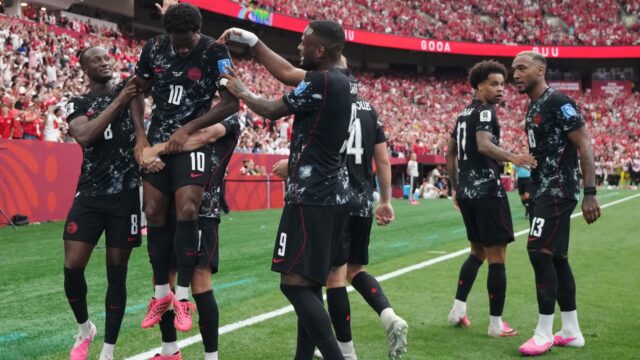
VANCOUVER — The morning after a tough-to-swallow loss, you might expect the president of Canada Soccer to be in a less-than-affable mood. Peter Augruso, however, is not one to dwell. He has already seen enough, both on and off the pitch, to keep his spirits up.
It is not often, after all, that a man in his station gets to see his sport grow and evolve literally before his eyes, all through the lens of a FIFA World Cup on home soil.
Losing 2–1 to Switzerland on Wednesday and missing out on top spot in Group B may have cost Canada the chance to play more matches in Vancouver, but the journey continues — albeit in Los Angeles with a Round of 32 tilt against South Africa on Sunday.
“Of course, we’re disappointed when we don’t win because our expectations are higher now but think about what we’ve accomplished: Canada’s first World Cup point, Canada’s first World Cup victory, now an opportunity to reach the last 16,” Augruso told Sportsnet.
“On the men’s side, we’ve achieved things that had never been done before. The women’s program has been setting standards for years, and now the men’s side is beginning to build its own history.”
That history on the pitch has been turned on its head and, in doing so, is turning heads.
“Right now, we’re getting a tremendous amount of credibility as a football nation,” Augruso said. “Every federation president I speak with around the world tells me the same thing: ‘Wow, Canada has really come a long way.’ From the outside it looks like it happened quickly, but of course it hasn’t. This has been building for years. [Former manager] John Herdman really started that movement when he came to Canada with the women’s program and then took over the men’s side. Jesse [Marsch] has built on everything John accomplished and taken it to another level.
“Now it’s nice to hear people talking about Canada as a legitimate football nation. We’re no longer viewed as the easy game.”
Of course, the footballing story is only half the picture. The success of the World Cup in both Toronto and Vancouver has gone beyond the expectations of most people, including FIFA president Gianni Infantino, who watched Canada’s historic 6–0 win over Qatar alongside Augruso and Prime Minister Mark Carney.
“I think he’s been pleasantly surprised by the reception the tournament has received here,” Augruso said. “The march to the stadium was incredible. We had around 8,000 supporters walking together before the Qatar match. Everywhere you go in Vancouver you feel like you’re in a World Cup city.
“[Vancouver] has completely embraced this tournament. Toronto was fantastic, too. We had tremendous support there, but Toronto hosts major events all the time. On one of our match days, the Blue Jays were playing as well, so there was a lot happening in the city. What impressed me — and him — was that soccer didn’t just compete with those other major sports, it surpassed them. A few years ago, that probably wouldn’t have happened.”
Marsch, who was Augruso’s most important hire as president, has helped generate some of that buzz during this tournament. Augruso welcomes it.
“Jesse’s a charismatic guy, and I think he’s been great for the sport in this country,” he said. “He might rub some commentators the wrong way, or certain former players in the United States, but you know what? He’s taught Canadians to believe in themselves.
“Canadians have always been viewed as polite and respectful — that’s built into the Canadian psyche. Jesse isn’t trying to take away our Canadian identity, but he has brought an edge to this group. If we want to compete with the best countries in the world, we have to have that edge.”
It appears that edge has been embraced by all on the pitch. Off the pitch, Canada has emerged as a country with a legitimate soccer culture — one that will only grow with more moments amongst the movement.
Of course, the party is always fun while the music is blaring and the people are dancing. What happens when the lights come on and the hangover sets in? Will the momentum continue? Will this moment legitimately become a movement, as Marsch contends?
“I think we’ll see the impact almost immediately,” Augruso agreed. “Right now, there are roughly three-quarters of a million registered soccer players in this country. Following this World Cup, I’d love to see that number climb to over a million by this time next year. That’s the opportunity in front of us. We’ve created millions of new fans. Now our responsibility is to turn that fandom into participation. We have to inspire young Canadians to believe they can play this game, that they can wear the maple leaf one day, and then make sure they actually have the opportunity to do it.
“The excitement is there. The dreams are being created. Now we have to build the pathway.”
The promise of growth has been delivered by previous generations of leadership, yet the sport has stalled in Canada on a regular basis. Augruso acknowledges this but also sees the World Cup as a unique opportunity.
“One of the biggest things I’ve learned in this role is that it’s not enough to inspire kids to play —we have to make sure we have the facilities to support them.”
Across the country, infrastructure is beginning to grow.
“Here in British Columbia, there are around 20 mini-pitches that have been built. Jumpstart has invested in another 25 community pitches across Canada. Canada Soccer has also started doing its part. We’ve already completed one community pitch project in Atlantic Canada, and we’re looking at another on the West Coast because we want kids, no matter where they live, to have access to the game. But we need much more.
“Soccer is already the No. 1 participation sport in Canada,” Augruso continued. “I think we have more influence than we sometimes realize. If we work together and advocate collectively, governments will understand that investing in soccer infrastructure isn’t just investing in sport — it’s investing in communities. That’s how we make sure this momentum lasts.”
Augruso believes the government seems to be waking up to the potential of the sport.
“The Prime Minister has been genuinely interested in what’s happening with this team and with soccer in general. He’s seeing first-hand what this World Cup has done for Canadians. At a time when the country can always use something positive to rally around, this team has given people that.”
Katrina LeBlanc, former national team goalkeeper, said something to Augruso that has stayed with him: “’There are only two groups of people who wear the maple leaf — those who protect it and those who inspire it.’ That’s exactly what this team is doing,” he said. “They’re inspiring Canadians. They’re bringing people together, and that’s something much bigger than football.”
That is hard to argue. Just walk the streets — not only in Vancouver and Toronto, but across the country — and soccer fever has arrived. It is like nothing we have seen before.
In the short term, supporting local soccer will determine whether this is in fact a movement. Will we see increased attendance at League1 Ontario, the Canadian Premier League, and the Northern Super League?
“That is absolutely critical,” Augruso said. “We can’t allow this World Cup to become just a great memory. We have to support our domestic leagues.
“The Northern Super League has only been around for a short time and we’re already seeing players coming into our national team environment. That’s exactly what you want. It’s creating opportunities for Canadian players to develop at home. The Canadian Premier League has done the same thing on the men’s side. It has become an important pathway.
“If we want this sport to continue growing, people have to support local soccer. Go watch your local club. Go to a CPL match. Go to an NSL match. Those leagues matter because they’re where the next generation develops.”