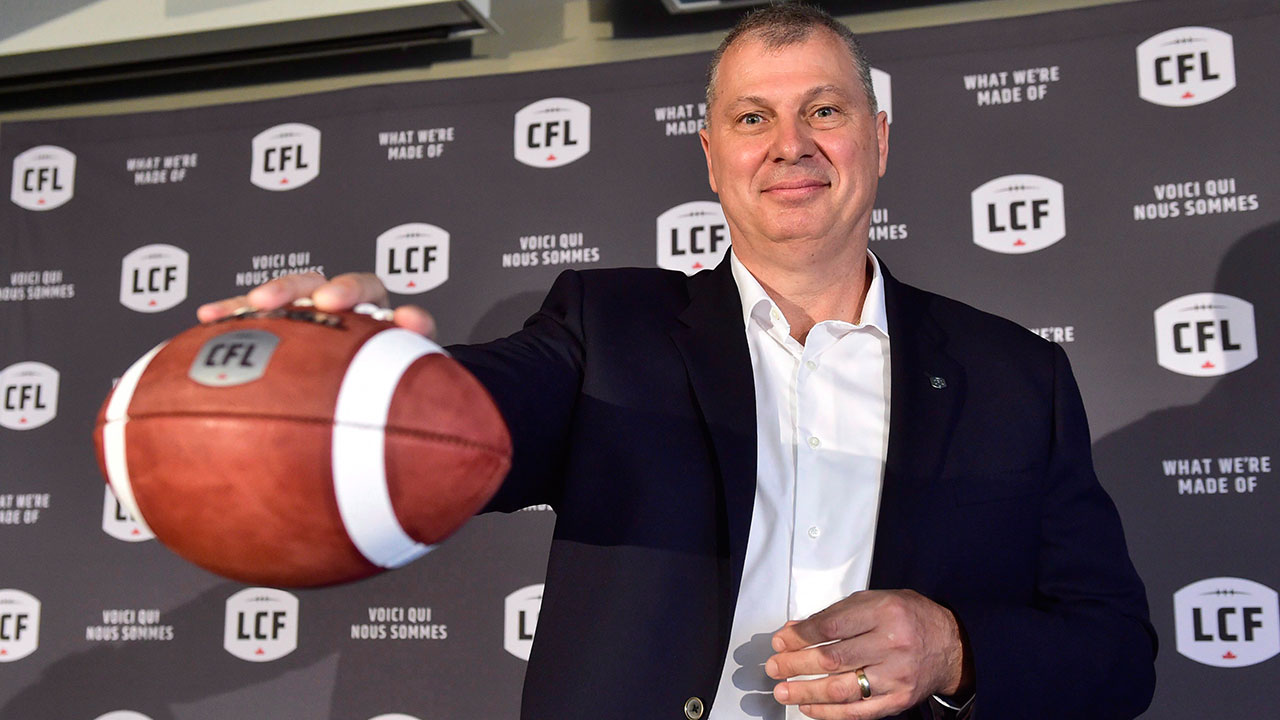

In a recent candid conversation with CFL commissioner Randy Ambrosie, we discussed a myriad of topics over 40 minutes.
But it was Ambrosie’s stance on cannabis legalization that both surprised and captivated me the most, especially given the CFL is the only professional football league played solely in Canada. As commissioner, Ambrosie, himself a former player, sees opportunity in legalization.
Here’s our full interview with Ambrosie, talking cannabis and what legalization might mean for the CFL.
It’s important to remember for context that different North American leagues have wildly different stances on the issue.
• Cannabis is not on the NHL’s list of banned substances in its Performance Enhancing Substances Program, but it is one of the drugs tested for under the league’s Substance Abuse and Behavioral Health Program.
• MLB tests its players for “drugs of abuse,” which they consider cannabis to be, but tests players only if MLB or union officials have reasonable cause.
• The MLS conducts unannounced testing for all prohibited substances including cannabis.
• In the NFL, players are tested once in the off-season from mid-April to mid-August.
• In the NBA, players are subject to four random drug tests during the season, but the league doesn’t test for marijuana in the off-season.
NBA commissioner Adam Silver confirmed last year he was open to the legalization of medical marijuana. That follows the lead of the BIG3 who earlier this year became the first professional league to legalize cannabidiol (CBD) for recovery and pain relief.
The CFL currently doesn’t test for marijuana, but the Canadian Centre for Ethics in Sports (CCES) does. Under their guidelines, marijuana is a banned substance and “Athletes subject to the Canadian Anti-Doping Program (CADP) must be aware that (legalization) does not affect the status of cannabis in sport. Cannabis continues to be a prohibited substance and a positive test can still result in a sanction.”
This means any U Sports athletes looking to be drafted into the CFL will still be tested and suspended for marijuana use while at school.
Ambrosie hopes the fact that the CFL isn’t running and hiding from association with the drug once the law goes into effect will in part help the stigma surrounding it.
“We want to make sure we’re really watching for an opportunity, talking with our medical community about an opportunity to support potentially a solution to the opioid crisis,” Ambrosie said. “(We want to) play a role in helping society as part of our ongoing contribution to Canada.”
The mixture of weed and sports is not a new subject to Canadians. In 1998, Canadian Ross Rebagliati won a gold medal in men’s snowboarding at the Winter Olympics in Nagano, Japan but initially had it stripped after a blood test found he had Tetrahydrocannabinol (THC) in his system. Rebagliati won his medal back on an appeal and now runs Ross’ Gold, a medical marijuana business, while continuing to advocate for athletes looking to acquire cannabis for medicinal purposes.
WADA has since removed CBD from its list of banned substances.
Research has shown CBD acts as an anti-inflammatory, which helps to reduce pain from swelling and prevent joint injuries during physical activity, which has caused many football players to advocate for its use. According to a 2017 National Academies of Science, Engineering and Medicine’s report, Health Effects of Cannabis and Cannabinoids: The Current State of Evidence and Recommendations for Research, there is substantial evidence that cannabis or cannabinoids are effective for the treatment of chronic pain. But the results haven’t been conclusive.
There are still questions to be answered and research to be done. All CFL players are over 19 and thus legally allowed to use, but the fanbase the league is looking to court is young and often under that age. How will that impact potential alignment with the cannabis industry? Will the league make a distinction in its alignment with use for both medicinal and recreational use?
Ambrosie is waiting for Health Canada to educate him on “what’s in the box and what’s out of the box.”
This is an issue the football community has been debating and will need to get a handle on now that all nine CFL teams and 20 NFL teams play in locations where marijuana is legal.
NFL players like Ricky Williams, Nate Jones and Derrick Morgan, along with organizations like When The Bright Lights Fade, have been outspoken about the health benefits a non-psychoactive cannabis ingredient like CBD has on players who use it as a Ibuprofen and Toradol alternative. Former NFL player Martellus Bennett went as far as to say 89 per cent of NFLers are already self medicating with the drug.
Ambrosie has talked about the fact the CFL should mirror the country and be progressive leaders in sport. Given the traditional restrictive and conservative stances by other sports leagues, the CFL is in a prime position to do just that with the legalization of cannabis in Canada.
[relatedlinks]