
The NFL scouting combine wrapped up this weekend in Indianapolis, where college stars got the opportunity to showcase their athleticism to the football world.
The combine is often written off as a glorified track and field competition with little relevance to evaluating future professionals. I disagree.
For fantasy football purposes, this event is a treasure chest of information for owners to scout the incoming rookie class and use it to compare to the player’s game footage. It’s a process I dive deep into every year and find extremely valuable as part of fantasy football off-season preparation.
[relatedlinks]
In the first of a three-part series, I’ll review combine performances and fantasy value for different prospects. We’ll begin with the wide receivers, and a NFL draft class viewed as the deepest in a long time.
For wide receivers, the physical tests that are most relevant are the 40-yard dash and vertical leap. The 40 gives an idea of breakaway speed, while the vertical can showcase how a player may fare in 50/50 jump balls.
Combine Crush
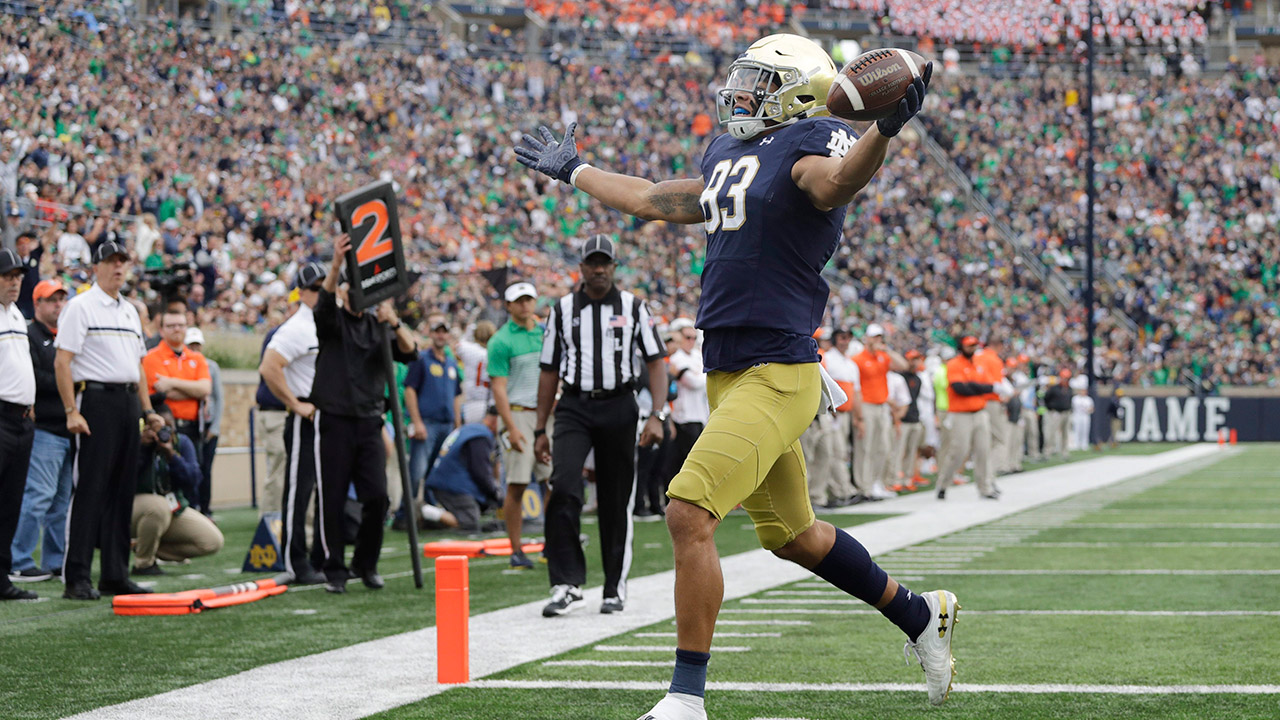
Chase Claypool, Notre Dame (6’4”, 238 lbs.)
Combine Results
40-yard dash: 4.42
Vertical leap: 40.5 inches
The added bonus to all of Chase Claypool’s talent is that he’s Canadian, hailing from Abbotsford, B.C. Listen below to find out why this Fighting Irish senior is going to be a Day 1 fantasy standout
Ceedee Lamb, Oklahoma (6’2”, 198 lbs.)
Combine Results
40-yard dash: 4.50
Vertical leap: 34.5 inches
Lamb is my highest-ranked fantasy wide receiver in this upcoming NFL draft class because he can be a playmaker no matter where he’s lined up. The Sooner can be moved from outside to slot during a game, make tacklers miss at any level, and catches everything that comes his way. Lamb’s pull-away speed and quick footwork off the snap allowed him to average an incredible 21.4 yards per reception as the primary target in 2019.
One of the knocks on Lamb is that his route running needs to become crisper, but that can be coached up in the pros. Hopefully the Texas native lands on a team with a pass-happy offence that can showcase his vast skill set. Lamb should be the first WR off the board in any fantasy keeper league.
Jerry Jeudy, Alabama (6’1”, 193 lbs.)
Combine Results
40-yard dash: 4.45
Vertical leap: 35 inches
It’s more like 1A and 1B between Jeudy and Lamb. Jeudy’s route running is superior and I’d argue his ceiling as a highlight-reel game-breaker at top speed is higher. However, Lamb is a more reliable receiver at this point.
Jeudy can get to full gallop in a hurry and is like an artist painting with his flow/elusiveness after the catch. Jeudy wowed during the combine drills, displaying ankle-breaking technique that reinforced my belief that this is an immediate NFL starter who is instantly WR2 fantasy-relevant in any format.
Justin Jefferson, LSU (6’1”, 202 lbs.)
Combine Results
40-yard dash: 4.43
Vertical leap: 37.5 inches
Straight-away speed and natural hands as a receiver with a ridiculous catch radius. Jefferson struggles to separate when facing man coverage, but the acrobatics to haul down any ball should give quarterbacks the confidence to throw the ball his way without hesitation. A creative offensive coordinator will have fun lining up the LSU product all over the field.
Jefferson may be slower to ramp up his pro career as a consistent fantasy producer, but there’s huge upside to grow into something special.
Best PPR-only possession WRs
Michael Pittman, USC (6’4”, 223 lbs.)
Combine Results
40-yard dash: 4.52
Vertical leap: 36.5 inches
Excellent quick footwork off the snap to create separation shone for Pittman in the combine drills as did his hand placement as a natural receiver. Pittman ran a full route tree in college and used his physicality to win contested ball battles, which helps make him NFL ready.
He doesn’t have pull-away speed after the catch and projects more of a chain-mover and red-zone target. I think he’d be a great fit in Philadelphia to take over the big-body possession role from Alshon Jeffrey.
K.J. Hill, Ohio State (6’0”, 196 lbs.)
Combine Results
40-yard dash: 4.60
Vertical leap: 32.5 inches
This is your prototypical slot receiver who will develop into a great flex roster spot in PPR formats. Hill inhales any football that comes his way, is a committed route runner, and is hailed as a tremendously hard worker that is always in position. The Buckeye is definitely not a burner, but also doesn’t shy away from contact over the middle.
Devin Duvernay, Texas (5’10”, 200 lbs.)
Combine Results
40-yard dash: 4.39
Vertical leap: 35.5 inches
Duvernay is built like a tank and his lightning-fast 40-yard dash confirms his college in-game zip. Duvernay is another slot-only receiver who excels at running through would-be tacklers and has sticky fingers. If a quarterback can get him the ball in space, Duvernay’s speed gives him touchdown potential on any play.
He’s definitely someone to monitor as a late-sleeper fantasy pickup.
Honorable mentions for keeper leagues
Henry Ruggs III, Alabama (5’11”, 188 lbs.)
The owner of the combine’s fast 40-yard dash time (4.27), Ruggs is a more versatile, durable John Ross III who can also contribute as a kick and punt returner on special teams. Ruggs’ thin frame is a concern when it comes to durability.
Denzel Mims, Baylor (6’3”, 207 lbs.)
Brandon Aiyuk, Arizona State (6’0”, 205 lbs.)