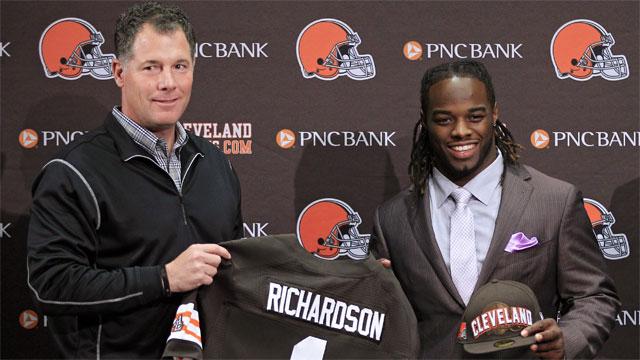

Trent Richardson stood on New York’s Radio City Music Hall stage, dressed in a sleek tan suit that barely contained his monstrous frame. He’d just become the third selection of the 2012 NFL Draft, the shiny new all-purpose running back on a Cleveland Browns team without much else to build on. And all that third pick had cost the Browns was the fourth pick, the 118th pick, the 139th pick and the 211th pick-an exchange of three players to move up a single spot. A lot of weight was about to be heaved onto those broad shoulders. The Browns let it be known that they expect a lot from the man who’s now The Franchise.
“He can do all three things,” raves Cleveland GM Tom Heckert. “He can run the ball, catch the ball and he can block. He is a tough, tough kid. We knew we had to trade to get him if we wanted him…we were pretty fired up.”
By all accounts, Trent Richardson is as close to a sure thing as a running back prospect gets-but even that, in the NFL, is a very large question mark.
Conventional football wisdom is moving further and further away from the idea that a homerun pick at the tailback position is necessary to-or even capable of-transforming a franchise. And even once they’ve proven themselves as bonafide Pro-Bowl rushers, there’s still very little evidence that says you need to pay them lavishly for services rendered, or even that you need them at all. “Most teams are going to five wide (receivers) with a QB that’s going to wing it around,” says NFL Network analyst Rich Eisen. “Why do you need somebody to carry the ball 20-25 times a game?”
The era of the big back in the NFL is all but over, and even some of the teams who have clung to the model in recent years are starting to realize it. The ones who haven’t yet are the grasshoppers, basking in the sun while the ant stocks his cupboard for winter. When the storms do come-and in the NFL, they come with the force and fury of 250-lb. linebackers slamming repeatedly against the body, and the helmet, of the man who carries the ball-they won’t have the resources to survive.
By making Richardson the highest running back selected in the draft since Reggie Bush went at No. 2 to New Orleans in 2007, the Browns were not only going against the new gospel of football, they were ignoring mountains of evidence-both from recent NFL success stories and from their own on-field results-that betting on a single back to carry you out of the basement is a roll of the dice at best, a fool’s hope at worst.
Exhibit A: Steven Jackson, the last of a dying breed
The first offensive play of the St. Louis Rams 2011 season might have been their best one. The hole on the left side of the Philadelphia Eagles defensive line was wide enough to drive a truck through. A good thing, too, as Steven Jackson looked nearly as wide as one as he rumbled into the secondary. Forty-seven yards, one quick cut and two solid downfield blocks later, Jackson was in the end zone and the Rams were up 6-0, the franchise running back doing what he does best, averaging a solid 47 yards per carry on the just-begun season. They should have taken a picture. It would have lasted longer.
He didn’t limp, but Jackson was hurt on the play. He’d miss just a single game, but would struggle with injuries throughout 2011. The Rams rushing attack-whether because Jackson wasn’t 100 percent, backup Cadillac Williams was ineffective, or the stagnant passing attack couldn’t open up any space-struggled to just 104 yards per game, 23rd in the NFL. The Rams finished 2-14.
Then, in the offseason, the rumours swirled. Jackson, one of the few franchise running backs still plugging away in the age of the backfield committee, should be replaced, or at least should split carries with someone to keep his legs fresh. Jackson, who still racked up over 1,000 yards for the seventh straight season, might be demanding a new contract over the summer. The Rams, who held the sixth pick in the NFL draft after trading the second selection in a deal that allowed the Redskins to take Robert Griffin III, were targeting Richardson with their pick. Jackson would tutor Richardson. Jackson and Richardson would share carries. Jackson, who had held down the Rams backfield single-handedly since the departure of Marshall Faulk, would be traded.
The contradictory nature of those rumours-he’s so washed up he needs to be augmented or replaced, but so good he can demand a new contract-illustrate just how in flux the very notion of a feature back is in the current NFL.
But don’t tell Jackson. “I take great pride that I’m one of the last of the franchise running backs, the guys who don’t have to come off the field,” he says a few days before the draft. “When I grew up, I always watched the other backs-the Emmitt Smiths, the Barry Sanders-and they did everything. They ran, blocked and caught. I think that’s how the position should be played. That’s what it takes to have that one solid guy in the franchise that you can lean on as a bell cow.”
Which is fine, if it works out for the team. But in Jackson’s seven years as the Rams main offensive threat, St. Louis has never finished above .500, hitting the 8-8 mark only once, in 2006. During three of those years, Jackson played in the Pro Bowl. In two of them, he was an All Pro. He’s been one of the NFL’s best and most consistent backs for more than half a decade, but without Kurt Warner, Isaac Bruce and Torry Holt leading the offence, the Rams have never returned to the glory days of the early 2000s, when they were the Greatest Show on Turf. It’s not a knock on Jackson, but it might be a reason why the Rams spent the past three drafts focusing on securing a franchise quarterback, then hunting for receivers and tight ends, then nabbing Cincinnati back Isaiah Pead with the 50th pick of the 2012 draft. “He’s just a great change of pace runner that we need here right now for Steven (Jackson),” says new coach Jeff Fisher. “A guy that can give Steven a blow.”
And just like that, the St. Louis Rams, one of the last holdouts, now employ a backfield committee. “You never know where you can find a bell cow running back,” says Eisen, speaking of the lack of need to spend an early pick on a rusher, “or if there’s even a need for one in the NFL anymore. And if you find one, you can find ’em in the late rounds of the draft.”
Exhibit B: Arian Foster, and why paying for running backs is a losing proposition
Arian Foster of the Houston Texans is probably the best running back in football. He’s terrifying in the open field, where his quick cuts and powerful legs make him almost impossible for a lone defender to bring down. He’s just as frightening running between the tackles where his burst propel him through the slimmest opening and into the backfield. He’s also a supreme checkdown weapon, racking up 617 yards through the air last season, including three 100-yard games-decent numbers for a wide receiver, never mind for someone who also racked up 1,200 yards on the ground in just a little more than 12 games.
Foster ran for 285 yards in two playoff games against the Ravens and Bengals-the second and tenth best rushing defenses in the NFL, respectively. He is talented, smart, coachable and almost unstoppable on the football field. And now, he’s hellaciously, stupidly, wildly overpaid.
Arian Foster will make $43.5 million over the five-year term of the contract he signed in early March, with $20.75 million guaranteed. “I give the Texans credit,” said Foster’s agent, Mike McCartney when the deal was signed. “He was restricted, at a low salary. It would’ve been really easy for them to just sit back and see what happened.”
Later, McCartney credited the Texans willingness to “reward” his client. A reward is payment for services already rendered-exactly what a contract given to a running back should never, ever be. Arian Foster has been stupidly good the past two seasons. But there’s no guarantee he’ll continue to be and, running under the same conditions as Foster, Ben Tate was just as good, at a fraction of the price. Tate, the Texans second-round pick in the 2010 draft, averaged a full yard more per carry (5.4 to 4.4) than Foster last season. He saw more than 15 carries only four times all season, but averaged 100 yards per game in those contests.
It’s not like Foster’s situation is unique-the NFL’s recent history is littered with running backs who were rewarded for production only to see their contributions decline. The Panthers gave DeAngelo Williams a nearly-identical five-year $43 million deal prior to last season, only to have him split carries with Jonathan Stewart and quarterback Cam Newton and deliver a total of just 836 yards. The Titans gave holdout Chris Johnson a $53 million deal as he was coming off a 2010 season that saw him rack up more than 2,000 yards. Johnson finished 2011 averaging just 4.0 yards per carry, nearly a full yard less than his career average. The recent list is a long one: Brian Westbrook, Shaun Alexander, Corey Dillon and Eddie George all received career-best contracts and followed it up with seasons in which their production declined significantly.
The Texans employ a zone-blocking scheme that has offensive linemen secure an area of turf, not block a single player, regardless of what the defensive line is doing. The running back, whether it’s Foster or Tate or someone else, knows where his linemen will be blocking. He’ll make one cut and, if the line has done its job, he’ll be into the secondary. It’s a scheme designed to create positive yards regardless of who’s carrying the football. You might remember the scheme from the Mike Shanahan-era Denver Broncos, when it made 1,000-yard rushers out of such luminaries as Olandis Gary, Mike Anderson and Rueben Droughns. Money spent on a solid offensive line can make producers out of the most anonymous of backs. Money spent on a premier running back can’t overcome the deficiencies of the men blocking for him.
In a Salary-capped league, where rushing production depends so much upon the line of scrimmage, selecting a player like Richardson-and paying him the salary he’ll ultimately command if he develops into a star-is a waste of precious resources. And the Browns should know this as well as anyone, having recently received Pro Bowl-production from Peyton Hillis two seasons ago for the cost of his $470,000 salary and backup quarterback Brady Quinn who went to Denver in the trade that acquired him.
Even if Richardson is everything they hope he’ll be, using that third pick on a back instead of an offensive lineman or a defensive player is, by definition, limiting the amount of return you’ll get from it. “Those (linemen and linebackers)…you can get 15-16 good years out of that pick,” says Eisen. “Whereas Trent Richardson, if he’s still running the football with the same success eight years from now, he’ll be lucky. He’ll be above the curve in that respect.”
Exhibit C: Super Bowl teams are built on committees
Quickly now: Who was the last Super Bowl champion to employ a running back who was among the top five leading rushers in the NFL?
Give up? Corey Dillon went for 1,635 yards-third in the NFL-for the New England Patriots in 2004, seven years ago.
The total yards accumulated by the leading rushers from the last five Super Bowl champions paint a picture of the irrelevance of a feature back: the Giants Ahmad Bradshaw, 659; the Packers Brandon Jackson, 703; the Saints Pierre Thomas, 793; the Steelers Willie Parker, 791 and the Giants Brandon Jacobs, 1,009. Bradshaw has never been a feature back. Jackson and Parker were cast aside, by the Packers and Steelers respectively, without any significant drop off in rushing production. Thomas is currently one of three running backs sharing the Saints backfield and the Super Bowl champion Giants didn’t bat an eye before letting Jacobs walk this offseason, only to watch him sign with the San Francisco 49ers, another Super Bowl contender who will now enter the 2012 season with four running backs on their roster.
The combined record of the last three teams to feature the league’s best running back in their offence is 19-28. The 2012 Giants won the Super Bowl with the league’s worst rushing attack. The ranking of the five Super Bowl champion offenses before them in team rushing yards: 24th, 6th, 23rd, 4th, 18th.
Forget about football security. Forget about winter weather. Forget about defences tightening up in the playoffs. There’s no statistical correlation between rushing success and playoff success.
In all likelihood, there are Pro Bowls in Trent Richardson’s future. Pro Bowls, however, aren’t Super Bowls.
If the Rams were hoping to excite a fanbase and sell some jerseys, the Trent Richardson pick was a no-brainer. If they were, as Heckert insists, building the foundations of a championship team, they might have examined the makeup of the most recent champions.
The Browns say Richardson is a special player, and he’ll have to be in order to confound the mountain of evidence, both empirical and anecdotal, that insists that no so-called “franchise back”-be it Richardson, Bush, McFadden or even Peterson-is worth the cost of a top-10 pick or the salary cap hit a superstar back will later command.