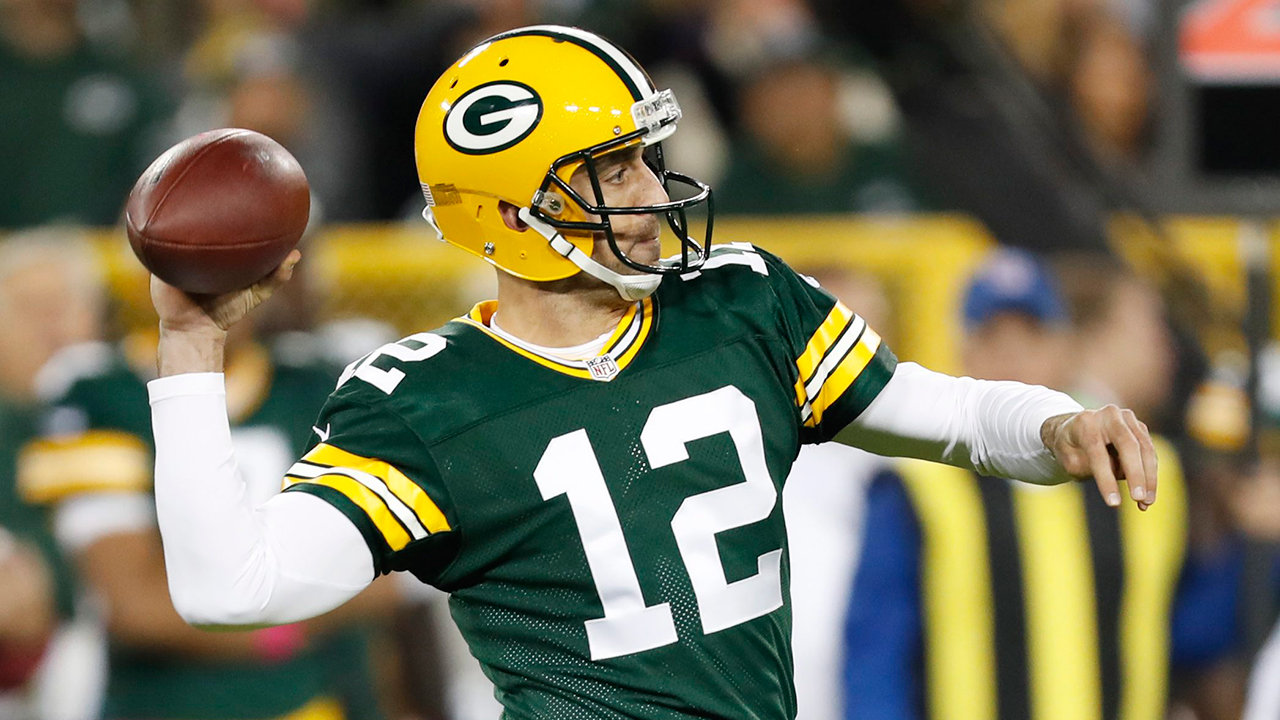
In a post-Peyton Manning world, Aaron Rodgers is one of the few true brand-name quarterbacks left.
Rodgers has won two MVPs and a Super Bowl, dates actress Olivia Munn, and is likely the most successful—or at least best-compensated—insurance salesman of all time. Add that to the fact he quarterbacks an NFL franchise that oozes nostalgia and likeability, it’s easy to see why he’s such a huge name.
However, the problem for Rodgers right now is the product doesn’t match the brand. Through one-quarter of his 2016 campaign, he’s thrown for fewer yards per game than Case Keenum with fewer yards per attempt than Cody Kessler and the lowest completion percentage in football.
Normally it would be fair to dismiss these numbers as a bizarre anomaly in a small sample. Rodgers has an impeccable track record, and at age 33 he’s far too young to experience such a steep decline from being arguably the NFL’s best player to a below-average signal caller.
Unfortunately for the Packers, the issues Rodgers is experiencing aren’t unique to 2016. Last year, he put together a very poor season by his standards hitting career lows in passer rating and yards per attempt.
Rodgers hasn’t looked like himself since 2014. The change has been relatively subtle as he’s been smart with the ball, posting a 41:11 touchdown-to-interception ratio since. He’s also coontinued to use his athleticism to make plays with his legs, recording his second-best rushing total in 2015 and scoring two touchdowns in four games on the ground this year.
The core of the issue is that he’s not pushing the ball downfield like he used to. Last year 24 quarterbacks connected on more 40+-yard bombs than Rodgers, and this season that number is 26. That’s rather shocking for a guy who tied for the league lead in that category in 2014 and is the most famous Hail Mary delivery system since Doug Flutie.
The difference between Rogers’s ability to deliver the deep ball over the last year and a quarter to what he did in 2014 is profound.
| GP | DEEP BALLS, CMP | DEEP BALLS, ATT | CMP % | YDS | 20+-YD PLAYS | 40+-YD PLAYS | |
|---|---|---|---|---|---|---|---|
| 2014 | 16 | 46 | 114 | 40.4% | 1462 | 59 | 15 |
| 2015-16 | 20 | 48 | 176 | 27.2% | 1372 | 65 | 7 |
This difference helps account for Rodgers’s falling completion percentage and the huge gap between his current 6.3 yards per attempt and the 7.9 he’s averaged in his career.
Even Rodgers’s biggest gain of 2016 was more catch-and-run than deep ball.
Beyond this play, the veteran quarterback has yet to crack 40 yards on a pass this season.
If the problem is that Rodgers isn’t biting off chunks of yardage like he used to, it’s worth asking why not. In this case, the simplest answer is likely the best: Jordy Nelson.
Nelson has been with the Packers since Rodgers took over the starting job, and between his breakout season of 2011 and 2014 he was one of the most feared deep threats in football. Then the man occasionally, and embarrassingly, known as “White Lightning” tore his ACL and was out for all of 2015.
A quarterback of Rodgers’s calibre isn’t supposed to be brought to his knees by losing a single weapon, but Nelson wasn’t just a receiver for Rodgers—he was an entire dimension of the Packers’ offence.
Possessing underrated straight-line speed and unbelievable hands, Nelson got behind opposing secondaries with consistency and created huge gains. In 2014 alone, he caught more 40+-yard passes (eight) than Rodgers has thrown since.
With Nelson out, the Packers were left with small shifty receivers like Randall Cobb and Davante Adams, who rely on yards after the catch to be productive. Those yards became harder to find when opposing defensive backs didn’t have to worry about Rodgers’s favourite receiver slipping behind them.
Last year, opposing defenses were able to key on short and intermediate routes, making life harder for Rodgers knowing he wasn’t blowing the top off them with any consistency.
Theoretically, this is a problem that should have resolved itself with Nelson back in the fold. However, the 31-year-old simply does not appear to be himself quite yet.
Though Nelson has used his size and rapport with Rodgers to be a red-zone weapon, he has yet to re-establish himself as the type of player who can change the shape of an opposing defence. When comparing his 2016 start to what he did in 2014, that much is obvious.
| CATCH % | YDS/CATCH | YDS/GAME | |
|---|---|---|---|
| 2014 | 64.9% | 15.5 | 94.9 |
| 2016 | 52.5% | 11.6 | 61.0 |
It’s hard to expect a player coming back from major surgery to get back in the flow of things immediately and it seems Nelson might take some time. That’s bad news for Rodgers who has gone 3-for-13 looking his way deep this year.
Despite the ugliness, there is plenty of room for optimism. For one, it seems exceedingly unlikely that Rodgers’s arm strength has dried up. He proved that on a ridiculous touchdown throw to Adams in Week 1 where he pushed the ball 29 yards downfield despite being yanked down by his jersey.
Also, it’s clearly too early to bury the Rodgers-Nelson deep connection when they have already pulled off a signature 39-yard bomb this year.
Rodgers remains an immensely gifted quarterback, but he can’t be a productive one unless defences have reason to fear him downfield. Otherwise, they will simply sit on shorter routes to make him claw for every single yard, allowing units with sound tacklers to keep him check.
The easiest solution is for Nelson to round into form. But if he doesn’t the Packers need someone to stretch the field. With only short and intermediate routes to work with, Rodgers isn’t going to look like an above-average quarterback, let alone the superstar we’re accustomed to seeing.