
Whether it’s superstition, bad timing, big-headedness or natural selection, there is a grim track record for athletes chosen to be on the cover of EA Sports’ Madden NFL video game franchise.
The affliction known as the ‘Madden Curse’ has been a widely-publicized phenomenon since the franchise began using athletes on the cover in 1999. The following is a disturbing history of the 15 players to have graced the cover of the popular video game:
Madden 1999: Garrison Hearst
.jpg)
San Francisco 49ers running back Garrison Hearst was the first athlete to be featured on the cover of the esteemed video game franchise, replacing Hall of Fame head coach John Madden, who appeared on every cover prior.
Hearst validated the inaugural cover selection by rushing for a career-best 1,570 yards with an average of 5.1 yards per carry. He continued to successfully pound the ball in the NFC Wild Card Game against the Packers, rushing for 125 yards.
But on the first play the following game, the Madden curse was born: Hearst suffered a gruesome ankle fracture which caused him to miss two seasons.
Madden 2000: Barry Sanders/Dorsey Levens
.jpg)
Barry Sanders seemed like the perfect candidate to crush the curse in its infancy. He was one of the best running backs of all time and was only a season removed from an astounding 2,000-yard campaign. But in a major twist, Sanders, only 31 at the time, abruptly retired from football before the 1999 season.
EA Sports released a second cover that featured Green Bay Packers running back Dorsey Levens. Despite a productive season in 1999, Levens was relegated to a backup role the following season before being released in 2001.
Madden 2001: Eddie George
.jpg)
In fairness to objectivity and the ‘silly-superstition’ crowd, Eddie George made a mockery of the curse in 2000. He set career bests in rushing yards (1,509), touchdowns (14) and led the Titans to the Super Bowl.
If you’re desperate for some sort of curse connection, a toe injury the following year contributed to George’s worst statistical season to date.
Madden 2002: Daunte Culpepper

After haunting running backs the first three years, the Madden curse was unleashed on quarterbacks for the first time in 2002. Its first victim: Minnesota Vikings third-year signalcaller Daunte Culpepper.
Culpepper was a revelation in his first year as a starter, earning his place on the cover after throwing for almost 4,000 yards and rushing for 470 more to go along with 33 touchdowns and 16 interceptions. But he too was unable to withstand the curse’s evil presence. In 2001, Culpepper suffered a knee injury and missed the final five games of the season, as the Vikings stumbled to a 5-11 record.
Things didn’t get any better the following year as Culpepper hurled 23 interceptions with 18
touchdowns.
Madden 2003: Marshall Faulk

Although he was 30 when he appeared on the cover — a normal age of decline for running backs — Faulk was limited to starting 10 games due to knee injuries and averaged 4.5 years per carry, his lowest total in three years.
Prior to appearing on the Madden cover, Faulk strung together three straight seasons of 1,300-plus yards rushing with an average of at least 5.3 yards per carry. The two-time NFL MVP played three more mediocre seasons after his cover year.
Madden 2004: Michael Vick

This is where things get weird. Michael Vick, drafted first overall in 2001, came into the league as one of the most dynamic young players in years. After seeing limited action his rookie year, Vick was handed the starting job in 2002 and helped lead the Falcons back to the playoffs where they pulled off a shocking upset against the 12-4 Packers at Lambeau Field.
Everything was going swimmingly for Vick until, of course, the dreaded curse took its course. One day after Madden 2004 hit the shelves in the summer of 2003, Vick broke his fibula in a pre-season game against the Ravens and missed all but five games that season.
Madden 2005: Ray Lewis

If anybody could stand up to the vaunted cover curse, Ray Lewis was that guy. And the intimidating, hard-hitting heart-and-soul of the Baltimore Ravens did just that.
Although he injured his wrist in Week 15 and finished the season without an interception for the first time in his career, Lewis was third in the NFL with 146 tackles and was named a first-team All-Pro linebacker.
Madden 06: Donovan McNabb

One year before landing on the cover of Madden 06, Eagles quarterback Donovan McNabb was flying high. He had led the Eagles to four consecutive NFC Championship Games, culminating in a trip to face the New England Patriots in Super Bowl XXXIX.
But a year after cowering to the menacing glare of Ray Lewis, the curse reemerged to strike down McNabb. The Eagles quarternback suffered a hernia in the first game of the 2005 season. He attempted to play through the pain before re-injuring himself and undergoing surgery, which forced him to miss the Eagles’ final seven games of the season. They finished last in the NFC East with a 6-10 record.
Madden 07: Shaun Alexander

Shaun Alexander was named NFL MVP in 2005 after leading led the NFL with 1,880 yards rushing and setting a record with 28 touchdowns. He also led the Seahawks to their first-ever Super Bowl appearance.
But early into the 2006 season, Alexander suffered a foot injury that caused him to miss six starts. As a result, his rushing yards dropped by nearly 1,000 while his yards per carry reached a career low. Alexander was never the same after his cover appearance. Just to make matters worse, LaDanian Tomlinson, who declined the cover honour in 2007, ended up breaking Alexander’s touchdown record.
Madden 08: Vince Young

It was a bit of a stretch to put Vince Young on the cover after a small sample of success during his rookie season. And while he avoided any serious injuries and put up similar numbers to his rookie year, Young’s career has spiraled into irrelevancy since.
Young, the No. 3 pick in 2006, was cut by the Buffalo Bills on Monday.
Madden 09: Brett Favre

Brett Favre had everything going for him when he decided to retire at the end of the 2007 NFL season: a Super Bowl ring, numerous records and achievements and legendary status in Green Bay.
That all came crashing down in the summer of 2008. Favre unretired and with Aaron Rodgers ready to take over in Green Bay, the Packers sent the grizzled Wrangler-wearing QB to the New York Jets. Looking to honour his legacy or cash in on the media attention, EA Sports chose Favre to grace the cover first in a Packers jersey then a Jets uniform.
He started off in vintage form, leading the Jets to an 8-3 record. But he struggled as the season wore on and the Jets dropped four of their last five games. During that span, Favre threw five interceptions and only two touchdowns as the Jets fell out of playoff contention.
It was later revealed Favre played through a shoulder injury, and also revealed himself to a Jets employee in an image-shattering sexual harassment scandal.
Madden 10: Troy Polamalu & Larry Fitzgerald

The best way to conquer the curse, apparently, is to confuse it. EA Sports went with two athletes for the first time for Madden 10, settling with Pittsburgh’s Troy Polamalu and Arizona’s Larry Fitzgerald.
On the bright side, Fitzgerald had a dynamite season in 2009, finishing with 1,092 yards receiving and a career-high 13 touchdowns.
Polamalu, on the other hand, missed four games because of a sprained MCL early in the season and later injured his PCL, which caused him to miss more time. The defending Super bowl champs struggled in his absence and missed the playoffs with a 9-7 record.
Madden 11: Drew Brees

Affable Saints QB Drew Brees was fresh off winning the Super Bowl and taking home the game’s MVP honours when he was named as the cover athlete of Madden 11.
Although he still had a productive season in the face of curse adversity, he threw 11 more interceptions in 2010 and his quarterback rating dropped 20 points. It was later revealed that Brees played six weeks with a torn MCL.
Madden 12: Peyton Hillis

Although Browns RB Peyton Hillis put up solid numbers in 2010 — 1,177 yards, 11 TDs — the only reason he ended up on the cover was because EA Sports allowed the fans to decide the winner through online voting. And the curse, with a disturbed penchant to harm, swiftly knocked the burly back off his perch in his contract year, breaking the hearts of Hillis fans everywhere.
Hillis finished with 587 yards rushing and three touchdowns in a season that was marred by injury and poor press stemming from a strep-throat incident and heavy-handed contract demands.
He expected to get a huge contract in free agency but only was able to find a one-year deal with the Kansas City Chiefs.
Madden 13: Calvin Johnson

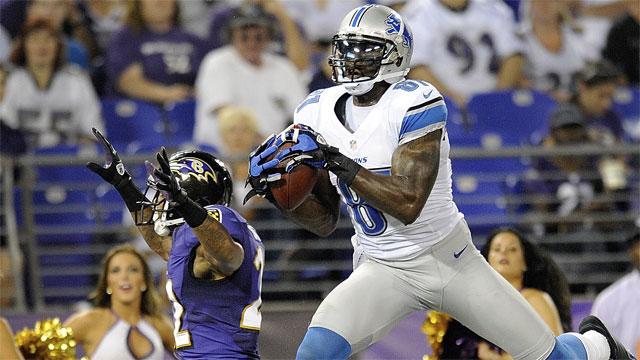
Time will tell whether ‘Megatron’ has it in him to stand up to the dark powers of the curse. Johnson, who was the NFL’s top receiver in 2011, signed a massive eight-year, $132-million extension with the Lions — a perpetually cursed franchise — prior to being named the game’s cover athlete in April.
He has looked good in the pre-season, but it’s a long season and the curse is always lurking.