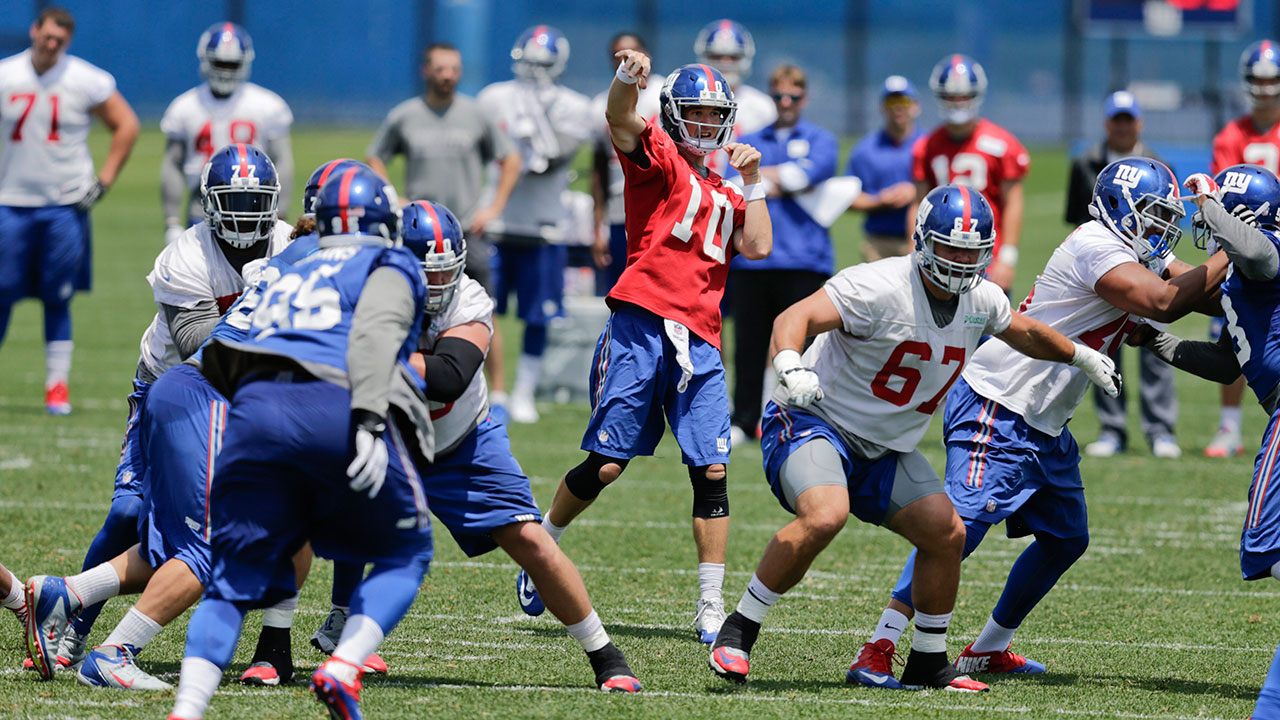

Call it the Moneyball trickle-down effect—analytics use continues to grow across all major professional sports leagues. While many NFL teams were initially hesitant to jump in with two feet, the New York Giants adopted analytics early—they were the first team in the league known to consult Pro Football Focus for opponent analysis and the G-men used a drone to film a mini-camp practice back in June, so they’re clearly looking at any avenue to improve how the franchise operates.
Giants’ assistant GM Kevin Abrams, a native of Toronto, discussed the analytics movement in the NFL in a recent Q&A with Sportsnet.
Justin Dunk: How prevalent have analytics become in the NFL?
Kevin Abrams: They’ve become prevalent and more so all the time. We’re finding better and more opportunities to take advantage of the analytics and newer technologies to look at different measurements that are probably more applicable to training methods, injury prevention and rehab. Our season is a long grind and it’s already helping us prevent soft-tissue injuries if you have the right data and you can interpret it properly. You have 61 players on your active roster and your practice squad, and throughout the season you can have more players available for practice and be fresh.
JD: How can analytics be used to evaluate players in the NFL?
KA: They’re not so much performance metrics. In baseball if you’re in a three-game series over the weekend, Jays versus Boston, and your No. 3 hitter plays right field and he’s a 20–home run, 100-RBI guy and you trade him on Saturday to the other team, he can probably produce the exact same numbers for that team just because it’s one-on-one, man-versus-man compartmentalized actions that happen within a vacuum. Whereas in football everything we do is 11-on-11. You can be a phenomenal running back, but you might not have the same production with one team as you would with another just because of the number of circumstances: quality of the passing game, offensive line and style of offensive scheme. Production, which we always respect when evaluating players, is not exactly the predictive tool and model that it is in baseball.
We do have our metrics and what we now consider analytics where we’ve got physical traits that we look for in college prospects: height, weight, speed, hand size, arm length, intelligence and medicals. But it really is a supportive tool more so than it is a primary tool with respect to how we evaluate our players. I can’t imagine a day where analytics will be level to a scouts’ eye when it comes to evaluating players—I just don’t see our game lending itself to it… Our scouts are great at what they do and I don’t imagine that is going to change significantly. But we can certainly provide them with background information based upon the data that we’ve collected.
JD: When the Giants were scouting Odell Beckham Jr. were any analytics used?
KA: I don’t think we needed to lean on a lot of analytics to identify Odell Beckham. He is a pretty special talent. When you’re picking in the top of the draft you’re going to feel pretty good about those guys. We used the same analytic methods that we always have, [but] our selecting of players is largely if not entirely done based upon the scouting process, not the analytic process.
 Download it now: iOS | Android | Windows
JD: Can analytics help with in-game decisions?
KA: We use a lot of analytics when it comes to game theory and management. That’s an ongoing, evolving data set. As you find a population of data for scenarios or circumstances—whether it be down and distance, venue, opponent, scheme—you’re starting to see more trends. You can sort of put more faith and reliability in that data the larger the population of data becomes.
JD: How does Pro Football Focus data help you from game to game or for a specific opponent?
KA: It provides you with a larger set of data that we wouldn’t have had time to capture. You try and find out if your opponents have tendencies that you can exploit and you want to make sure that you’re not too transparent with our tendencies that they might try to exploit. We’ve always been a proponent of self-scouting, and PFF’s information provides us with another layer of data that we can incorporate into studies for both us and our opponents. And league-wide there are trends as well.
JD: Are analytics changing the way NFL teams approach the game or the way the game is played?
KA: I don’t know if I would go that far, yet. Where it’s easy to gain traction within our building and get buy-in from everyone involved is if you can create greater efficiencies in your processes to augment your training program—to make more players available throughout the season. That’s where the low-hanging-fruit benefits are and hopefully once you get those established you then will find opportunities where you can maybe affect in a positive way other areas of your operation as well.