
Just when you think you have the answers, the NFL changes the questions. We’ll try to stay one step ahead of league’s carousel by answering on Friday the queries you’ll be pondering Sunday morning.
Q: So the Green Bay Packers are a third-place team, huh? When did that happen?
A: The standings don’t lie—but the schedule, especially bye-week timing, can screw with them a little bit. The Pack opened the season against a strong 49ers team, thumped Washington, then lost a crazy game to Cincinnati. They’re a turnover away from a 2-1 record. The Lions and Bears, meanwhile, played teams with a combined 7-17 record until they faced one another last weekend. There’s no room for error in this division, though, and a loss at home to the Lions would leave Green Bay desperate in week six—and give Detroit an early 3-0 division record. Considering the Packers’ preseason status as a Super Bowl contender, if you’re looking for contests that will impact the rest of the 2013 season, this is the most important game so far.
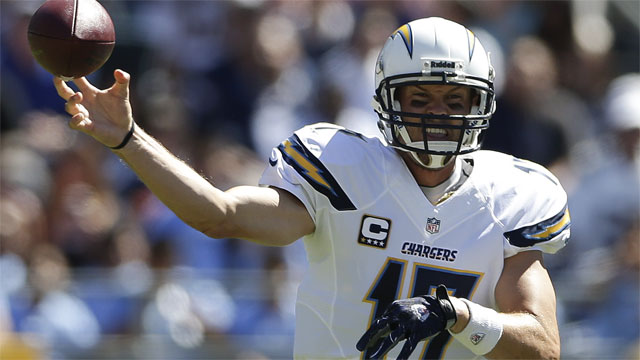
Q: So Philip Rivers is now a top-five quarterback just a year after he was among the league’s worst in almost every conceivable category? I knew that happened to teams sometimes, but how does that happen to an aging quarterback?
A: It happens very quickly. Much like the way the ball is leaving Rivers’ hands these days. Chargers coach Mike McCoy has Rivers throwing the ball an average of 2.39 seconds after the snap, the third-fastest release in the league. You’d expect that to result in a bevy of short completions, and it does—he trails only Peyton Manning in Pro Football Focus’s accuracy percentage, a stat helped greatly by short, high-percentage throws.
But Rivers has been throwing deep too—17 times for eight completions and two touchdowns on attempts of 20 yards or more. He’s the most accurate deep passer in the NFL, in fact. To do that he’s needed more time, and though he hasn’t always gotten it—hence the bevy of checkdowns to the likes of Danny Woodhead and Vincent Brown—when he has had 2.6 seconds or more to throw, Rivers has a QB rating of 139.4, tops in the league.
So how does a quarterback get more efficient and accurate, even as he gets the ball out faster and throws it deeper?
It’s simple: reads. Or rather: simple reads. The return to health and dominance of tight end Antonio Gates and the emergence of Vincent Brown in the short passing game make Rivers’ job less complicated. Nearly every Chargers’ passing play is designed around multiple short options. McCoy’s specialties are pre-snap movement and using Rivers’ calls at the line to create scenarios in which two defenders find themselves matched up against three or even four receivers on one side of the line, with just a lone safety to help them deep. In that case, there will almost always be a four- or five-yard gain for the taking, and when defences get sick of being nibbled to death, it creates chances for your short guys to go long.
You can see it in last week’s 26-yard touchdown pass to Danny Woodhead. Rivers moves Gates out wide on the right side, creating a mismatch with Cowboys linebacker Bruce Carter, who can’t cover Gates in the open field and knows it. Carter switches to Woodhead—who the Cowboys assume is there as a safety valve, or to run a short slant route. Woodhead runs a wheel route, burns the much slower Carter deep and all Rivers has to do is put it beyond Carter’s grasp.

Had the Cowboys not switched Carter onto Woodhead, Gates would have had a linebacker attempting to cover him as he cut across an empty middle—and the Chargers would have taken that easy 10-yard gain for a first down and just kept nibbling. Simple.
Q: The New England Patriots and New Orleans Saints are undefeated, right? And the New York Giants are still winless, yes?
A: Yes.
Q: But the Patriots and Saints are both underdogs this Sunday against the Bengals and Bears respectively, yet the Giants are favoured over the Eagles, correct?
A: Correct.
Q: WHY? How does that even happen? Should I bet my savings now or wait until Sunday morning?
A: Settle down. It’s time for a remedial point spread lesson. We’ll try to keep this brief and to the point. Three points, actually:
1. Every game exists in a vacuum. Football lines are not set in concert with one another. The vast majority of money bet on NFL games is bet on single games or two- and three-team parlays and teasers. This is because picking every game against the spread is unbelievably hard to do. And it’s hard to do specifically because every line is set in a vacuum.
Because of this, when you look at all the lines for a week on one sheet of paper, there are always anomalies—occasionally, for example, you might see a week in which 80 percent of the road teams are favoured, which seems like manna from heaven to a certain subset of gamblers who swear by the strategy of taking home underdogs. It’s not manna from heaven though, and a whole bunch of those home underdogs will fail to cover.
2. The lines aren’t set based on who’s going to win or lose. They’re set at whatever point the oddsmaker feels will cause an equal amount of money to be bet on both sides. That means public perception plays a huge role. The Giants, for example, are still seen as a team with a track record of recent success and a Super Bowl-winning quarterback. It doesn’t matter that this 0-4 catastrophe might be who these Giants really are; that Hakeem Nicks’ best days might be behind him; or that the offensive line is a joke and the secondary isn’t much better.
The Eagles, meanwhile, were just humiliated by Denver, all the flaws of the young Chip Kelly era exposed by Peyton Manning and the Broncos in a game that a whole lot of people watched. Hence, a line with the Eagles and Giants even, or even with the Eagles favoured by a point or two, ends up dumping a huge amount of money on the Giants. And that means Vegas could win a ton or lose a ton—and Vegas would always prefer to be guaranteed a small profit on an evenly bet game over taking any risk. That’s why they’re the house
3. Home-field advantage is not a myth, or even just an overblown concept. It exists, and it’s worth actual points on a spread. It’s why that aforementioned bettor trusts his home-’dogs-always-win strategy—it’s one that’s been shown to produce results when used on the right games. And it’s a strategy that isn’t used as often as it should be.
An empirical study of football wagering found that over 21 years in games in which the visiting team is favoured (the visitors usually must be measurably better than the home team in order to be favoured on the road) 68.2 percent of bets are placed on the visitors—but the favourite only covers 46.7 percent of the time. That’s home-field advantage and bettor biases working in concert. And it’s why Chicago and Cincinnati—both quality teams, both playing at home against undefeated opponents—are favoured. Vegas doesn’t want to give gamblers a free chance to take a good team as an underdog at home. That’s how they lose money.
Q: I have Josh Freeman on my fantasy football team. Ok, I’m lying—I cut him after week two, but I always kind of liked him and want him to end up somewhere nice. Is there hope?
A: By “somewhere nice” we’ll assume you’re not referring to a pleasant ranch in a sunny locale but, rather, an actual NFL team interested in starting him. And that, sadly, is a problem. There are possibilities out there for Freeman, but they’re either situations in which he’d be strictly a backup or situations in which he’d be set up to fail even more spectacularly than he already has. The list of teams for whom a quarterback of Freeman’s natural gifts but limited success would be an upgrade is very short—and the Jacksonville Jaguars don’t appear overly interested in improving at the moment.
Freeman’s old offensive coordinator, Greg Olson, is in Oakland now and has expressed support for his former protégé, but the Raiders have a younger, faster quarterback in Terrelle Pryor, and would be considering Freeman more as an upgrade over Matt Flynn and Matt McGloin or as injury insurance than as competition for the starting gig. Arizona and Minnesota, meanwhile, seem committed to the mediocre-to-bad quarterbacks they already employ. That leaves two spots where Freeman could make a case for himself—both Cleveland and Tennessee have recently lost signal-callers who were breaking out as true No. 1s to injury. Freeman may get a call from the Browns or Titans as an injury fill-in and, if he can flash his 2010 form, make a case for himself as a permanent part of the offence. If those calls do come, and if Josh Freeman can’t beat out Ryan Fitzpatrick or Brandon Weeden, then it’s probably time to just buy that ranch and kick back on the porch.