
GLENDALE, ARIZ.—It was the final Sunday of the opening month of the 2013 season. The Patriots were in Atlanta. It was the Falcons’ first possession. Vince Wilfork came off a block, stumbled ever so slightly to his left, then planted his right foot, trying to change direction.
And then his season was over.
He didn’t know it at the time. Not when he limped off the field. Not after they took off his sock and his right shoe to examine his ankle area. Not even in the locker room. Truth be told, Wilfork didn’t think anything was wrong. He’d never been injured before, and was in no pain.
“It just felt kinda weird,” he was remembering the other day.
New England’s trainers knew what was wrong, but Wilfork wasn’t buying it. There was a divot just above his right foot. They had him lie face down, with his lower leg bent at a 90-degree angle, and squeezed his calf. “Move your foot downward,” they told him.
“I couldn’t do it,” Wilfork says. “And I was like ‘What? What is that? What’s wrong?’”
The next morning, he went to a clinic and the MRI confirmed the suspicions of the medical staff. Wilfork had torn his right Achilles tendon completely. For a moment, he was in stunned disbelief.
“I broke down like a baby after that.”
***
Vince Wilfork is a monster of a man. They list him at six-foot-two and 325 lb., but that has to be before breakfast, in his skivvies. At the age of 33, he’s a captain, the second-longest tenured Patriot, the only one in the locker room not named Tom Brady to have won a Super Bowl with the franchise. Over the past decade, there hasn’t been an NFL defensive tackle with a more complete, sustained résumé than New England’s first-round draft choice in 2004.
But here’s the deal: Nobody messes with Wilfork. Not in the league, certainly not in Foxborough. He’s the heartbeat, the tone-setter, the identity of that Patriots locker room.
“We’re always going to look at Vince first,” says Devin McCourty, whom Darrelle Revis called the best free safety in the game this week.
It’s Wilfork who is one of the first in the building every morning. It’s Wilfork who occupies the double team. It’s Wilfork who can just give a guy a look in a situation, and they know exactly what’s on the line.
“His experience and ability to communicate with me during the game is huge,” says Rob Ninkovich, who has moved around from linebacker to defensive end during his six years with the Patriots. “You really don’t have to talk too much to know what he’s trying to do or what I’m trying to do. That’s maybe a hand signal, maybe looking at him and saying, ‘Hey, I’m doing this,’ and just give him a little eye, and he understands what I’m doing.”
“Vince,” Seahawks Pro Bowl centre Max Unger said Monday, “has been playing the game at maybe the highest level anybody has in the last 10 years.”
***
It was the final morning of September in 2013, the day after the Atlanta game, and Wilfork was still sitting in the clinic, looking at the MRI result that showed his torn Achilles. He wiped away the last of his tears, got himself together, and had surgery the next day.
“I never thought about it again,” he says, matter-of-factly. “In my life I worked hard for everything I did, so I said, ‘It’s nothing different, just a bump in the road.’”
The Patriots’ view of it was quite different.
“Clearly, there are no Vince Wilforks just standing around out there on the corner,” Bill Belichick said at the time. “There’s no way that you would replace him with one guy—that’s totally unrealistic.”
But Wilfork rehabbed, and he was around the building. He sat in on film sessions, attended meetings, was an extra set of eyes and ears on the sidelines during games and gave his fellow defensive linemen tips when they’d come off the field.
He kept his spirits up by being one of the fellas. It helped. It helped him and it helped a young defensive line that could still learn from him. Most injured players are like ghosts—detached from the team and forgotten about.
Not Wilfork.
But there was still the elephant in the room: Here was a player, on the wrong side of 30, on season-ending IR after a catastrophic injury in the area that gives him explosiveness at the point of attack. The data was sobering—few return to the game at the same level.
“That was the funniest thing to me,” Wilfork says.
Say what?
“I was reading all the stories about (people) my age, my size coming back from this injury,” he says before stopping and chuckling to himself. “Sometimes I tell people I’m not human. Don’t put me in that stat. Don’t put me there.”
Wilfork heard the whispers he was done, and wouldn’t back down. Not in his rehab. Not in his stance on contract talks. It had been ugly with the Patriots before his last extension, and the legitimate conversation in football circles was whether or not this would be the end. Wilfork had missed only six games in his first nine seasons. Would this be it in New England?
During the long, lonely road back to recovery, he got his motivation from those vanishing from his corner.
“I think that’s one of the most [important] things that drove me—just to hear all the doubters saying that I can’t come back because of my weight, my age, all that stuff,” Wilfork says. “When I went to work, I went to work.”
He spent time both at the team facility and back home in Florida. He worked with the Patriots staff that he didn’t believe when they first told him his Achilles was toast. In Florida he found a trainer to help him. His wife, Bianca—a strong-willed woman who is no stranger around the Patriots and wears a “Mrs. Wilfork” jersey to games—kept him upbeat mentally.
“I killed myself every day to make sure I was right,” he says. “Sometimes I do things that might be impossible.”
There were two goals: return for opening day and win a second Super Bowl ring.
***
At some point after Super Bowl XLIX, either after the parade or following a third straight defeat in the title game, Wilfork will return home to Boyton Beach, Fla. One of the visits he plans on making is to a teacher of his—whose identity he would not reveal.
Wilfork’s upbringing still resonates with him, and on media day he revealed he had a seminal moment as a teenager. In ninth grade, he saw a classmate with a pair of shoes that he liked.
“I stole them,” Wilfork says.
He was suspended from school for 10 days.
“I had a teacher who took me aside and ripped into me,” he remembers. “I decided to make changes. I decided to listen. I had told my dad since I was four years old that I was going to play in the NFL. I knew right then that to make that happen, I had to listen.”
Two decades later, he still does.
Matt Patricia says it’s Wilfork who sits in the front row of meeting rooms every day, taking meticulous notes. Eleven years in the NFL, and there he is, paying attention, upright, into what the Patriots defensive coordinator has to say, day in and day out.
“It’s phenomenal for me to have a leader like Vince,” Patricia says. “If I need to point to anyone in the room that I think needs to do [something] a certain way, I can point to Vince and say, ‘You need to follow this guy’s example. This is how you sustain in the NFL. This is how you succeed in the NFL. This is how you’re a champion in the NFL. You do it like he does.’”
Patricia paused.
“He’s an easy follow.”
But it wasn’t that simple for Wilfork. Just months after winning a national championship with the Miami Hurricanes, his father died in the summer of 2002. Six months later, his mother suffered a stroke and was gone. Suddenly, Wilfork was without the two rocks he had been listening to since the day he stole those shoes.
“I was going to quit football,” Wilfork says. “I was going to quit on a lot of things.”
But he didn’t. And if he didn’t do it then, an injury 10 years later certainly wasn’t going to make him.
***
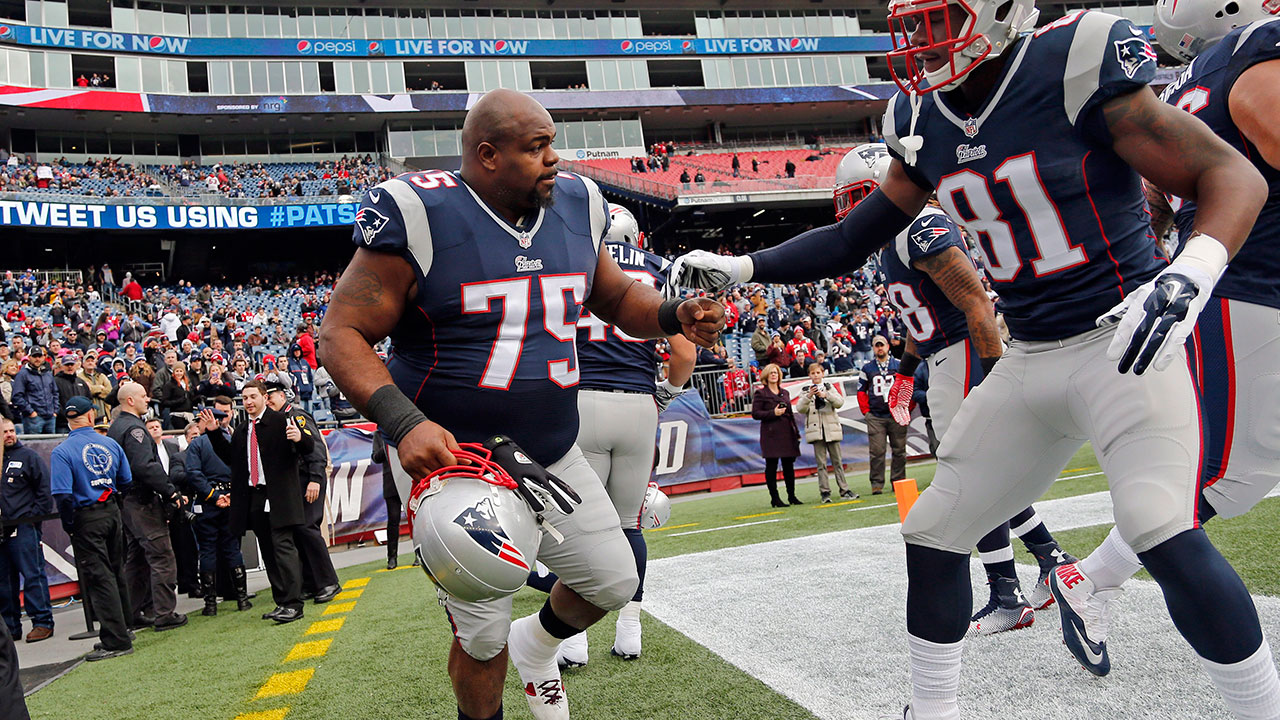
Opening day, 2014. The Patriots were in Miami. Back in Wilfork’s home state, down the road from where he won that collegiate national title, an hour south of the school that suspended him in ninth grade—the day that changed his life. And there was big No. 75, running out of the tunnel with the defensive starters. The first goal, reached.
Two weeks later, nearly a year to the day his Achilles came apart in Atlanta, New England was home to Oakland. The Raiders were at the Pats’ 12-yard line, trailing by a touchdown with less than a minute remaining. On first-and-goal, Patricia sent a three-man rush, dropping Ninkovich into coverage over the middle. Wilfork, as usual, was occupying the middle of the line and taking on a double team.
Raiders quarterback Derek Carr, out of the shotgun, threw a pass over the middle for Denarius Moore. The ball popped loose and back into the hands of the unquestioned defensive leader. Interception, Wilfork. Ballgame, Patriots.
Twelve months prior, he couldn’t flex his foot. A year later, he had his new contract, he had his health, and he had the game-winning football.
Wilfork has played each of the Patriots’ 18 games this season, defying all those who said he couldn’t.
“Nothing is given to you. Everything you do you have to earn. There’s a price to pay for everything, and all my life I’ve worked towards being good, worked towards trying to be great—chasing greatness,” he said this week. “Sometimes I do things that might be impossible, and I find it out the hard way. Nothing wrong with trying. I always grew up saying that—work as hard as you can. Dedicate yourself. When you dedicate yourself and work hard enough, you’ll succeed in a lot of stuff in life, and that’s what I live by.”
One more mission remains. That’s Sunday. Should he win his second career Super Bowl, he may cry like a baby again.
Who could blame him for that?