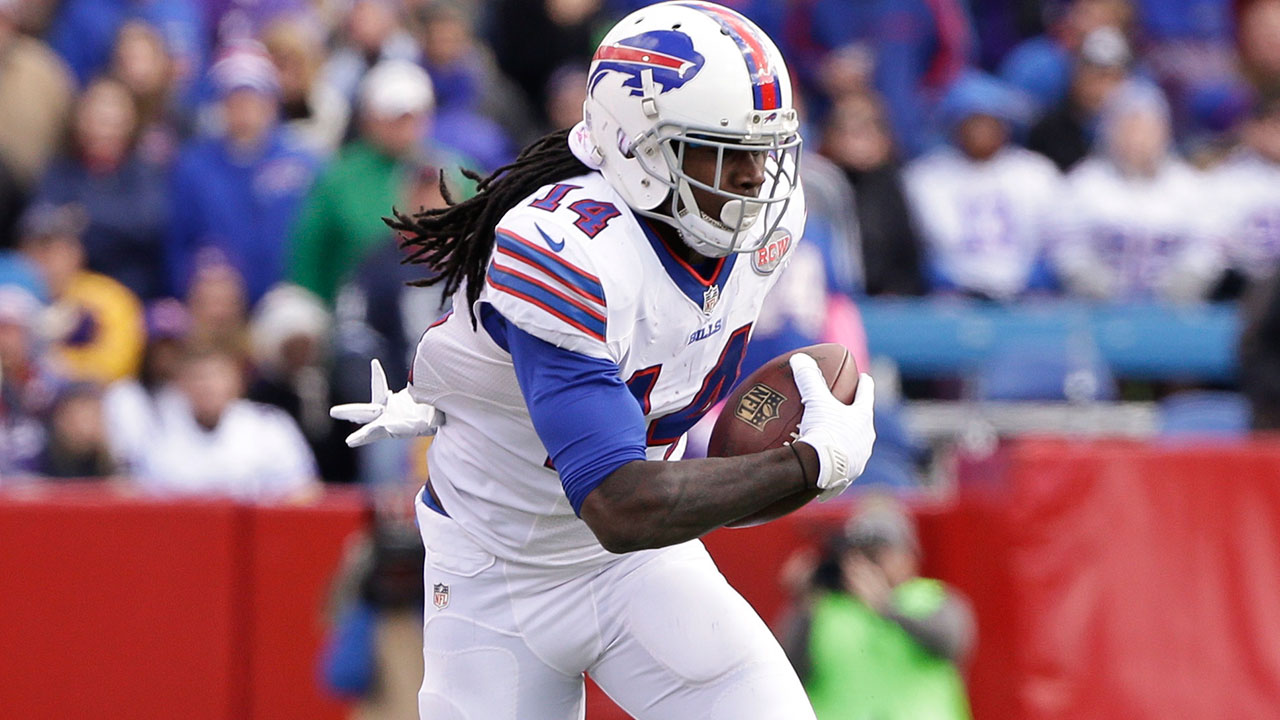

When the Buffalo Bills brought in head coach Rex Ryan and offensive coordinator Greg Roman it was clear they wanted to move towards a run-first offence, but that shouldn’t have to come at the expense of their best skill-position player.
Sammy Watkins is a special talent. Scouts put him on a similar level to Julio Jones and A.J. Green. He’s got speed, great hands and crisp route-running ability, yet he ranks tied for 111th in the league in targets (38 targets in seven games). He didn’t receive a target in the first half against the New England Patriots on Monday night, and when the team started targeting him in the second half the passes in his direction were underthrown despite the fact that he was getting clean releases off the line of scrimmage.
Watkins didn’t have a catch until he made a spectacular one-handed snag midway through the fourth quarter.
“We’ve got to look at it,” Ryan told reporters after the game. “Obviously, we tried to spread the ball around. But (Watkins and Charles Clay) are guys we need to get the football to.”
As a comparison, Texans receiver DeAndre Hopkins ranks third in the NFL in receiving yards, first in touchdowns and first in targets while playing alongside underwhelming quarterbacks such as T.J. Yates, Brian Hoyer and Ryan Mallett, so it would be unfair to fully blame Bills quarterback Tyrod Taylor. At some point, Ryan and Roman have to be held responsible.
Watkins needs to be an cornerstone part of the Bills’ game plan on a weekly basis going forward because the team is wasting a player who should be as productive as other 2014 draft-class mates like Odell Beckham Jr. and Mike Evans. He’s that good.
Game management issues a recurring problem: It’s hard to comprehend why so many experienced NFL coaches struggle with basic clock management issues on a weekly basis.
Tom Coughlin and the New York Giants displayed picture-perfect examples of how to effectively botch a game in previous losses to the Dallas Cowboys and New England Patriots, and this week the Cincinnati Bengals made one of the most head-scratching decisions of the season.
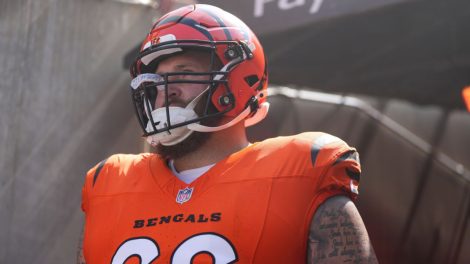
The Bengals were deep in Cardinals territory with less than a minute to play in the fourth quarter, down by three points. The team was facing a 3rd-and-2 and the Cardinals were out of timeouts, so basic strategy would tell you running down the clock should be a critical element of their decision. Instead, the Bengals (whether it was Marvin Lewis, Hue Jackson or Andy Dalton) decided to go for the kill shot, throwing a deep pass into the end zone that wound up incomplete because A.J. Green couldn’t get his feet in bounds.
As a result, the clock stopped before the Bengals kicked the game-tying field goal and the Cardinals had enough time left to drive down the field for a last-second victory. This isn’t complex stuff. It’s basic strategy. Running 40 seconds off the clock (if they ran the ball or threw a shorter high-percentage pass) would have effectively killed the Cardinals’ chances of getting a last-second score. Even if they’d scored on that play to Green, Arizona still would’ve had more than enough time to come back and win the game.
Given the struggles around the league in this department, every team should consider hiring a clock-management expert. Or maybe coaches just need to play more Madden to enhance their game-management strategy. This shouldn’t be so difficult.
Seahawks finally find their successor to Lynch: The Seattle Seahawks spent a high draft pick on Christine Michael in 2013, hoping he could be the successor to Marshawn Lynch when the body of the violent runner began to break down. Instead, the Seahawks appear to have found their running back of the future at a much lesser cost in undrafted free agent Thomas Rawls.
Rawls has been fantastic in each of his starts this season and his best effort came on Sunday (although it was against San Francisco) when he turned in a monster 209-yard performance on 30 carries. He ranks 12th in the NFL in rushing, but has at least 50 fewer carries than any player who ranks above him.
Rawls offers a deadly combination of speed and power and has a lot of of Lynch’s style in his game, averaging 2.80 yards after contact (the best in the league). He has already recorded six runs over 20 yards in limited action and his teammates have responded well to his physical style. Watch the reaction of the Seattle sideline below.
Lynch could miss the rest of the season with a nagging abdominal injury, but the Seahawks should be able to hold up just fine with their new rookie runner in place.
Lacy gets Packers back on track: The Green Bay Packers have been struggling to maintain their usual offensive efficiency over the last month. Their receivers are struggling to get open on their routes and Aaron Rodgers had been pressing as a result.
So it was an extremely positive sign, from Green Bay’s perspective, to see Eddie Lacy returning to his dominant power-running form versus Minnesota. Lacy ran for 100 yards on 22 carries against one of the league’s best run defences, which helped open up the passing game for Rodgers in a key divisional victory to put the Packers back in first place.
The Packers are more effective when they are balanced between the run and the pass and when they can have Lacy wearing down defenders in the process, rather than him sitting on the bench or the inactive list (like he has this season) due to a lack of productivity.
“This is the way we prefer to play,” Packers coach Mike McCarthy said after the win over the Vikings. “We don’t want to be 66 runs or 66 passes each game. The way our offence performed (Sunday) is what we’re looking for.”
Rough year for the Ravens: What did John Harbaugh do to the football gods this season? Prior to Sunday’s comeback victory over the St. Louis Rams, the Baltimore Ravens were already down two of their top players (Steve Smith and Terrell Suggs) and their top rookie (receiver Breshad Perriman) to season-ending injuries.
This past Sunday, the injuries struck even deeper. Starting running back Justin Forsett broke his forearm early in the first half against St. Louis before quarterback Joe Flacco tore the ACL and MCL in his knee on the final drive of the game. The injuries put a damper on an otherwise-exciting victory and it summed up what has been a long season for Baltimore.