
Can a dynasty exist in today’s NFL?
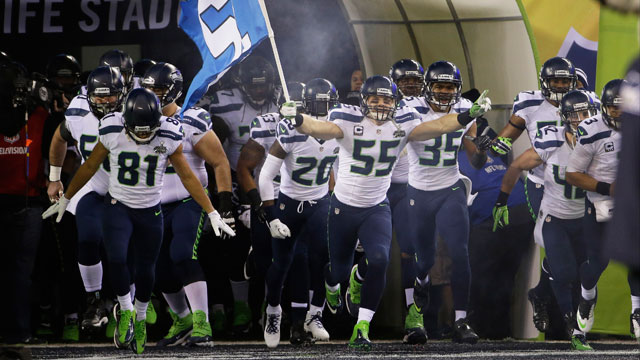
The Seattle Seahawks are an interesting case. They’ve won a championship with one of the youngest and deepest rosters in the league—but the salary cap and draft are set up to create parity.
With a number of the key contributors in their utter dismantling of the Denver Broncos currently 27 or younger—Russell Wilson, Percy Harvin, Doug Baldwin, Cliff Avril, Kam Chancellor, Malcolm Smith, Earl Thomas, Richard Sherman and Byron Maxwell to name a handful—the Seahawks certainly appear to be built for sustained success, but let’s take a closer look at where they’ll need to go from here.
Seattle has a young quarterback in place and are loaded with ferocious talent on both sides of the ball. Already, the Seahawks are Vegas’ pick to win the Super Bowl in the 2014 season. The online sportsbook Bovada released odds for Super Bowl XLIX Monday morning that had them pegged as 9/2 favourites to repeat.
“Nobody here thinks we’re done,” quarterback Russell Wilson told MMQB.com’s Peter King. “And we really think we have such a great chance here to keep it going. That’s how you distinguish yourself in this game.”
Despite the optimism, Seattle will be forced to make some very challenging roster decisions over the next few seasons.
THE DRAFT
Let’s start by taking a look at the current roster, where it is abundantly clear that Seattle has been built from the ground up. Everything about their success starts in the draft, which is the cheapest, most efficient way to acquire talent. It’s not hyperbole to say that fourth-year general manager John Schneider has been more productive than anyone else in the league since he came to Seattle in 2010.
For example, Schneider and Pete Carroll’s first three drafts included:
2010: Earl Thomas, Russell Okung, Golden Tate, Kam Chancellor, Walter Thurmond
2011: K.J. Wright, Richard Sherman, Byron Maxwell, Malcolm Smith
2012: Bruce Irvin, Bobby Wagner, Russell Wilson, Jeremy Lane
They have found productive players all over, whether it’s in the first round (Thomas, 2010), third round (Wilson, 2012) or fifth round (Sherman, 2011, and Chancellor, 2010)—as well as after all of those rounds. The two Seahawks who scored receiving touchdowns in the Super Bowl (Doug Baldwin, Jermaine Kearse) were both undrafted free agents.
With that success as a base, Seattle has been able to create a clear competitive advantage in roster building with a team full of cheap rookie contracts. For example, Wilson and Sherman each have a base salary that costs the team under $600,000, and there are a ton of these contracts sprinkled throughout the roster.
That’s why Seattle has been able to spend aggressively in free agency and in trades the last two years. They brought in pass rushers Cliff Avril and Michael Bennett in free agency and spent big to acquire receiver Percy Harvin from the Minnesota Vikings. All three contributed greatly to the Super Bowl victory.
Don’t expect this to continue, though. Seattle has too many quality young players (who thought that would be a problem?) that need raises and contract extensions over the next few seasons, making it exceedingly difficult to add veteran players at free agent prices. They will need to rely on the draft – even though they will be picking later than ever – to help maintain themselves as one of the younger teams in the league. That’s the only way to stay cost efficient. It will be a clear priority for Carroll and Schneider.
“If it was like baseball with no salary cap, then we would be like the Yankees,” cornerback Walter Thurmond told USA Today after the victory over Denver, “just hoarding guys and really creating a dynasty.”
Thurmond is right. If Seattle could spend uncontrollably, the Seahawks would have a clear advantage with Paul Allen’s bank account, Carroll’s ability to recruit mixed in and his staff’s ability to evaluate personnel. But that isn’t a reality. That’s why teams such as the 1970s Pittsburgh Steelers and the New England Patriots of the early 2000s are so rare.
FREE AGENCY
Super Bowl teams are routinely picked apart on the free agent market. Take a look at last year’s champions, the Baltimore Ravens, who were unable to afford receiver Anquan Boldin, safeties Ed Reed and Bernard Pollard as well as other key defensive players because they had to reward quarterback Joe Flacco with a huge contract extension. A year later, the Ravens did not qualify for the post-season.
That dramatic dropoff is unlikely to occur in Seattle—but the Seahawks do have an extensive list of players hitting the free agent market and they won’t be able to re-sign all of them if they want extend some of the core players on their roster down the road.
Here is a list of the Seahawks who will be unrestricted free agents, and what’s likely to happen to them:
Walter Thurmond, CB: Unlikely to return, as he could start somewhere else
Golden Tate, WR: Could only return at a modest deal
Michael Bennett, DL: Seahawks have clear priority to re-sign
Breno Giacomini, OT: Seahawks likely to replace with younger player
Paul McQuistan, OG: Would only return at veteran minimum
Tarvaris Jackson, QB: Could come back as backup to Wilson
Chris Maragos, S: Seahawks likely to replace with cheaper option
Tony McDaniel, DT: May find a big free agent deal after breakout season
Clinton McDonald, DT: Solid, rotation player that may find greener pastures
Michael Robinson, FB: Seahawks may turn to cheaper, younger Derrick Coleman
Steven Hauschka, K: Due for a raise after career year
The difficulty for the Seahawks will be to continue to find a balance between keeping their core roster intact while maintaining their goal of staying young. To accomplish that, they will have to release some veteran players. The age of 30 becomes a key number here—not only to create salary cap space to pay the top-end talents but to allow younger players to get on the field more frequently.
According to many sources, the Seahawks primary goal is to sign All-Pro safety Earl Thomas to a contract extension. He could become the highest-paid player ever at his position, considering his dominant play over the past four seasons. Sherman is also expected to engage in contract talks with the club, and his salary will dramatically increase. In order to make those moves work, Seattle will to create significant salary cap space. Here’s who could be looked at to reduce their salaries or be released from the team.
CANDIDATES FOR A RELEASE:
Sidney Rice, WR
2014 cap number: $9.7 million
Cap savings of 7.3 million with release
Chris Clemons, DL
2014 cap number: $9.66 million
Cap savings of $7.5 million with release
Red Bryant, DL
2014 cap number: $8.5 million
Cap savings of $5.5 million with release
Zach Miller, TE
2014 cap number $7 million
Cap savings of $5 million with release
All in all, the Seahawks are in a pretty good place going forward. They still have a majority of their key players under contract for the foreseeable future and should be able to contend over the next few seasons.
As per the CBA, they cannot extend Wilson until the 2015 season so that buys them more time with their quarterback making peanuts by NFL standards. Schneider and Carroll are forward thinkers that have created models to map out their long-term plans—especially with regard to the salary cap.
They may not be a dynasty, like the Patriots, Steelers, and Cowboys of years past, but the Seahawks are built better than anyone else in the league to remain atop of the NFL world.