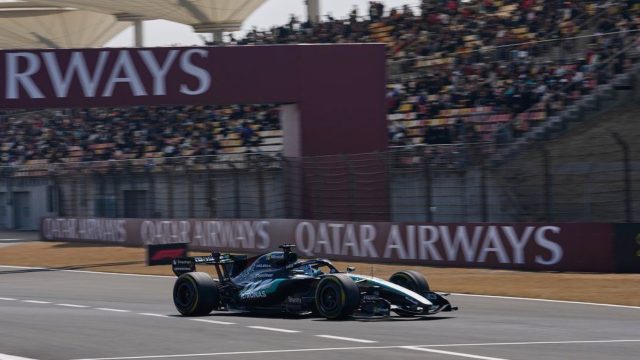
George Russell praised his Mercedes as a “joy to drive” as he took pole for the sprint race at the Chinese Grand Prix on Friday to continue his team's dominant start to the new era of Formula 1.
Russell is the driver to beat in Shanghai after his dominant win in Australia last week. With teammate Kimi Antonelli qualifying second, 0.289 of a second down, and no other team close, Mercedes is on target for another 1-2 finish in Saturday's sprint, which is followed by qualifying for Sunday's Grand Prix.
“The car has been feeling amazing,” Russell said. “The engine is performing really well and today it was a real joy to drive.”
Lando Norris was .621 adrift, a vast gap in F1 terms, in third for McLaren. Only Lewis Hamilton of Ferrari in fourth and Norris' teammate Oscar Piastri in fifth got within a second of Russell's time.
Antonelli held on to second despite an investigation for impeding Norris during qualifying. He wasn't penalized because Norris said he wasn't trying to set a “meaningful lap time,” so didn't lose out.
Hamilton might be the biggest threat to the Mercedes pair because the Ferrari is quick off the line, which allowed teammate Charles Leclerc to jump into the lead in Australia last week before a strategy error ended his victory hopes. Russell suggested Mercedes has improved its sluggish starts, though.
Verstappen, the most prominent critic of the new regulations, lacked grip and was eighth on a day he called a “disaster, pace-wise”. It still wasn't as bad as the crash which left him at the back of the grid in Australia last week.
Ferrari debuts ‘Macarena’
Russell and Mercedes led the way in Friday's sole practice session, as Ferrari failed to find a significant advantage from its unique rear wing which rotates upside-down for more speed on the straights.
The benefit wasn't clear in a session where Hamilton touched tires with Norris and also spun on another lap, and Ferrari didn't use it for qualifying. Hamilton said it was only ever planned as a test to develop the concept to use later in the season.
Dubbed the “flip-flop” or “Macarena,” it was used briefly in testing, dropped for Australia, and is the sort of innovation which could potentially help Leclerc and Hamilton compete with Mercedes. It could also disrupt the airflow and hinder cars following close behind.
Changes on the way
F1's governing body, the FIA, could take stock of how the racing is going and make changes, potentially even in time for the Japanese Grand Prix later this month.
One gripe so far has been the lack of control by drivers of when the electrical power kicks in and how much is used.
They can't stop the power being deployed in typical straight-line driving and can only add an extra boost, which in Australia resulted in cars finishing the formation lap with an empty battery and lacking pace at the start. That's “not a lot of fun and also quite dangerous,” Verstappen said Thursday.
A related issue ended home hero Oscar Piastri's race before it began in Australia, when the extra power kicked in unexpectedly and tipped him into the barriers before he even reached the grid.
If F1 can't race next month in Bahrain and Saudi Arabia, which remain on the schedule for now despite the Iran war, it would leave a five-week gap in the calendar, which teams could use to refine any changes.
Zhou a boost for Cadillac
There hasn't been a Chinese driver on the F1 grid since Zhou Guanyu left Sauber at the end of 2024, but he's still a big celebrity in his home country. As reserve driver for Cadillac, he could give the new team extra recognition in a key market after its solid but unspectacular debut in Australia.
It was a tough day for Cadillac as Valtteri Bottas was 21st in sprint qualifying, slower than even the unreliable Aston Martins, while Sergio Perez couldn't start because of a problem with his fuel system.