No Rachel Homan, no problem.
Switzerland’s Team Silvana Tirinzoni has finally broken through this season on the Grand Slam of Curling tour.
She earned her sixth career Slam trophy with a dominant 7-1 win over Japan’s Team Satsuki Fujisawa at the HearingLife Canadian Open in Saskatoon, Sask.
Despite making the previous three finals this season, Tirinzoni and her team fell short each time to Homan.
With the victory, Tirinzoni has moved into a tie for second place with the most GSOC titles by a European skip of all time. Sweden’s Anna Hasselborg leads the way with eight, while Scotland’s Eve Muirheard and Tirinzoni each have six.
Sunday’s results (Full scores and standings)
Draw 21
Tirinzoni 7, Fujisawa 1
Draw 22
Y. Schwaller 7, Whyte 4
Women’s final
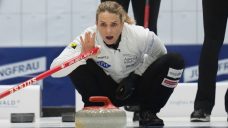
Rule No. 1, never trust Alina Paetz at a poker table.
When Paetz was asked about facing Fujisawa in her pre-game interview with reporter Devin Heroux, she gave all the credit to Fujisawa.
"We have to bring our A-game, that’s for sure. They’ve been so good," said Paetz. "We lost some important games against them, but we also won some important games against them, so it’s just 50/50."
Well, she wasn’t exactly telling the truth. In their careers it’s been a little more than just a 50/50 chance for Tirinzoni when facing Fujisawa.
Tirinzoni’s all-time record against Fujisawa coming into the final was 23-6 — that's 15-3 in Slam tournaments and 5-0 this season.
Having said that, in the first end Fujisawa started with double centre line guards, trying to give Tirinzoni trouble, and it worked. The end looked really good for Fujisawa until she threw her last stone.
Fujisawa attempted a triple-takeout (two Tirinzoni stones) to get rid of everything in the middle of the house, all while leaving her biter on the outside, hoping to force Tirinzoni to one.
She did get rid of three stones, but one of them was her biter that she jammed on Tirinzoni’s stone. This gave Tirinzoni an easy draw for two.
After Fujisawa was only able to get a single point in the second end, her team bounced back in the third. Tirinzoni couldn’t get anything going and elected to use her one blank end.
Fujisawa did a great job again in the fourth end, forcing Tirinzoni to take a single with her blank gone to take a 3-1 lead into the break.
In the short break it was clear, even though Tirinzoni was winning, her team needed to make some adjustments to really take control of the game.
In the fifth end, we saw those adjustments.
After Tirinzoni’s lead Selina Witschonke threw the centre line guard with her first stone, they elected to come around with Witschonke’s second rock for a draw in the top button. This strategy change threw Fujisawa’s team off their game.
After Tirinzoni threw her last stone in the fifth end, making a great guard, there was nothing Fujisawa could do and gave up a steal to trail 4-1.
If something works, don’t change it.
That’s exactly what Tirinzoni did, using the same step up in the sixth end, causing even more havoc for Fujisawa.
With four stones in the four-foot, three of them being Tirinzoni’s as Paetz went to throw her last rock, they were left with a decision. Guard and possibly just give up one point or make a hit on Fujisawa’s rock, and, if made right, sit four with no chance once again for Fujisawa to score.
After a lengthy discussion, they elected to go for the hit.
With the choice made, Paetz needed to deliver.
She did just that, hitting Fujisawa’s rock and driving it through the port to sit four.
Fujisawa gave up three more and lost 7-1.
The fourth-end break adjustments were a major factor in this game, along with the fact Paetz curled an outstanding 87 per cent, while Fujisawa only shot 61 per cent.
Men’s final
Even though Scotland’s Team Ross Whyte lost to Switzerland’s Team Yannick Schwaller earlier in the week, it felt like Whyte was playing the better curling.
Especially considering he had to knock off Canada’s Team Brad Jacobs in the quarterfinals and world No. 1 Bruce Mouat in the semifinals to reach his second Slam final of the season.
When asked by Heroux pre-game how his team could beat Schwaller after losing to them earlier in the week, Whyte said the start was everything.
"We're gonna have to come out here, start sharp, and try to flip the hammer as quick as we can."
Whyte got the result he wanted, playing an exceptional end and earned the force to flip the hammer.
However, Whyte found himself in the same situation, taking just one point in the second end.
Both teams weren’t giving an inch, as they swapped singles once again in the third and fourth ends, resulting in a 2-2 tie at the break.
In the fifth end however, Whyte finally broke.
With Whyte’s final stone he tried to weld a draw onto Schwaller’s rock sitting just behind the tee line. Whyte was just a tad heavy, and created enough separation for Benoit Schwarz van-Berkel (throws the fourth stones for Schwaller) to do damage.
A cross-rings double-takeout was there for Schwarz van-Berkel, who was playing excellent all game. He made no mistake while keeping the shooter as well to score a massive four points, blowing the game wide open.
Whyte tried to answer the call in the sixth end, making a crazy double himself, but lost the shooter and only scored a single to trail 6-3.
Even though Whyte’s team fought until the very last stone in the eighth end, after the fifth-end mistake, there was no coming back.
Schwaller picked up the 7-4 victory, earning his first GSOC title in his third Slam final.
With the win, for the first time in Grand Slam of Curling history, Switzerland swept the week, making it a historic showing for the Swiss curling program.
The next stop on the Grand Slam of Curling tour is the Crown Royal Players’ Championship, running Jan. 6-11, 2026 in Steinbach, Man.

 1:27
1:27