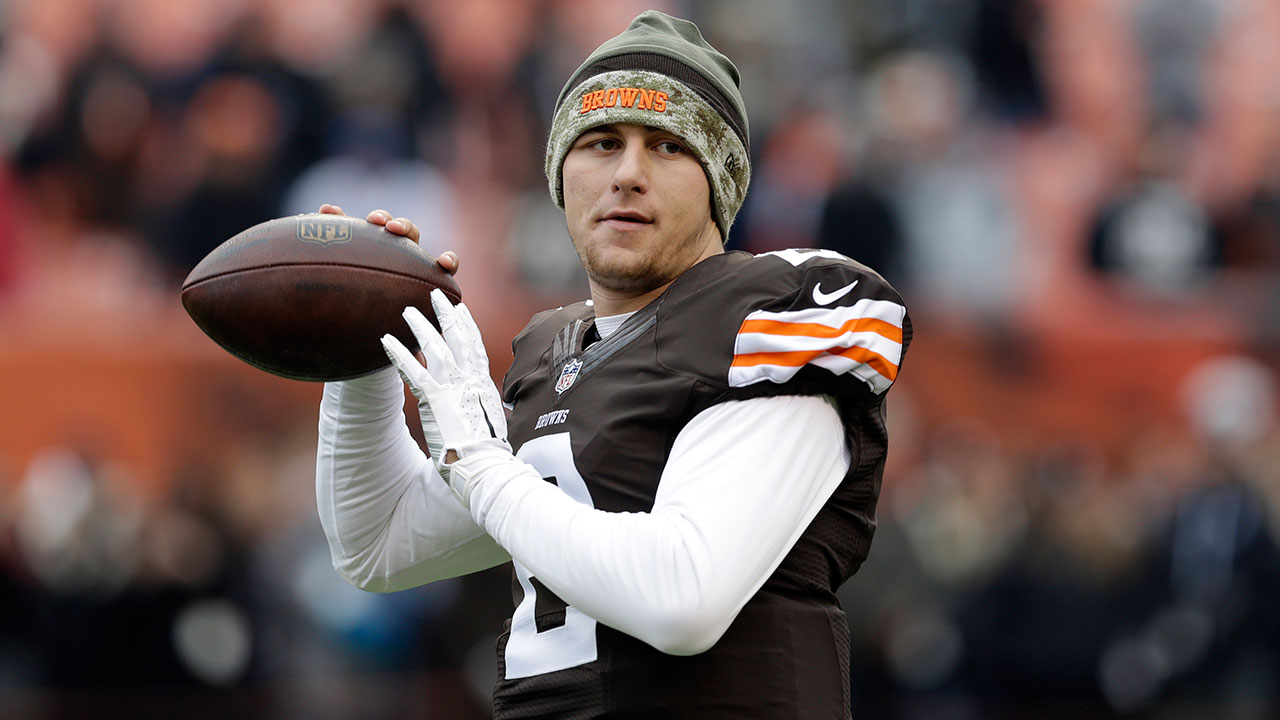

In August of 2014, Dan Robson went to Berea, Ohio to find out how Cleveland Browns fans were welcoming their latest quarterback. The answer? With open arms and high expectations. With news breaking this week that Manziel had entered a treatment facility following a rookie season of questionable decisions on-field and off, and rumours of a drinking problem, we thought we’d revisit the beginning of it all. This story originally ran in the Sept. 8, 2014 edition of Sportsnet magazine.
“Is it time yet?” Michael Spring Jr. asks. “Dad, is it time?”
The binoculars are huge in his six-year-old hands, and he leans forward to give the lenses some help. He wears a brown T-shirt with “Manziel” written above “2” in white on the back. He nudges into his father, Mike Sr., a 32-year-old contractor, who sits beside him on the packed metal bleachers wearing a grey Browns T-shirt and a faded brown baseball cap.
“Almost, buddy,” Mike says. “It’s almost time.”
The Springs made the trip from Columbus to Berea, Ohio, a two-hour drive, and are among more than three thousand already in attendance at 9 a.m. on the opening day of Browns training camp—fans hoping that a new season will reverse the hard luck of a franchise that hasn’t won a championship in half a century. Some lined up at 2:30 a.m. to get seats. They bark wildly, a tradition of the “Dawg Pound,” as the team’s faithful are known. One man wears an orange-and-brown suit of armour. Another has sparkling green money signs taped all over him. Every third person, it seems, wears something dedicated to the young man they’ve come to see, the one who has given them something to be excited about, something to believe in. “Money Manziel,” “Johnny Be Good,” “The House that Johnny Built”—all of the nicknames and tag lines Johnny Manziel has accumulated over the past two years on his rise to national fame with Texas A&M are plastered across shirts and hats and signs.
Michael Spring Jr. lifts his binoculars again as a few players jog out of the Browns’ training facility. “Is that him?” he asks.
No, not yet—no Johnny.
 ATTENTION Rogers and Shaw customers.
Already enjoying Sportsnet ONE? Now get access to digital editions of Sportsnet magazine at no extra cost.
While the Browns’ starting quarterback role will initially go to homegrown veteran Brian Hoyer, it seems inevitable that Manziel will take over at some point this season. Cleveland is a team begging for a quarterback capable of magic. The Browns have youth and talent on both sides of the ball, but they also have a long history of being cursed. They haven’t won a championship in 50 years and haven’t had a decent quarterback since the early ’90s. The most famous moments in Browns history are painful: The Drive in ’87, the Fumble in ’88. So the idea of Johnny Manziel brings a great deal of hope to this tortured sports city. They desperately need him to be a saviour, not another false pivot.
Collectively, we’ve been waiting for “Johnny Football” since he was a freshman at Texas A&M, when he won the Heisman Trophy and became an instant celebrity. His highlight-reel play, cocksure attitude and Playboy Mansion dream life turned him into one of the most polarizing figures in sport. We stared into the fishbowl of ESPN and TMZ, fascinated by his money-making gestures, his nightclub antics, his stacks of cash and however the hell he passed out on that inflatable swan. He’s easy to hate, but evidently also easy to love. Without even throwing a football in an NFL game, Manziel’s No. 2 Browns jersey is already the NFL’s top seller. His first pre-season game set an NFL ratings record. Despite the fact that he’s starting as the backup, Vegas odds have him as the favourite for offensive rookie of the year. Meanwhile, Manziel’s detractors can’t wait to see him fail. On both sides of the divide, it’s a charged, intoxicating obsession. There is something about Manziel that inspires extreme reactions. I went searching for the root of that, trying to find the heart of Manziel Mania and the truth about the 21-year-old kid behind it all—to talk to those who know him, and not the writers who loathe him. And somewhere along the way, I discovered just how easy it is to be sucked into the cult of his personality.
The story of Manziel’s American Dream begins in Kerrville, Texas, a sleepy town of 22,000 people about an hour outside of San Antonio. It is the kind of place where thousands show up for Friday night football games and high-school quarterbacks are kings. Manziel moved there with his family from Tyler, about six hours away, when he was in the seventh grade. And when he enrolled at Tivy High School and joined the freshman football team, incredible things started to happen.
Here’s one story: When Manziel was in his first year at the school of about 1,300, the varsity team sat
in the bleachers and watched the freshman team play. Colton Palmer, the six-foot-four varsity quarterback, had heard the new kid was good, but wanted to see for himself. On one play the ball was snapped well over Manziel’s head. The 14-year-old turned and ran after it. He caught it one-handed, spun on one foot and fired a 35-yard pass on a rope to his teammate in the end zone. “I can’t do that,” Palmer said after a long, astonished pause. “I can’t make that kind of throw.”
Later that season, Manziel sat alone at one end of the varsity locker room, after being called up to play receiver during the playoffs. Some of the older players wanted to let the kid know that this was the big time and plotted to set him up for a bone-crushing hit during a scrimmage. “He was scared shitless,” says Gareth Kirk, then the team’s backup quarterback, who ignored the planned initiation and walked over to welcome the rookie to the team. “He didn’t know anyone.”
During that practice, offensive coordinator Julius Scott called a deep route that sent Manziel bolting down the field. “Let’s see what this kid can do,” Scott said. As the rookie ran, Kirk threw a bomb into tight coverage. Manziel jumped over a defending corner, palmed the ball in one hand and kept his feet in bounds before falling out of the end zone. “All of us kind of looked at each other like, ‘Did that really just happen?’” Kirk says. After that play there was no more talk of putting the rookie in his place. “The next year he came in guns blazing,” Kirk says. “He wasn’t scared to do anything.”
That’s how it began, with Manziel showing he belonged and earning the respect of peers who had previously wanted to keep him down. He became close friends with both Kirk and Palmer, the senior starter. Kirk picked Manziel up for practice every morning at 6:30 a.m. and the two listened to country music, planned pranks to play in class and complained about teachers. After morning classes, they ate breakfast at the Donut Palace or hit Rita’s for an early taco on game days. Manziel started on the varsity team as a sophomore—first at running back and then receiver. When Palmer was suspended for two games after getting busted for underage drinking, Manziel filled in. The night before his first game as varsity quarterback, Manziel went to Palmer’s house and sat on the back porch with the senior. The two often hung out watching movies and playing Halo, but this time the future Johnny Football asked how he could get the team to follow him. Manziel wasn’t nervous, but he peppered Palmer with questions. “Look man,” Palmer eventually said, “if you go out there and play as hard as you can, nobody can play with you. You’re going to be great. You already know it.”
On the first play of the game, Manziel hit a receiver with a 50-yard pass. A few plays later, he ran 69 yards for a touchdown that was called back on penalties. The line moved back 20 yards. On the next snap, Manziel ran 89 yards and scored the touchdown again.
“His first game, it took five minutes for you to realize that you’re looking at something you’ve never seen before,” says Stuart Cunyus, the football reporter at the Hill Country Community Journal. “He moved on another level. He was a man among boys. He wasn’t big, he was still pretty skinny. He had a way of running. He threw perfect passes. When he got into trouble, he was able to work his way out of it. He leaped over people. It was unbelievable.”
The Antlers went to the state semi-final that season, with Manziel and Palmer alternating between quarterback and wide receiver. Trailing late in the game, Palmer told his coach to let him run the ball. Manziel spoke up and told Palmer to look for him in the end zone—“It was some leadership,” Palmer says—and after scrambling around searching for a place to run, Palmer hit Manziel, wide open in the end zone, for a touchdown. The Antlers lost on a late field goal, seconds away from going to State. On the bus after the game, in a scene straight out of Friday Night Lights, Palmer sat in his regular seat eating a barbecue sandwich and reflecting on the end of his high-school career. He felt a large hand grip his shoulder. “I love you, man,” Manziel said. “Thanks for everything.”
Manziel’s on-field miracles drew a buzz, and soon reporters from San Antonio were showing up to cover Tivy games. Over the next two years, fans from across Texas flocked to watch Manziel. One couple drove all the way from California to see him play, says Mark Smith, the team’s head coach. The serious recruiters, initially repelled by his lack of size, came after the hype, drawn by Manziel’s near-cult following in Kerrville. He was nicknamed the “Rocket Man” by Wally Reed, the voice of the Antlers on 94.3 Rev Radio. Reed speaks of Manziel in excited, loud hyperboles, comparing him to Joe Montana (“Saw Montana at 18; Montana was not Johnny Manziel at 18”), Tiger Woods (“Johnny is tougher, mentally, than Tiger ever was”) and James Dean (“They have a certain persona, don’t they?”). He swears that if he could travel back in time and was only allowed to see two athletes, he’d see Babe Ruth and Johnny Manziel (“Who else?”).
Unsurprisingly, it didn’t take long for Reed, who is now in his late 50s and runs an osteoporosis clinic, to become an unabashed superfan. By the time Manziel was a senior, being named Texas’s high school player of the year and shattering local records, Reed could be found standing on a street corner near Tivy every time the team bus left for an away game, holding up a seven-foot cardboard cutout of a rocket with the words “Rocket Man” written in big black letters. “I used to stand on that corner with tears practically, shaking my rocket,” Reed says. “There is nobody like Johnny.”
Manziel was a baseball player, too. And a damn good one. True story: Manziel batted .416 with seven home runs and 12 doubles as a high-school junior, before taking his senior year to focus on football. Pittsburgh, Texas and Cincinnati were among the MLB teams that came asking about him. He had natural talent, coach Steve Rippee says, incredible bat speed and remarkable defensive instincts in the field, but it was his will that set him apart. He loved being doubted and loved to win—two forces fuelling his success. “He’d get very upset if he got out” Rippee says. “He’d yell at himself.” During a close game, down a run, Rippee told Manziel to bunt to advance a runner. Manziel disagreed but obeyed his coach. He tried to push the ball out toward second base, but was narrowly tossed out. Manziel stormed into the dugout, furious
at his coach and himself. The next morning he came into Rippee’s office and apologized.
“You were right,” he said.
“Yep.” Rippee replied. But he’d already changed his mind.
“Knowing what he could do, I probably should have let him swing,” Rippee says now. “He probably would have hit one out.”
Confidence and athleticism weren’t the only things that set Manziel apart. “If you want to know what makes Johnny Manziel Johnny Manziel, here’s what,” says Julius Scott, the Antlers’ offensive coordinator. “This sounds like an anti-football thing, but Johnny has an enormous amount of love in his heart for mankind. He makes everybody better, because he genuinely loves and cares for them. That’s why people are drawn to him.”
Near the end of his senior year—already committed to Texas A&M and a state-wide sensation–—Manziel devised a plan to get another player on his team a touchdown during a home game. The player had never seen any game time before and had only made the team because he was a senior. “He wasn’t very good. He was 120 lb. soaking wet,” Scott says. “Could hardly lift a football.” Manziel came to his coach with the plan. After a late-game 50-yard rush, with the ball down at the two, the star quarterback looked to his coach and nodded. Scott took out his running back and put in the undersized, nervous bench player. “He was scared out of his life,” Scott says. Off the snap, Manziel handed him the ball, but he just stood there as the defence rushed. So Manziel grabbed him by the jersey and dragged him into the end zone.
“The stands went crazy. His mother is bawling her eyes out. She says that’s the happiest moment of her life. The kid says that’s the happiest moment of his life. The kid got carried off the field,” Scott says. “He made a touchdown because, number one, it was Johnny Manziel’s idea, and, number two, Johnny Manziel got him into the end zone. He pulled that kid into the end zone.
“Everybody hears about him going to Las Vegas, riding the swans, getting drunk—whatever the hell he does. But they don’t hear that story. And that’s the kind of guy he is. People say, ‘Look at him, he’s very flamboyant.’ Shut your mouth! You don’t know the kid. I’ve talked to him from the time he went to A&M until now and do you know how every conversation ends? ‘I love you, coach.’”
That was the message I heard over and over: “You don’t know Johnny.” The media has it wrong, he’s a victim of their venom. Manziel lives life large on and off the field and he refuses to accept anything less, they said. That makes him exceptional, not degenerate. He’s one of a kind. “I believe in my heart, God has his hand on this kid,” Scott says. “I do.”
The coaches, friends and fans who’ve known Manziel longest all echoed the sentiment:
“Have you seen him around children?” I was asked. “He loves kids.”
“I don’t know what it is, or how to describe it, but he’s got something that draws people to him.”
“I’m going to sound like I’m writing love letters to Johnny, but he’s got the best smile you’ll ever see. He’s cool. Johnny is cool.”
“I believe that Johnny is going to show us perfection.”
Forget the critics, those lost non-believers. Is he smart enough to learn the Browns’ playbook? Are you kidding, he practically has a photographic memory! Won’t his out-of-control, freelancing style fall apart in the NFL? They’ve doubted him at every level! But what about all the flaws in his game? Shut your mouth. Flaws? What are you talking about? Is he a team player? He carried a teammate into the end zone! But is he a nice guy? Dammit, have you seen him with children?
Manziel Mania had me. I flipped through his Instagram account—that log of beautiful women and celebrity friends—and could only think of how cool his life must be. I scoffed when a prominent columnist suggested that Manziel would flounder in his first regular-season game. And when Manziel flipped the bird to his Washington opponents during the pre-season, I immediately thought, Well, why are they provoking him?
I understood the craze for this unproven quarterback, for all the show-me-the-money gestures and Johnny Football T-shirts, for all the belief, for all the hope. The perception of Manziel, the disdain for the rules and the damn-them-all appeal, fits perfectly in Cleveland—but also in America. The obsession is only partially about football. This is about the creation of modern heroes—flawed as they may be—and a man living the life we all dream we could.
So we keep searching for the “real” Johnny Football, wondering whether his legend will grow or wither in the burning light of our collective obsession. We wait and we watch: “Is
it time?”
This story originally appeared in Sportsnet magazine. Subscribe here.