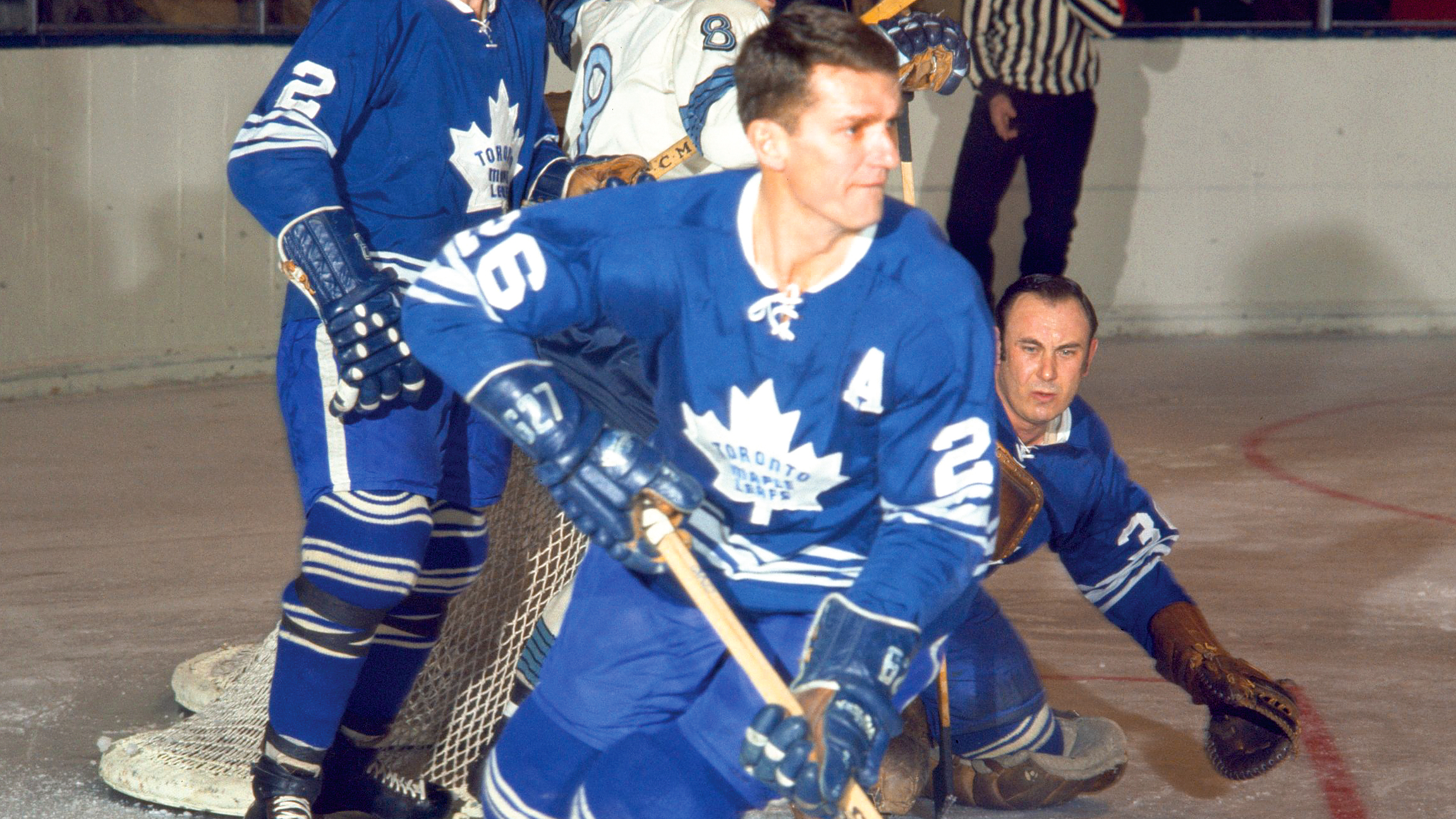

Each day from now until the Winter Classic, Sportsnet will count down the greatest Toronto Maple Leafs of all time.
When the Toronto Maple Leafs gathered for a team meal, Allan Stanley behaved essentially the same way he did on the ice; the dependable defenceman would wait, watch, then act. During the game, Stanley eyed opponents and played the angles with an acute precision that completely compensated for the lack of foot speed that led to his “Snowshoes” nickname. Around the dinner table, he observed trusted teammate Bob Baun, certain his fellow blueliner wouldn’t lead him astray. “He’d let me order, listen to what I had to say and then just say, ‘Me too,'” Baun recalls.
The technique was typical of Stanley, a quiet, uncomplicated man who—though certainly capable of contributing offensively—was best known for his hold-the-fort brand of defence that allowed partner Tim Horton to push the puck up ice during Toronto’s heyday in the 1960s, a period that was also the best of Stanley’s career after he struggled for years to find a home in the NHL. One in a steady line of NHLers to come out of Northern Ontario, Stanley split the first decade of his career between New York, Chicago and Boston, asserting himself as a dependable—albeit not indispensable—soldier. In fact, he was run out of Madison Square Garden in the mid-1950s by fickle Rangers fans who made him a scapegoat for the team’s ongoing dreadfulness. But salvation finally came in the fall of ’58, when Toronto swung a deal for the 32-year-old just before the season began. The move invigorated Stanley, who led all NHL defencemen with 10 goals in 1959–60 and put together a career-high 35-point season in 1961–62. The production was obviously welcomed, but Stanley was defined by rock-solid defensive skills built on an exceptional economy of motion. “He didn’t move too fast, but he was smart as hell,” Baun says.
His sluggish skating ensured the six-foot-one defender wasn’t about to go chasing opponents all over the ice, but like a lion that understands every animal eventually has to make its way to the watering hole, Stanley would stalk the prime scoring areas, wait for his man, then pounce. “He’d go right for that post in a straight line and eventually the guy had to come back to him,” says former teammate Ron Ellis.
Stanley’s sturdy play during Toronto’s dynastic run in the 1960s made him a Leafs legend, but had he actually gone on a fishing trip he was originally scheduled to take, the blueliner would occupy an even bigger, much more tragic place in team lore. The Leafs’ championship in 1962 not only represented the first of four Cups won by the team in the decade, it marked the first time the Maple Leafs had ruled the NHL since 1951, when defenceman Bill Barilko scored the Cup-clincher in overtime against Montreal. The story of what happened to Barilko mere months after that goal is common knowledge throughout the hockey world, but less known is the fact that Stanley originally thought he would be joining Barilko—whom he knew from his youth in Timmins, Ont.—and Dr. Henry Hudson on that ill-fated fishing trip. As it turned out, Stanley wasn’t around when final plans were firmed up and, ultimately, wasn’t on board when the single-engine Fairchild piloted by Hudson crashed.
Barilko’s remains went undiscovered until six weeks after the Leafs clinched that Cup in ’62. Stanley was one of the pallbearers later that summer when Barilko was finally laid to rest and, in a sad bit of symmetry, he performed the same sombre task for a Leafs legend 12 years later, when he took his last turn beside Horton. As tough as those two days must have been on Stanley, they speak to how entrenched he was in the Maple Leafs family, a kin whose support helped him flourish like never before. “That was the big reason he did so well in Toronto,” Baun says. “He was appreciated.”