
Each day from now until the Winter Classic, Sportsnet will count down the greatest Toronto Maple Leafs of all time.
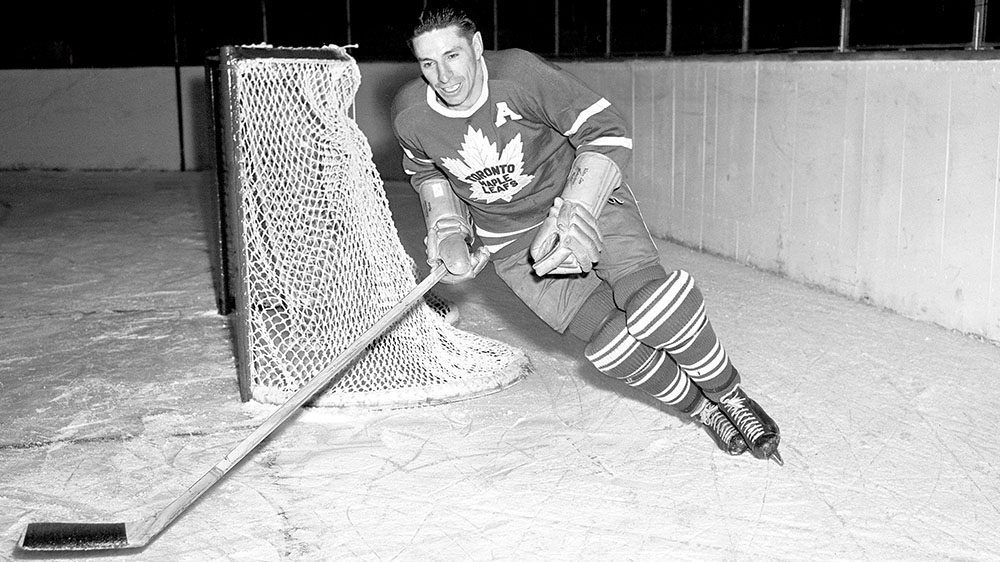
The game was keepaway, and coach Hap Day liked to end practice with it. He’d put three guys in a faceoff circle with a single puck and let them battle. Howie Meeker and Joe Klukay often ended up as the unfortunate wingers paired with Max Bentley, meaning there was a good chance neither of them would touch the puck. “Max would dipsy-doodle around in there and laugh like hell,” says Meeker, chuckling. “Joe and I would chase him around a bit, then we’d just laugh and shake our heads.” Bentley wasn’t called “The Dipsy Doodle Dandy from Delisle” for nothing: The undersized Saskatchewan farm boy regularly stickhandled through entire teams at top speed. “You’d never seen anything like it,” Meeker says. “What a hockey player.”
The youngest of 13 kids, the five-foot-nine, 158-lb. Bentley learned from his dad that he wouldn’t get hurt if nobody could catch him. So he developed the speed and wizardry with the puck that made him one of the NHL’s best playmakers. Bentley had a wicked wrist shot, too, from forearm strength he credited to hours spent milking cows on the farm. He had won two scoring titles and the Hart Trophy by the time the Toronto Maple Leafs landed him in 1947. In what remains one of the most significant trades in hockey history, Toronto unloaded a whole line’s worth of players to get Bentley, along with prospect Cy Thomas, from Chicago. The gamble paid off: The next four years, the Leafs won three Stanley Cups.
In Chicago, Bentley starred on the famed “Pony Line” with older brother Doug, and though his production in Toronto wasn’t what it was with the Hawks, Bentley was an important part of a Maple Leafs lineup—a star among stars—that gave him a chance to win. His arrival in Toronto gave the Maple Leafs the NHL’s deepest trio down the middle—so good that Bentley centred the third line in 1947–48, behind Syl Apps and Ted Kennedy. “Imagine those three on one team,” says Meeker of the trio of Hall of Famers. “I could have played goal and we still would have won the Cup.” Bentley’s 48 points his first season in Toronto ranked second-best on the team, next to Apps. By a mile the most productive third-line centre in the NHL, fifth overall in points and goals. By his third season with the Leafs he led the team in goals, and in 1950–51, his 62 points ranked third in the NHL. “Offensively, he could make the puck stand up and sing,” says former Maple Leaf and fellow Hall of Famer Red Kelly. “He had that kind of ability.”
Bentley was a key figure during his third and final Cup run in Toronto in 1951. His 11 assists and 13 points in the playoffs ranked first on the Leafs, tied with Maurice Richard for first overall. Perhaps his best dipsy-doodling came in the dying seconds of game seven of the final against the Canadiens. Toronto was down 2–1 and had pulled goalie Turk Broda. Bentley deked into the slot to set up the tying goal, sending the game to OT and setting the stage for Bill Barilko’s legendary winner.
Bentley retired in 1953 after a stint with the New York Rangers. He remains one of the most electrifying players the NHL has ever seen. Twenty-five years after his retirement, a kid named Wayne Gretzky entered the NHL, and the man now known as The Great One initially drew comparisons to Max Bentley. The Dipsy Doodle Dandy from Delisle was that good.