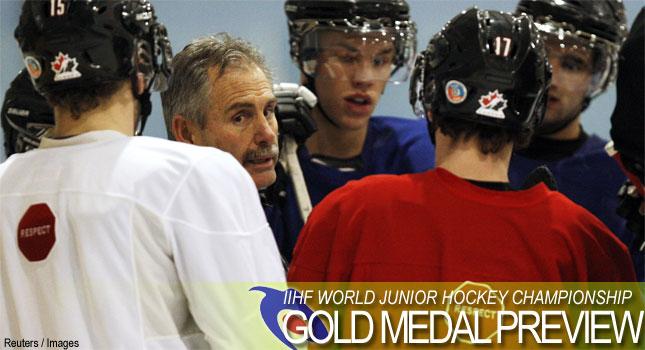

A win for Canada on Tuesday night against the U.S. will not only avoid the pain of losing to its closest rival, but will also set the mark for most gold-medal victories in tournament history with 16.
The Americans are undoubtedly the underdogs, a role that suits them just fine.
The Canadians defeated the Americans 5-4 on New Year’s Eve in the final round robin game between the two to determine the winner of their pool. Canada came back from a two-goal deficit to tie the game late before winning in a shootout.
Historically, an early lead is the kiss of death when these two countries meet. In 2004 Canada led 3-1 going into the third period before the monumental collapse that allowed the U.S its only gold-medal victory in the tournament.
The Americans scored three unanswered goals in the third period of that game, the last coming on a now infamous play. With Patrick O’Sullivan attempting to reach a loose puck, Canadian goaltender Marc-Andre Fleury left his crease to clear the puck out of harms way, but it ricocheted off his own defenceman, Braydon Coburn, and into the net.
But the rivalry has never been short of drama.
Jonathan Toews and Carey Price were difference-makers in Canada’s thrilling semi-final win over the Americans in 2007, where Toews scored three times in the shootout. The United States led 1-0 before Luc Bourdon tied it with less than eight minutes remaining.
Canada went on to beat the Russians, 4-2, to capture its third-consecutive gold in 2007.
The Canadians came back from a 3-0 first period deficit a year ago during a round robin contest, eventually winning 7-4. This year, the United States led 4-2 early in the third period before falling in a shootout.
As a result of the loss, the Americans played an extra game against the Finns in the quarter-finals before upsetting the favoured Swedes in Sunday’s semi-final.
For Canada to win: There’s no point in understating the obvious: Canada needs to take better care of the puck. Canada nearly handed the game over to the Americans with mental mistakes and poor puck possession in their round robin meeting.
The one aspect Canada may have underestimated is the speed of the Americans and the relentlessness of its forecheckers. Canada’s defensive core had far too many turnovers, many of which led to breakaways and scoring chances. Better care of the puck will go a long way in achieving Canada’s goal of another gold-medal win.
Many players struggled against U.S.A. in the first meeting, which should serve as additional motivation. Ryan Ellis and Alex Pietrangelo, who scored the tying goal on a pretty shorthanded goal, struggled through most of the game. Both players possess the ability to control the pace of the game and are known to their ability to handle the puck.
The wildcard is the play of special teams. Canada surrendered two shorthanded goals in the first meeting, while the Americans also felt the effects while up a man on Pietrangelo’s goal. Canada needs to create space in front of goaltender Mike Lee and find a way to utilize the hard and heavy slapshot of Ellis. Since U.S.A. does not boast a big and intimidating defensive presence, the Canadian forwards should have the ability to create traffic near the net.
Goaltender Jake Allen will have a lot of pressure on his shoulders. The consensus starter dating back to last season, Allen is known for carrying his team and stealing games. He was not at his best on New Year’s Eve. His confidence and demeanor will be huge in determining the outcome of the game.
For U.S.A. to win: A repeat performance from the first meeting could bring different results for the Americans this time around. If nothing else, U.S.A. exhibited some doubt in Canada with their impressive performance, as they know they can compete with them.
The speed of this team is its bread and butter. Team speed enables the U.S. to carry a quick transition game, which produced many scoring chances. The only problem was that the Americans failed to make Canada pay for many of its errors. Since Canada will undoubtedly improve in this area, U.S.A. will need to capitalize on Canadian mistakes.
There is noticeable skill up front and the Americans boast snipers in Jordan Schroeder and Jeremy Morin. Schroeder is a gifted scorer with a lightning-quick release while Morin boasts pin-point accuracy. The U.S. doesn’t create as much traffic near the crease, but has the shooters to finish chances.
Although the team that has had the lead historically doesn’t come out on top, it’s hard to argue the merits of a lead. After nearly beating Canada the first time, an early U.S. lead could make things awful interesting. The Americans have solid defensive forwards, particularly Tyler Johnson, and should be better in defending a lead.
After watching from the bench the other meeting, Lee will be thrown in the fire in this contest. His rebound control isn’t as strong as his younger teammate, Jack Campbell, but his athleticism enables him to make saves he shouldn’t make. It’s been argued that Campbell is the better of the two, so Lee will be looking to prove his coach made the right decision. His play, for better or worse, will likely be the determining factor in this game.