
The world junior championship is a hard tournament to win even with a healthy team. The degree of difficulty goes way up with an injury or two.
Canada’s road to a gold medal was made more daunting with a 3-1 loss to the U.S. on the final day of the opening round at the Air Canada Centre in Toronto. If form holds and the universe unfolds as you’d expect in the quarterfinals, the second-seeded Canadians will face Sweden in the semifinals. And the Swedes look like the best team in the tournament.
Still, you could say, “You’d have to beat them to win gold, so why not get it done in the semis?" It’s a pretty flimsy rationalization but if you buy it, knock yourself out.
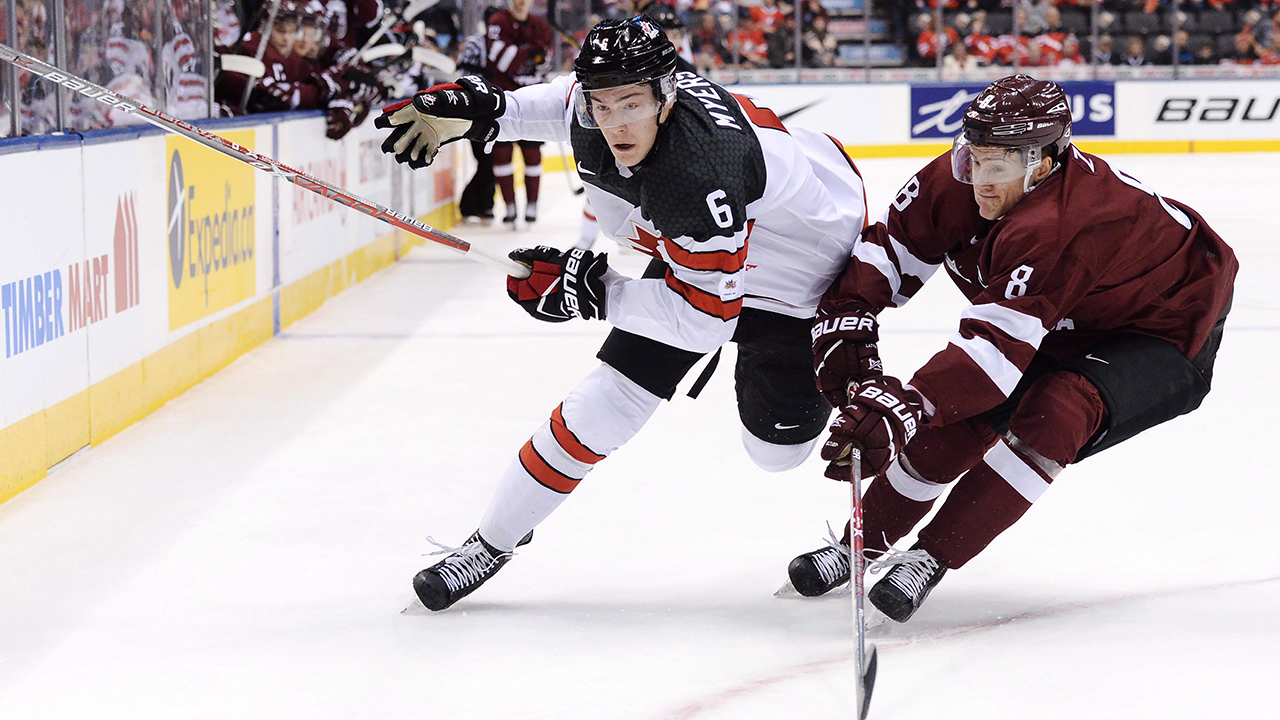
Far more troubling for the Canadian side, though, is the potential loss of defenceman Philippe Myers. The Moncton, N.B., native had been one of the tournament’s feel-good stories.
Somehow NHL scouts managed to miss Myers in his draft year—even though at 6-foot-5 he should draw anyone’s attention when he’s on the ice or off.
Through the first three games of the opening round, Myers partnered with Thomas Chabot on what was Canada’s best and most heavily used blue-line pair. And against the U.S. the story started out that way—in the first period Chabot was on the ice for a team-leading 11 shifts and a prodigious 9:15 in ice time (a good chunk of it coming at the point on the Canadian power play). Myers was second among the rearguard in ice time with nine shifts, logging just under six and a half minutes (losing a shift when he was sent to the box for a dubious-looking kneeing penalty).
Regardless the situation, up a goal, down a goal, Chabot and Myers were the two that coach Dominique Ducharme wanted out there.
Through exhibitions and three tournament games the mix on the Canadian blue line has been a pretty fragile one. Chabot and Myers were great in tandem while Jake Bean and Noah Juulsen established themselves as a second pair. After that, however, there was a significant fall-off. The third pair, Dante Fabbro and Kale Clague, didn’t inspire the same level of confidence. The seventh d-man, Jeremy Lauzon, a teammate of Myers with the Rouyn-Noranda Huskies, was lightly used and looked shaky.
Five minutes into the second period Saturday afternoon, that mix was trashed by Luke Kunin, the captain of the U.S. team. With Canada down two-zip and getting soundly outplayed, Myers chased a puck down along the boards behind Canadian goalie Connor Ingram. After getting a handle on it and moving it along, Myers left himself unprotected for an instant and Kunin jacked him. Contact was high. Was it a head shot? That’s a matter of interpretation. Ditto the question as to whether Kunin left his feet. No question, though, about the effect. Myers’ helmet caromed off the dasher and wall. It was not pretty. Play went down the ice on a delayed penalty call but Myers lay flat for a couple of breaths and then struggled to get to his feet.
As soon as Myers made it to the Canadian bench he was ushered into the dressing room and examined by team physicians. He had played his last shift of the night. It remains to be seen whether that will turn out to be his last shift of the tournament.
It was Kunin’s last shift of the night as well. The call on the play is one of those quirks of international play—five minutes for interference and a game misconduct. It might have been a charge or a headshot or, as Kunin said after the game, "just a hockey play." Kunin maintained that he had "no intent to injure" Myers, just to finish his check. That’s sort of like throwing fine china against the wall and saying you didn’t intend to break it.
Kunin wanted to hurt him, just not so bad that he gets penalized or tossed out.
Chabot scored on the power play that followed—it was in fact a 5-on-3 situation and he let a shot fly from the top of the circle to make it a 2-1 game. The Canadian teenagers made it close but no closer.
The rest of the game the Canadian blue line pairings were jumbled.
Myers is a right-hand shot and so the other starboard d-men wound up taking their place beside Chabot. Juulsen, the Canadiens’ first rounder in 2015, looked like the best fit—as expected. But then it’s a question of what to do with his erstwhile partner Bean.
Clague, a left-handed shot, took shifts on his wrong side beside Chabot. Clague lost edges and scrambled a couple of times—not the stuff that will put you in good stead in the medal round. Chabot and Clague were on the ice for the third U.S. goal, the only one scored at even strength in the game but they couldn’t be much faulted on it. While their attention was focused elsewhere, Jeremy Bracco, the Leafs’ second rounder from 2015, shook his man, Pierre-Luc Dubois, skated out from the corner with a body or stick on him and crashed the net, beating Ingram. Would Myers’ presence have made a difference on that play? Well, he couldn’t have hurt.
After the game Chabot said that he had talked to Myers but he wasn’t going to go into details about the injury. "I hope he’s back next game," Chabot said.
Chabot stayed on the team message that we’ll hear in coming days as the games go to Montreal. He said that any changes in pairings are going to work out with some practice time together. He can hope, I suppose. More likely, though, over the course of a couple of practices, Chabot has almost no chance of developing comfort beside Clague or anyone else equal to what he felt playing across from Myers.
The loss of Myers hurt Canada’s chances of coming back against the U.S. The loss of Myers for a game or two in the medal round will hurt even worse.