By Shannon Proudfoot
When sculptors from Madame Tussauds meet with a celebrity to create a wax doppelgänger, it’s usually the eyeballs that freak the famous out. Not Alex Ovechkin. A team of artists met the Washington Capitals superstar this summer, and when they pulled out a foam-lined metal case of acrylic eyeballs—complete with veins made of red silk thread—he plucked himself a pair, squished them into his eye sockets like a kid in a magic store and started mugging for the cameras.
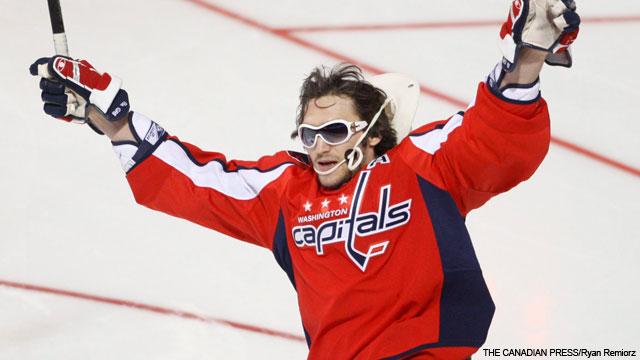
In a league where most players give the impression they’d rather have their face driven into the boards than deal with one more microphone or camera, Ovechkin comes off as the only one who would probably enjoy testing his comedic timing as host of Saturday Night Live. Since he blew into the NHL following the 2004–05 lockout, he’s livened up the joint with both his freak-of-nature on-ice talents and his flamboyant personality, willingly playing the clown in a class that badly needed one. He is the anti–Sidney Crosby—bombastic rather than humble, brash instead of low-key, saying and doing interesting things rather than the right things—and he’s been no less essential to selling the game. But now, with the gaudy offensive numbers he posted in his first five NHL seasons declining to mere mortal levels, his team faltering in the playoffs and the league relying on him for a personality injection, the NHL’s king has become something more akin to its court jester.
 Make sure to vote: The 9th Annual Sportsnet Canadian Athlete of the Year is underway. See if GSP can win a fourth-straight title. Vote here.
YouTube offers a perfect snapshot of Ovechkin’s dual brand. Alongside videos of his superhuman goals and the exuberant celebrations that appalled Don Cherry are his greatest hits from off the ice: behind the wheel of a utility cart barrelling down a back hallway of the Verizon Center, nearly decapitating himself and Mike Green on a loading dock door; hooting at his teammates and calling out, “Girls, where are you?” while darting around Capitol Hill on a Segway; spying two pretty young things on the big screen during the All-Star Game and offering a long sideways whistle like a man who’s seen something he likes on a car lot.
And then there are the commercials. He’s punked Crosby, played a Russian spy with Semyon Varlamov as accomplice, and mumbled his way through a car dealership jingle while requesting “some shots vodka.” Before he switched to endorsing Bauer this season, Ovechkin appeared in a series of weird CCM ads in which his disembodied head barked training advice from locker shelves and bowling ball bags at frightened-looking kids. This summer, he signed on to be the face of Mr. Big chocolate bars in Canada, starring in a string of even more trippy spots. In one, Ovechkin perches on a throne and intones, “To be a big deal like me, you have to make bad things good things,” before transforming a kid’s broken skateboard into a hot-rod piano with a geriatric seductress perched on top. “It’s clear that he’s being pushed to really be a personality,” says Hockey Central’s Nick Kypreos. “You almost feel like he has to make up for the guys that don’t have the personality to sell the game.”
But over the past year, there have been markedly fewer of those jaw-dropping goals to anchor Ovechkin’s on-ice reputation. After three straight 50-goal and 100-point seasons, Ovechkin racked up just 32 goals and 85 points last season, ranking him 14th and seventh in the league, respectively. In the first 12 games this season, he collected six goals and 13 points, putting him on pace for 41 goals and 89 points. His playing time is down as well; he’s never averaged less than 21 minutes a game, but he’s clocking fewer than 19 minutes a night this season. ‘Alexander the Great’ just doesn’t look like the same player.
There’s speculation that Ovechkin is haunted by two absent pieces of hardware: an Olympic gold medal and a Stanley Cup ring. His stacked Russian squad was expected to put Canada’s golden dreams in jeopardy at the Vancouver Olympics, but Team Canada tore into the Russians “like gorillas coming out of a cage” during a 7–3 quarterfinal dismantling, as goalie Ilya Bryzgalov put it. Ovechkin was virtually invisible in the game, and his normally gregarious character turned surly and reticent off the ice. A reporter who asked how he felt after the rout got only “What do you think? I’m disappointed” in response, and Ovechkin later shoved a Russian fan who turned her camera on him. He had to watch Crosby, his archrival, score Canada’s overtime winner and go home with a gold medal around his neck, less than a year after Crosby became the youngest NHL captain in history to hoist the Stanley Cup.

The Penguins had done away with Ovechkin’s Capitals in a seven-game quarterfinal series en route to their 2009 championship, laying the groundwork for what now looks like a playoff hex settling over Washington. The first-place Caps were finished off by the eighth-seed Montreal Canadiens in the first round the following season, and then swept by Tampa Bay last spring. As Washington’s captain and most talented player, Ovechkin has become both the symbol and spokesman for whatever is ailing a team that looks loaded on paper but keeps coming undone in the spring. “His legacy isn’t going to be about how many 50-goal seasons he’s had if Washington can’t get out of the second round of the playoffs,” says Kypreos. “I think he gets that.”
As pressure mounts on the Capitals to exorcise their playoff demons, the weight has settled mainly on Ovechkin’s shoulders. Questions about his ability to lead a championship team have piled on top of speculation about his own scoring struggles, and there have been whispers about nagging injuries and even his fitness level. He’s admitted to being so fixated on the playoffs that he came into training camp last season a little short of peak condition in the hopes of hitting his stride in time for the end of the season. That strategy didn’t pay off, so this year he ramped up his off-season training and came into camp leaner and stronger. “This is the year, it’s no more excuses and no more mistakes,” he told Sportsnet. “We’re mature players, experienced players, and we know how we have to play to win.”
But while his presence on the ice and on the score sheet is less electrifying than it once was, some argue that’s a sign of what’s right with his game rather than what’s wrong. The 22-year-old whose youthful exuberance and raw skill made him a dominating—and sometimes selfish—force of nature has become a 26-year-old who reins himself in to be part of a team and a system that’s supposed to get him closer to the Stanley Cup. And despite his relatively slim contribution to the box scores so far, his team is steamrolling opponents. The exasperation is audible each time Capitals GM George McPhee and coach Bruce Boudreau are asked what’s going on with Ovechkin. Both insist there is nothing wrong, and they cast his less-dazzling offensive numbers as a sign of his transformation into a more complete and ultimately more valuable player. “People are looking for some sort of revelation or something,” Boudreau told Sportsnet. “I think the biggest thing is he’s older, he’s more mature, I think the values are different.”
But the final minute of an early November game suggested things aren’t serene in Washington. With the Capitals trailing Anaheim by a goal, Boudreau sent out his third line along with Nicklas Bäckström as an extra attacker, leaving Ovechkin on the bench muttering a few choice words beginning with the letter F. The coach later explained that those players had simply been better that night and he believed they could get the job done; and indeed, Bäckström scored both the tying goal and overtime winner. The next day, Ovechkin said he was “pissed off” to be relegated to the bench at such a crucial point in the game—a position he figured he hadn’t been in since he was about 14 years old. He was careful to say the right things about the stellar play of his teammates afterward, but he also smirked that his outburst made for entertaining TV.
So while his coaches and many analysts agree that this new, lower-scoring and more responsible Ovechkin will ultimately be a better Ovechkin, the man himself doesn’t sound convinced. His trademark enthusiasm still roars to life when his team scores, but he seems frustrated and apologetic about his own performance when the inevitable questions arise about what happened to that 65-goal-a-season beast who once stalked the ice. Ovechkin offers up the right soundbites, saying it’s all about winning games and his team is doing that with him fading into the pack, but it doesn’t sound like he believes it—and he’s never been one to cough up the party line in tidy one-liners anyway. If everyone is right and he’s simply adjusted his game to the realization that his name will always carry an asterisk among the greats if he never wins a Stanley Cup, it’s still tough to imagine that a guy who choreographs his own milestone goal celebrations would be satisfied as a point-a-game player. The swagger and sly humour of the NHL’s in-house entertainer have always been backed up by the incandescent talent that’s made him the most exciting player on the ice; a jester who doesn’t know any magic tricks isn’t much fun for anyone, including himself.
Special magazine trial offer: Sign up for four FREE issues of Sportsnet magazine and get a discounted price on a subscription. Satisfaction guaranteed. Order now!
In late October, back at Madame Tussauds, a wall slides aside to reveal Ovechkin crouched beside his wax likeness in an identical faceoff pose. Wax Alex’s head is a bit flatter on top, like Frankenstein’s monster, and the real Alex has a fresh row of stitches and a puffy eyebrow from a misfire in practice, but both sport the same cheek-warping, gap-toothed grin. He’s the only NHLer aside from Wayne Gretzky to be immortalized in wax, and with the audience laughing and the cameras chattering, Ovechkin leans over again and again to peer into his own face. A reporter asked who he would pick if he could teach any politician or celebrity to play hockey. He flashed a wide grin and answered, “A hot actress,” earning another round of laughs. The former scoring king is still looking to regain his throne, but the court jester never disappoints his audience.