The Ottawa Senators aren’t going anywhere, says NHL commissioner Gary Bettman.
Bettman, along with deputy commissioner Bill Daly, was in Ottawa Wednesday to testify at the Parliamentary subcommittee on concussions in sport. This was the final day of testimony and a written report on the findings will follow.
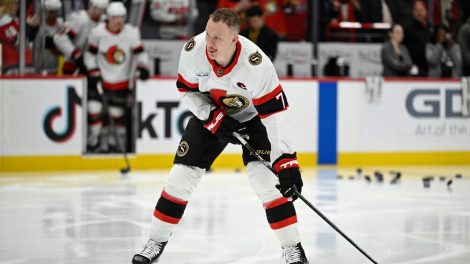
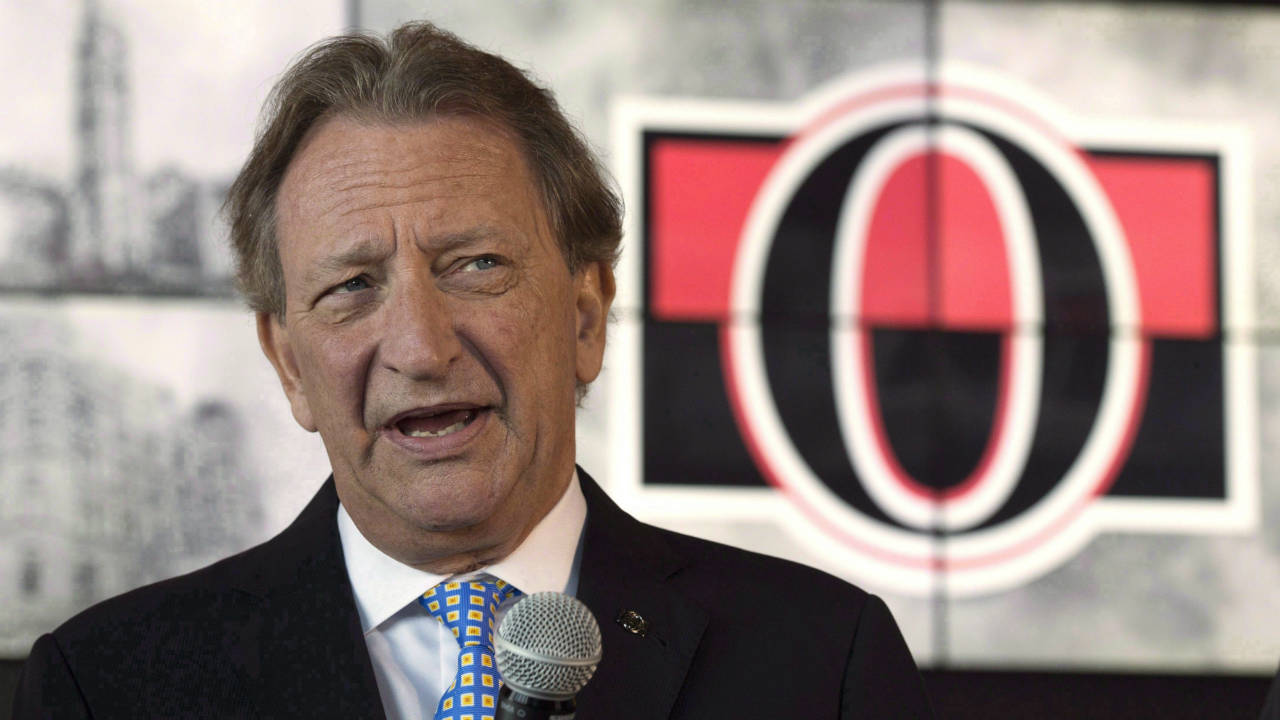
In a brief scrum following the testimony, Bettman answered several questions, including on the state of the Senators, who are coming off a last-place finish, diminished attendance and concerns in the community about the ownership of Eugene Melnyk.
Bettman was asked if the Senators are in financial difficulty.
“Not that I’m aware of,” Bettman said.
Asked if there have been “suitors” expressing interest in buying the hockey club, Bettman said: “The team is not for sale.”
The commissioner grew more animated when someone asked him if the Senators would move.
“NO!” Bettman shot back.
A plan to move the Senators — not out of Ottawa, but into a downtown location known as LeBreton Flats — fell apart when the partnership of Melnyk and other business interests, including John Ruddy of Trinity Developments, couldn’t agree on the ultimate plan.
Melnyk has said he might pursue another central location but has also suggested he’s more likely to hunker down in Kanata, where the team has been since moving into a new arena in 1996. That rink is now in need of upgrading, and Melnyk has said he might expand on the property.
Bettman had no further news on that front.
“I believe that Mr. Melnyk is looking at all of his options and deciding how best to proceed with an eye toward keeping the team in Ottawa,” Bettman said.
And you’re confident in Melnyk, Bettman was asked directly?
“Everything I hear and every interaction I’ve had with Mr. Melnyk would lead me to no other conclusion,” Bettman said.
The NHL is believed to have been involved in helping Melnyk hire a new president of hockey operations to provide guidance to general manager Pierre Dorion. Dorion has not had a senior advisor since the passing of former Senators GM Bryan Murray last summer.
Bettman did not bite on an insinuation that the NHL would have a hand in bringing in a president of hockey operations for the Senators.
“It’s a process that Mr. Melnyk is going through,” Bettman said, “and while we occasionally consult with clubs, ultimately it’s ownership and managements’ final decision.”
MARCHAND WARNED
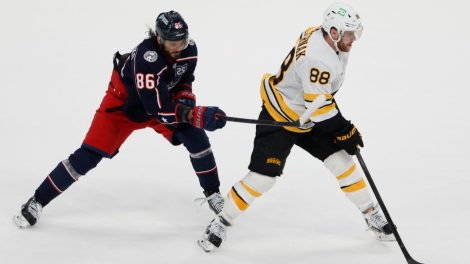
Both during the Parliamentary questioning and afterwards in the scrum, Bettman was asked why Brad Marchand of the Boston Bruins was not suspended for his sneaky punch to the head of Scott Harrington of the Columbus Blue Jackets on Tuesday. Marchand came around from behind Harrington, who was kneeling on the ice, and popped him in the head.
“There should have been a penalty in the game,” Bettman said, “but a missed penalty doesn’t rise necessarily to the level of a suspension — but he was warned.”
[relatedlinks]
IN DEFENCE OF FIGHTING
Bettman’s testimony and exchanges with the committee were mostly civil. The commissioner defended his league’s history of protecting players and in providing concussion protocol for players suspected of having brain trauma.
Bettman cited Rule 48, which bans hits to the head in which the head is the primary site of contact, but argued that a ban of incidental hits to the head would be a step too far. He used the parable of a tall player (think Zdeno Chara) trying to hit a player of Bettman’s height without contacting his head in an attempt to body check Bettman.
“There would be no more body checking in the game,” Bettman said.
The liveliest exchange involved committee member and physician Dr. Doug Eyolfson, who argued that there should be no fighting in the NHL. Period.
Bettman trotted out the argument of fighting as a deterrent to other crimes of passion (presumably stick work), and said any change in the rules to fighting would have to be agreed to by the Players Association.
The players, Bettman said, don’t want fighting gone because it helps protect smaller, skilled players.
Dr. Eyolfson shot back:
“Players, sir, don’t make the rules.”
Bettman says his research indicates just 2.6 per cent of concussions are related to fighting. And fighting itself is evolving “organically,” said the commissioner.
“In the last four years, incidents of fighting are down 54 per cent,” Bettman said. “There is less fighting in the NHL than in any other (hockey) league in North America.”