
We’re down to crunch time now in the 2018-19 NHL regular season, with only a handful of games left for each team, and the playoff picture has narrowed considerably.
Gone are the pie in the sky ideas that Edmonton, Chicago, or Vancouver might make a run in the West. The last two wild card spots in the conference are a battle between four clubs now: the Dallas Stars, Arizona Coyotes, Minnesota Wild and Colorado Avalanche.
Over in the East, the race has been fairly clear for a long stretch now. A few weeks ago it appeared that the Pittsburgh Penguins were going to be in a four-team stretch drive, but a red-hot streak has put them four points clear of the wild card. That leaves the East’s wild card spots up for grabs between the Carolina Hurricanes, Columbus Blue Jackets and Montreal Canadiens.
[snippet id=3816507]
A lot of what’s left in the season comes down to the math of how points are dolled out in the NHL. It’s easy to look at the Blue Jackets and think that since they’re only a few points out with eight games left, there’s enough time to make up ground. However, you also have to account for how many points the Canadiens and Hurricanes are going to accumulate over that time.
Using season-long points percentages for each team, it’s easy enough to estimate how many points should be accumulated over the remainder of the season, and from there we can estimate how many points each team would need, should their opponents play at their season averages.
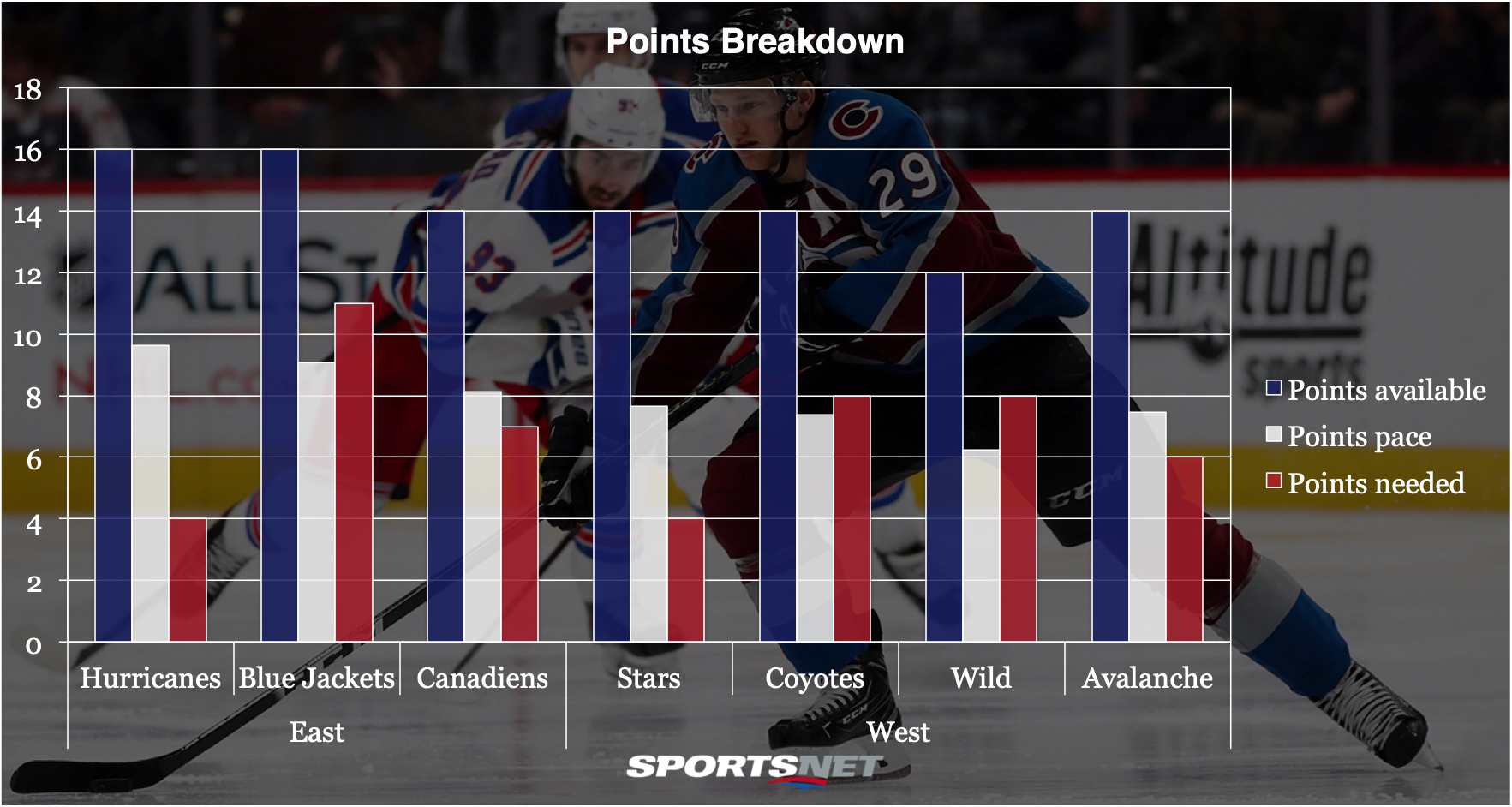
What jumps out right away is that the Hurricanes are essentially a lock at this point. Assuming all tiebreakers stay the same, Carolina needs to collect four points of 16 available in order to essentially clinch a spot as at least the second wild card team in the East.
Dallas is in a similarly strong position; the Stars need just four points as well, though they have just seven games to do so. Still, you would expect getting four points of an available 14 should be a relatively easy task for Dallas.
The Avalanche and Canadiens need six and seven points, respectively, and based on how they’ve played so far this season each team should be able to hit those marks in the games they have remaining. Both teams hold the last wild card spot in their respective conference and control their own destinies. If they play well enough, they’ll make it in.
The teams that are in tough here are the Blue Jackets, Coyotes, and Wild. Of those teams, Arizona is in the strongest position; they need to play just over a half-point better than their season average. The Blue Jackets and Wild both need to add an extra win over their points pace in order to make it in.
How things shake out over the last stretch of the season is going to have a lot to do with the strength of schedule each team has left. We can contrast that with how they’ve played this season, as well as by how they’ve played over the last 25 games to get a more recent idea.
We could use a variety of statistics to compare these teams, but we have almost a full season’s worth of data, and we know that what it’s all going to come down to in this last stretch is goals. There’s not enough time to count on regressing to any means, so let’s focus in on outscoring opponents in all situations.

Once again, Carolina has this on lockdown. The Hurricanes have scored 60 per cent of the goals in their past 25 games, and all season long they’re the only team of this group over 52 per cent. Their opponents are tougher than average, but I can’t see it mattering here. I think it’s very safe to say Carolina will make the playoffs.
Dallas hasn’t been playing nearly as strong as Carolina, but the Stars have improved over their season average of late, and their strength of opposition is below average. They’re probably as close to a lock without clinching as you can get.
On the other side of the table are the Minnesota Wild, who face the second-strongest opposition to end their season of any team fighting for a spot, and they’ve been downright horrible over their last 25 games. I doubt there’s enough time to turn that ship around, so they’re highly unlikely to make it.
The Avalanche face higher than average competition by a little bit, but they’ve been a strong team all season and have been even better lately. That makes them by far the favourite to secure the second wild card spot in the West.
[snippet id=4269767]
Arizona has improved lately as well, but they’re still getting outscored, and even an average level of competition from opponents probably isn’t enough to overtake Colorado in the next couple weeks.
While they hold a three-point advantage, the Canadiens face a tough road to end the season. Of their seven remaining games, only one team has a negative goal differential, and only two have a lower goal differential than Montreal. Luckily for them, one of those teams is the Blue Jackets. The Canadiens have been playing well of late, but this is still a tighter battle than some believe.
Luckily for the Canadiens and their fans, the Blue Jackets have fallen off big time recently, because aside from having a game in hand, Columbus also has a far weaker schedule than their rivals from Montreal.
Only four of the Blue Jackets’ remaining eight opponents have a positive goal differential this season, and one of those four is Montreal, who is essentially dead-even with Columbus’ own season-long goal differential.
If the Jackets are to beat every team with a negative goal differential they face, and take that game against Montreal in regulation, they have a real shot at squeaking in. The problem is, they just haven’t played well lately. This is the race to watch though, because I think everything else is close to settled.
[relatedlinks]