PENTICTON, B.C. – When the Vancouver Canucks were here a year ago for their annual prospects tournament, rookie Brock Boeser was unprepared for the avalanche of questions about his skating.
Perplexed, he asked team officials why everyone was asking about his mobility.
“I told him if anyone questions your skating, send them to me,” Canucks player development director Ryan Johnson recalled Friday. “He just laughed.”
Turns out Boeser’s skating wasn’t such a big issue after all. It improved during the season, as often happens with 20-year-olds. The winger sniped 29 goals in 62 games, co-led Vancouver in scoring, was named MVP of the National Hockey League All-Star Game and a Calder Trophy finalist, and he is continuing preliminary discussions with the Canucks about a contract extension that could pay him $7-8 million a season.
Reporters stopped asking about Boeser’s skating a while ago.
This was important to remember on Friday because Canucks rookie Elias Pettersson became agitated about questions regarding his weight and strength, which seem relevant while he embarks on an NHL career as one of the top-rated prospects on the planet.
[relatedlinks]
A lanky centre who smashed long-standing records last season while winning the Swedish Hockey League scoring race and MVP award as a teenager, Pettersson refused to say how much he weighs and is clearly fed up with questions about it. This was just his second day being interrogated by NHL media.
“I think those (questions) would be already answered after last season,” the 19-year-old said, referring to his 56 points in 44 games for the Vaxjo Lakers. “I’ve always been smaller growing up. I’ve always been the lightest on the team. I’m used to being the smaller guy, not having strength and the weight on my side. But I’m learning.
“I play with a lot of speed and I try to be fast. Say if I would go up 10 pounds, just put on 10 pounds of muscle, that wouldn’t be that much of a success for me, I think. It’s going to take more time for me than other guys to put on some weight and muscle, but I’m aware of that and working hard to become bigger and stronger.”
At one point, pressed to divulge his weight, Pettersson deadpanned: “225.”
He didn’t specify whether those were pounds or kilograms, but either would be a gross exaggeration for a player who was six-foot-two and 165 pounds when Canucks general manager Jim Benning drafted him fifth-overall 15 months ago. His weight is likely somewhere in the 170s now.
After Pettersson’s spectacular draft-plus-one season, he looks like the most talented player from the 2017 lottery and worthy of recognition as one of the best two or three prospects outside the NHL.
“I’m used to pressure,” he said after Friday’s morning skate. “I like challenges. When there’s a lot of pressure on me, I get more focussed and I want to show that I can play good every time. Sometimes it’s going to be bad games for me, but I will always work harder if I have a bad hockey game.”
In every sense but the literal one, Pettersson is too big to fail as a Vancouver Canuck. The franchise, at a 20-year nadir, desperately needs Pettersson’s skill and scoring and marketability. With a heavy shot and sublime hands, he is the most gifted Canucks prospect since Pavel Bure arrived in Vancouver in 1991.
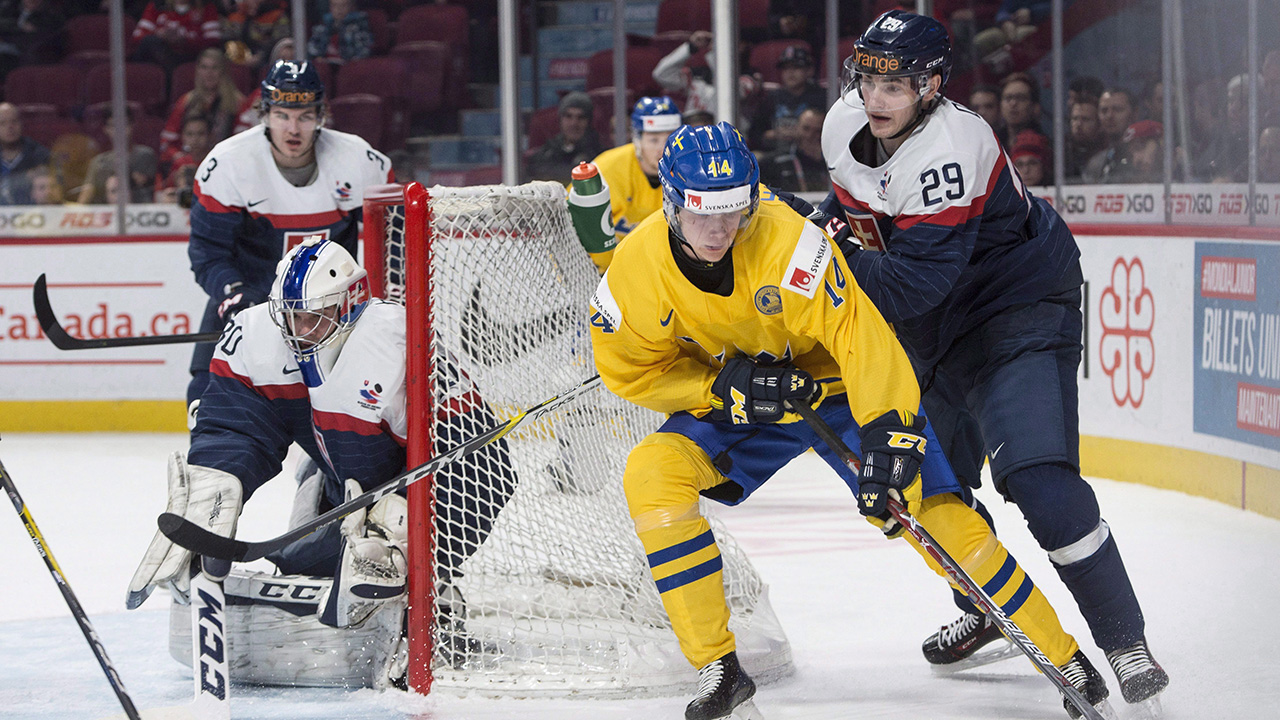
The greatest Canucks ever, Swedish twins Daniel and Henrik Sedin, have just retired and Pettersson is being counted upon to help fill that gaping void at the top of the lineup. Beginning with games here Friday and Sunday against the Winnipeg Jets’ prospects, Pettersson already projects into the Canucks’ opening-night lineup on Oct. 3.
All he has to do is show that he’s strong enough to compete. Pettersson’s secret weight is unimportant compared to his strength and ability to battle for the puck at the NHL level.
“It’s something that Elias and I have talked extensively about,” Johnson said. “Do we want him to continue to get naturally stronger? Yes. But I’ve said to Elias don’t let anyone get you caught up in a certain number as far as weight. If he puts on 15 pounds (too quickly). . . we’re making him less mobile. We’re making him bulky and affecting that special skill set that makes him so good. If he puts on two pounds in a six-month period, but he’s stronger and feels better, we all win. This isn’t the 1980s.”
Canucks strength and development coach Bryan Marshall visited Pettersson in Sweden last season, and minor-league strength and conditioning coach Ken Hetzel spent time with Pettersson and Jonathan Dahlen, another good Canucks prospect, this summer.
“Honestly, with a player like Elias and all that he’s doing, the development plan is basically to stay out of his way,” Johnson said. “He’s a competitor. He’s got a heavy stick. He loves puck battles and plays in hard areas. But sometimes his quickness is his best asset. We don’t want to take that away from him.”
[snippet ID=3322139]
Pettersson said Friday that “absolutely” he is stronger than when he was drafted and Johnson confirmed this, saying his improvement in strength is “immense.”
“I feel very ready, and I’m very excited to get things started, too,” Pettersson said.
He said the biggest challenge is not his thin build but the narrower North American ice.
“The Canucks have had some bad years recently, and I will be more than happy to help them turn that around,” Pettersson said. “I’m not saying I promise I will do it, but I will do my best.”
Boeser ended discussion about his skating by scoring in the NHL. Pettersson can kill interest in his weight by doing the same.
“It’s been that way all the way up (in hockey), people are saying he’s too small,” Dahlen said of his former Swedish linemate. “He’s not apparently. He’s taken every level by storm. I just think there’s too much talk about his weight. I’d rather look at his skill than his weight.”