THE CANADIAN PRESS
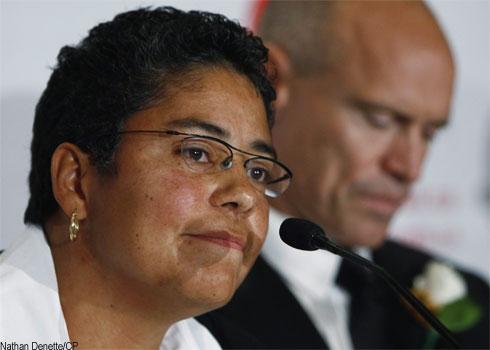
She’s had weeks to get used to the idea, but Angela James still feels overwhelmed by her upcoming induction into the Hockey Hall of Fame.
“I sit back and think ‘Why is this happening to me?”‘ the former Canadian women’s team forward said in a recent interview from Toronto. “I’m just a kid from the projects. I’m just a goof. That’s what I tell my friends. They say ‘You’re not a goof’ and I say ‘I’m a goof.’
“I think it just can’t get any better than this. The heart rate keeps elevating the closer we get to this day, that’s for sure.”
James and former U.S. women’s team captain Cammi Granato will be the first women inducted into the Hall in downtown Toronto on Monday.
Former NHL player Dino Ciccarelli of Sarnia, Ont., will also be inducted. Detroit Red Wings executive Jim Devellano and the late Daryl (Doc) Seaman, one of the founders of the Calgary Flames, will enter in the builder category.
The Hall of Fame established separate induction criteria for women this year, which paved the way for James and Granato. A maximum of two women, in addition to up to four men, can be inducted as players each year.
The Hall’s all-male 18-member selection committee had different eras of women’s hockey from which to choose their first women. They selected players representing the years just before and during the sport’s entry into the Olympics.
“We did whatever it took to get our game on the map,” James said. “If that meant we had to kick and scream and fight and do whatever it took to get to where we wanted to go, that era of girls, we did that.”
James, 45, was a controversial omission from Canada’s 1998 Olympic women’s team. The power forward from Richmond Hill, Ont., was a dominant player earlier that decade both domestically and internationally.
She was top scorer for eight seasons and MVP for six in the Central Ontario Women’s League. James was also MVP at eight Canadian women’s championships. She recorded 34 points for Canada in 20 games over the first four world championships in 1990, 1992, 1994 and 1997.
Granato was front and centre in her sport’s debut in the ’98 Olympics. She was the American captain when the U.S. won the first Olympic gold awarded in the sport.
The 39-year-old from Downers Grove, Ill., is the only woman to participate in each of the first nine women’s world championships sanctioned by the International Ice Hockey Federation. Granato remains the all-time leader in goals and points for the U.S. in world championships.
James started out playing hockey on outdoor rinks in Toronto’s Flemingdon Park. She recalls skating with a deaf man and mimicking his stride as an eight-year-old. Then she would go to the indoor arena and watch some of the women who played then.
“It was a great area to grow up. Everybody was poor and on welfare kind of thing,” she recalled. “We would find a pair of skates as best as we could. I started off in boys’ house league there and from that point on kept playing year after year.”
Her introduction to hockey was different than that of Granato, who grew up with older brothers who had hockey scholarships to U.S. schools. Tony Granato went onto play and coach in the NHL.
The Granato boys shared their knowledge with their younger sister, whose secret dream was to play for the Chicago Blackhawks. She remembers Tony returning from a U.S. development camp with a weight vest and showing her how to do plyometrics in their yard.
“I had it right at my fingertips all the time,” she said. “We would make highlight videos of goals and would watch Wayne Gretzky’s top 10 goals.
“They treated me like an equal. I was a little sister, but I was also a hockey player and they accepted that and really helped me grow as a player.”
Like James, Granato is still stunned by her induction. After years of watching men go into the Hall, she can’t believe her face will hang alongside players such as Gordie Howe and Bobby Orr.
“The Hockey Hall of Fame was made for legends,” she said from Vancouver, where she lives with husband and former NHL player Ray Ferraro. “It was a place you go to visit to see the legends of hockey, your idols.
“To know you are being inducted into that club is just hard to wrap your head around. It gives me chills to think about it.”
Granato knows some of the disappointment James felt about not playing in the 1998 Olympics. Coach Ben Smith’s decision to leave her off the 2006 Olympic team was shocking, especially because the Americans were upset in the semifinal by Sweden and settled for bronze.
Granato considered returning to the national team when Mark Johnson took over as coach. She was entering her late 30s by then and had to decide between having a second child or continuing her hockey career. Granato chose to have another baby. She and Ferraro have two sons, one three and the other almost a year old, and Granato is also stepmother to Ferraro’s two sons.
The hockey she plays now is on her knees with mini-sticks as three-year-old Riley aspires to play the game.
“And I’m really good,” Granato said. “I shoot the puck really hard.”
James is a sports co-ordinator at Seneca College, where she has worked for 24 years. She has three children, including twins, with partner Angela McDonald.
James has coached her 11-year-old son in minor hockey. Her five-year-old twins were in initiation hockey last winter. James still plays Monday night women’s pick-up hockey with “the 40-and-over club,” as she calls it.
She and Granato will forever be joined as the first women who entered the Hall. They recall the grudging respect they had for each other in their playing days, as there are few rivalries as fierce as Canada and the U.S. in women’s hockey.
“She was the one player that when she was on the ice, you knew it,” Granato said of James. “She was pretty much unstoppable.
“I was intimidated by her. I remember beating her on a faceoff, which is tough to do. I turned around and thought ‘Yeah, I just beat her’ and whack, right across the back of my legs. She made me pay. She did not like to lose.”
Meanwhile, James recalls having her head on a swivel to keep track of the fleet-footed, skilled Granato.
“That was the one player we had to key on and make sure she didn’t get loose,” James said. “She was definitely their leader. She was the backbone, the catalyst of the U.S. team during the time I was playing against her.
“To say the least, we didn’t like her. We had to chop her down a little bit every chance we got.”