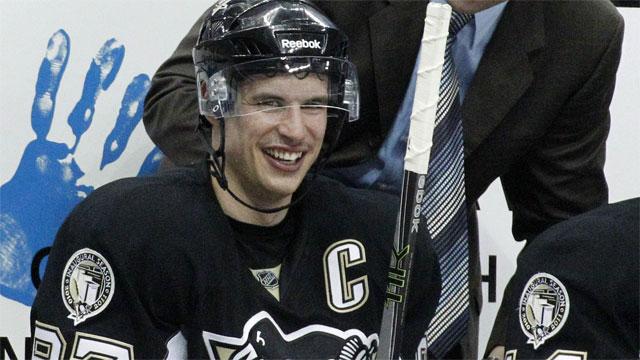

While agent Pat Brisson works the phones in hopes of landing Sidney Crosby a spot in Europe, another of his other prized clients, Claude Giroux, has a doctor’s appointment today.
Giroux, the Philadelphia Flyers superstar, is seeing Dr. Ted Carrick, the chiropractic neurologist who worked Crosby and Jonathan Toews through their concussions. Though it should be said that no one has yet used the "C word" concerning Giroux’s condition, he came straight home from Europe after his injury and directly to the NHL’s premier head/neck doctor.
And so we wonder: What possible reason could Crosby have of running the same risks as Giroux, who had a concussion history before he got caught while playing in Germany?
What could Crosby have to gain by skating in the KHL, or the Swiss League? And do the career-ending risks not far outweigh the reward of simply staying in shape in case the lockout is lifted?
"I don’t think I’m in any rush," Crosby said Wednesday in Arizona, where he spoke to azcentral.com after skating with a bunch of NHLers at a desert retreat. "But that being said, I haven’t played a lot of hockey the last couple years, so I need to play games.
"At some point, that’s something I’ll really have to consider because you can only practice so much," Crosby said. "You’ve got to get in games."
This is the way hockey players are bred. Crosby may be better than perhaps any other player on the ice, but between the ears he fights the same Pavlovian instincts as every other NHLer who has been raised on competition.
"I think he probably is fighting that," said former flyer Keith Primeau, the concussion advocate whose NHL career was ended prematurely due to repeated brain injuries. "It’s a mentality, the urge and the need to be on the ice and playing. Competing is a hard urge to avoid. You’re just yearning to play, yearning to compete."
For a player like Crosby, who has been denied a lot of hockey ever since David Steckel clocked him in that Jan. 1st, 2011 Winter Classic, competing is like a drug, and he’s jonesing for a fix.
"It really is (like a drug)," Primeau says. "Players talk about it when their career is done, that decompression period. You’re so used to the emotional high, the physical high – it takes a really long time to fall into everyday life.
"You’re so used to that adrenaline kicking in at 7 o’clock at night…"
Brisson is one of hockey’s finest, most level-headed agents, and Crosby is no dummy either. These aren’t rash decisions, when a player of Crosby’s stature investigates his European options
Why would he do it?
The money?
Well, we’re going to go out on a limb and say that Crosby — who has earned more than US $38 million in his career and next season will embark upon his 12-year, $104.4 million deal — doesn’t need the cash.
With the cost of insuring his contract and career rumoured to be somewhere between $200,000 and $400,000 per month, we’d also submit that finding a European team that would cover those insurance costs and also pay Crosby a significant wage on top of that is nigh impossible.
So the only real gain here for Crosby is to up the competitive ante — from the practice rink in Pittsburgh, to the Arizona rink where he and several other pros are currently skating, to actual competitive games in Russia, Switzerland or Germany.
He played just 41 games in 2010-11, and 28 in total last season, ending with bitter disappointment as the Flyers cleaned up Pittsburgh in Round 1.
But with his history of concussions, the reality is that his next concussion could be his last. So could his next shift.
What would Primeau say to Crosby?
"Just that there are risks," He said. "Certainly, there’s a heightened risk every time you step on the ice. You really have to ensure you carefully think it through."