Heading into their series against the San Jose Sharks, the big question for the Edmonton Oilers was if they could hang with last year’s Stanley Cup finalists defensively. Offensively, there isn’t really a problem, with the Oilers’ depth scoring getting stronger as the season wore on, and Connor McDavid being Connor McDavid, but the Sharks are an elite defensive team.
With Logan Couture battling an injury and Joe Thornton missing game one, I figured the Oilers would take advantage offensively, but that wasn’t the case.
After jumping ahead to a 2-0 lead, the Sharks adjusted and ran the Oilers out of their own building for the remainder of the game, out-chancing the home team 29-10, including 15-4 from the inner slot.
A big reason why the Sharks were able to shut down the Oilers so effectively was that despite having home ice advantage, Todd McLellan was taken to school in the matchup battle.
Twitter user Woodguy55 broke down who McDavid was on the ice against in game one, and the matchup of defencemen Marc-Edouard Vlasic and Justin Braun led by a mile:
This is who McDavid played against sorted by TOI. Looks like DeBoer’s wet dream. pic.twitter.com/AAPZdAirOQ
— Woodguy (@Woodguy55) April 13, 2017
Because McDavid is so great, it can be tempting to just roll him out there no matter the matchup and hope to win it (and most times you will), but gift-wrapping the matchup your opponent wants, on home ice, is a mistake. Vlasic and Braun are arguably the best pure defensive pairing in the NHL, but if you keep them away from your top line it limits their effectiveness.
The more worrying problem for the Oilers in game one was how badly the Sharks dominated puck battles.
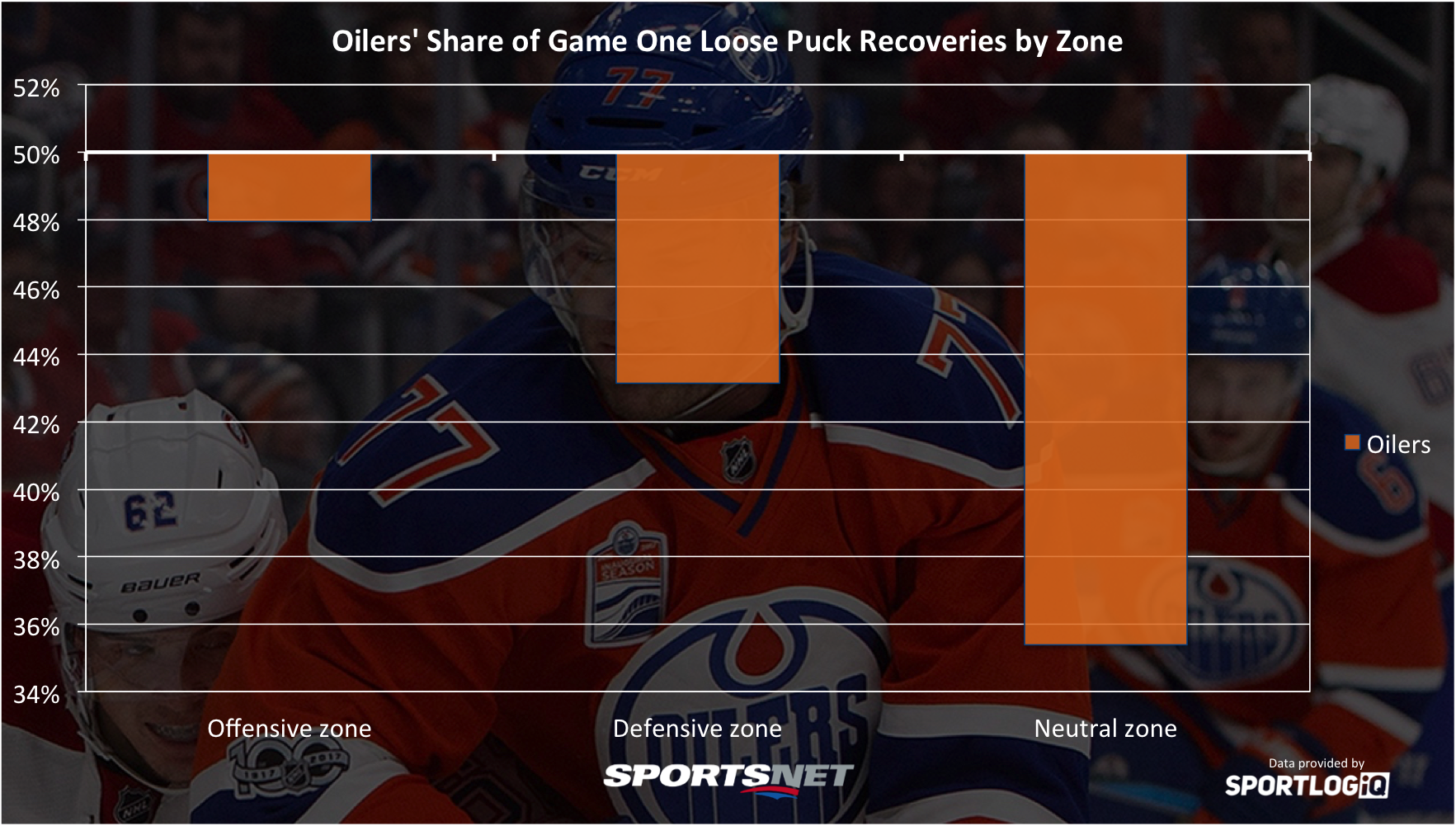
League-wide, defending teams usually win about 55% of puck battles in their own zone, and while the Oilers’ forecheck was better than average in game one, they didn’t end up outpacing the Sharks in their own zone. They were nearly 12 per cent below the league average in the percentage of loose pucks recovered in their defensive zone, a brutal performance.
The Sharks are one of the best forechecking teams in the league, so it makes sense the Oilers could struggle in this area, but this was a bad night even for this matchup. They were even worse in the neutral zone, where the Sharks controlled nearly 62% of loose pucks, an area that is usually close to equal.
Overall, there were 657 loose pucks recovered and the Oilers only managed 46.3%. At even strength it wasn’t much better, with the Oilers coming in at 47.3%. Considering the Sharks were missing their best loose puck recoverer in Joe Thornton, that’s a bad sign for Edmonton.
There’s a talent that comes with recovering pucks — anticipation, physicality, positioning and speed — but ultimately it comes down to compete level. After a nice start the Sharks taught the Oilers a harsh lesson about how tough the playoffs are.
The onus is on them now, especially in the defensive and neutral zones, to compete as hard as the their opponent did in game one.
[relatedlinks]