
TORONTO — For 60 games now Randy Carlyle has watched his team play as if they are stuck in an existential battle of contradictions. They have been at times unbeatable and at others anemic. Sometimes energetic and sometimes listless. A hurdle or a speed bump for the opposition, depending on the night.
It’s never clear which variant of the team is going to show up until puck drop, and from there it can be a game of table tennis—22 players bouncing back and forth between extremes. Two periods into Saturday night’s contest, down a goal to the Vancouver Canucks, Carlyle had seen only the substandard side of his oft-polarized squad and spent the second intermission trying anything he could to reverse course.
“We were pleading, begging, crying, all those things—for us to change the way we were playing,” Carlyle said. “We turned the puck over; we didn’t drive the puck deep; we started letting the game get away from us.”
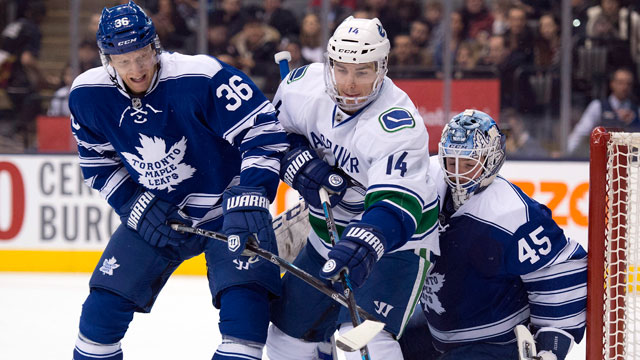
Well, wouldn’t you know it, his Maple Leafs found their polar personality in the third, as the former Canuck Mason Raymond tied the game seven minutes into the frame before Phil Kessel scored his 31st and his Olympic teammate James van Riemsdyk added one more, sending the Leafs to the Olympic break with a 3-1 victory. If a game could embody the 2013-14 edition of the Maple Leafs, this was it. “We had a lackluster, flat evening for the better part of the game,” Carlyle said. “And then, in the third period, we got more things going for ourselves.”
The Maple Leafs are such a fickle team. They can control a period like they did Saturday night in the first, earning several quality scoring chances and running the shot count to 8-1 ten minutes in, before seemingly losing the handle of their sticks and coughing the puck up uncontrollably. Canucks winger Ryan Kessler scored with less than a minute left in the first, throwing his stick out at a Chris Higgins shot that Maple Leafs goalie Jonathan Bernier never saw. What was shaping up to be something coaches call a-good-period-to-build-on quickly turned into a one-goal deficit heading to the second.
But after the at-times torrid pace of the first, the second period was played at whatever the opposite of torrid is. The teams traded chances here and there but few were especially threatening and the energy level in the rink dipped well below freezing, noticeable even in the ever-reserved Air Canada Centre. The teams, the fans, the kiss-cam marriage proposal—everyone was just going through the motions. Canucks pest Alex Burrows attempted to escalate things late in the frame by polishing Kessel’s face with his stick and then punching him in the head a few times, but it sparked little consternation from either side.
No, it was not a game played with much combativeness, a reality partly due to a lack of animosity between these two teams and partly due to the fact they’ve each played 60 games in a little more than four months. The legs are tired, you know? The problem with taking two-and-a-half weeks off mid-season to have an international tournament in a Russian resort town is that you’re giving away time you don’t have. The NHL campaign is terribly long as it is; no one’s interested in a Stanley Cup final after Canada Day. So you compress it all down and end up with game 60 of 82 on a cold night in early February being a bit of a bore. It happens.
Let it be known that no one would have been shocked if the third followed trend and the Leafs let the Canucks fly home with an easy shutout. Hamstrung by the early loss of Jay McClement to an injury of the “upper-body” variety and the addition of Frazer Mclaren who played just one-and-a-half of the game’s 60 minutes, Toronto was in a less than optimal position to provide late-game energy.
But suddenly, like greyhounds to the electric hare, the Leafs found one of those spontaneous bursts of vigour that can make you think this team might just be alright if they can figure out how to harness it. They opened the third with the their first sustained period of offensive zone pressure of the game, producing good scoring chances for Kessel and Nikolai Kulemin, whose emergence as a reliable centre has astonished even the Leafs coaching staff.
That opened up space for Raymond who was skating backwards and away from the net as he whipped a puck over Luongo’s shoulder to tie it. And then everything the Leafs threw at the net seemed to find its way in. Kessel scored on a screened point shot and then, a few minutes later, simply flicked the puck in the net’s general direction, missed, and watched as it bounced off the boards, off van Riemsdyk’s stick, off a Vancouver defender and in. It all just came together.
That is what this team does and what must make it so bewildering to be a fan of these Maple Leafs; how a team that was outplayed on an almost nightly basis throughout December and early January can flip on its head and win 11 of 14 as they have going into the Olympic break. They just won’t let you get comfortable with whether they’re any good or not. In all likelihood, that question won’t be decided until April.
And boy, April will come fast. Following the Olympic break, March will be an all-out sprint with 15 games in 29 days—9 of them on the road. “We know that the games are going to get tougher,” Carlyle said. “There’s no easy ones in the NHL and it’s not going to get easier when we come back, that’s for sure.”
But while Saturday night’s win didn’t do much to help the Maple Leafs advance through the slow-moving bottleneck that has developed in the Atlantic Division—Montreal and Tampa Bay also won, keeping Toronto in a wild card position—it didn’t hurt either. And while the Leafs at times seem to loaf through their games, giving up shots at an almost unbelievable rate, they also sometimes race around the ice like marauders, playing like a dynamic, potent team, that would be a handful to contain in a seven-game series.
Randy Carlyle can beg, plead and cry—but it seems like he, just like the rest of us, is forever unsure which version of his squad will show up.