
It is with great trepidation that a grownup revisits one of his fondest childhood memories.
If this hypothetical man were to, say, pop The Goonies into the ol’ VCR, he’d be a little nervous that the classic from his youth wouldn’t hold up more than two decades later.*
And so it was with hesitation and the comfort that he knew he was in for a happy ending (literal, not metaphorical) that a guy re-lived the joy of the 1987 Canada Cup three-game final between Canada and the U.S.S.R., 25 years after he first experienced one of the most indelible hockey moments of his impressionable ‘tweens, when hockey players were gods and gods set up other gods for beautiful game-winners in the dying moments.
Here are 8 + 7 things he noticed with a quarter-century’s worth of retrospect:
1. Wonderful foreshadowing by the commentators.
With 2:36 left in regulation, U.S.S.R. coach calls Viktor Tikhonov calls a timeout as the dream combo of Wayne Gretzky and Mario Lemieux are mid-shift. The commentator says it might not be a wise idea: “Give those guys a little extra rest?” Bad Idea Jeans. One minute and 10 seconds later, 66 and 99 have enough breath to make history.
2. How badly Tikhonov lays into Igor Kravchuk.
Defenceman Kravchuk, who would join the Chicago Blackhawks in 1992, is the one caught pinching on the deciding play that leads to a Gretzky-Lemieux-Larry Murphy jailbreak. And even though the Russians have over a minute to try and tie the thing up – not an inconceivable notion in a series that featured 11 goals per game – Coach Tikhonov responds not by encouraging the Russians to rebound but by absolutely losing it on poor goat Kravchuk, who gets chewed a new one.
3. That final minute is a nasty one.
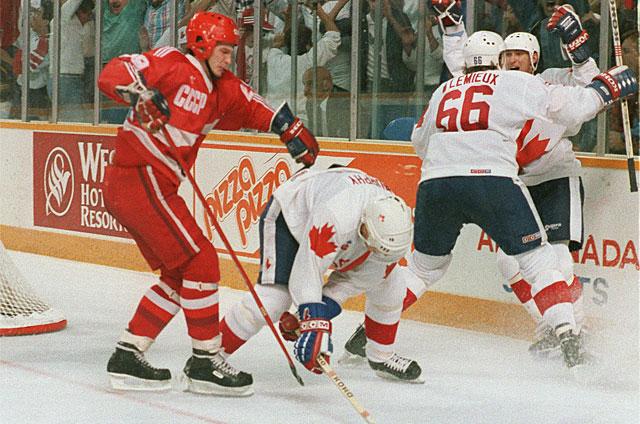
The image of Gretzky and Lemieux embracing after their 6-5 go-ahead goal is the last image of the Canada Cup in our consciousness. But the 86 seconds of play afterward are something. Mark Messier takes the faceoff at centre ice and gets into it right away, both teams generate wicked scoring chances, and some angry hits are delivered. A thrilling denouement.
4. They didn’t bother to spruce up the Forum.
For Game 1 in Montreal, which the Soviets won 6-5, the teams played on ice painted with the usual Canadiens logo. Imagine that happening now? An international clash of titans not coming with its own specialized logo dominating the ice surface?
5. Hamilton’s Copps Coliseum was used for something other than WWF matinees.
Oh, yeah. Completely forgot that Games 2 and 3 – both Canada victories — were played before 17,000 hockey fans in the Hammer. Lucky as Copps may be, Hamilton has been shut out from getting an NHL team on five different occasions.
6. Holy crap, what a first-unit power-play.
How’s this for a Hall of Fame lineup? Coffey-Bourque-Gretzky-Lemieux-Messier. Jeez. Kobe Bryant says they could beat the ’92 Dream Team.
7. Just how awesome Paul Coffey’s skating is.
The then Edmonton Oiler’s feet have been written about nearly as much as Usain Bolt’s, so this is my no means breaking news. But with it having been decades since you’ve watched Coffey stride in his prime, you forget how effortless he makes those speedy rushes look, how deep into the other team’s zone he glides and how swift he is to get back. It’s a damn gift, I tell you.
8. Fifteen years after the Summit Series, there was still a mystique to the Russian game.
Which is why you hear un-ironic comments from the booth like, “Hockey players in Russia tape up their sticks the same way as they do in North America.”
1. The magic wasn’t just the final one.
The last three game-winning goals for Canada in the tournament were all scored by Lemieux and all set up by Gretzky.
2. The “lower-body injury” had yet to be invented.
When discussing Soviet star Igor Larionov, the booth reports: “He’s playing with either a knee injury or a back injury, depending on which member of the coaching staff you talk to, but he’s playing hurt.” A historical precursor to the purposely vague “lower-body” ailment.
3. Just how chippy Team Canada was.
With Mike Gartner and Glenn Anderson running goaltender Sergei Mylnikov, and Rick Tocchet and Mark Messier doing their fair share of roughhousing, the Canucks were a decidedly less classy bunch than their counterparts. Elbows and high sticks flew. During the second period of Game 2, Gretzky blatantly trips a dude for no reason as he back-checks, then sets Doug Gilmour up for what should’ve been a goal on same shift. When Craig Hartsburg blatantly cross-checks Vladimir Krutov, the play-by-play man exclaims: “What in the world are we degenerating to now?”
4. Wow, a lot of lesser-knowns made the Canadian team.
Who would you have picked for Team Canada: Doug Crossman, Normand Rochefort, Brian Propp and James Patrick? Or Scott Stevens, Al MacInnis, Cam Neely and Dino Ciccarelli? Some stellar Hall of Famers were left off in favour of solid role players. That took nuts.
5. Team Canada had zero right-wingers, but a crapload of centremen.
And so we see guys like Gilmour and Lemieux playing the wing. For a reversal of this scenario, see the current Toronto Maple Leafs, who might place wingers at centre.
6. The best goal of the tournament was in fact scored by a Russian.
Valeri Kamensky knifes through Rochefort and Crossman to score the 5-5 game-tying goal while falling on his rear end in Game 2. It is so sick, easily the best individual effort of tournament. Had the Soviets won, we’d see this replay more often:
7. How much better 6-5 OT games are than 3-2 OT games.
Credit the streamlined goaltender equipment. Credit the abundance of offensive talent. Or credit the pace set by the Russians, who insisted on rolling four lines to try to out-tempo Canada’s 10 forwards. But you kind of forget how thrilling offensive hockey is. The best part is that when a team is down by three goals in the second frame, they’re still very much in it. There’s no need to flick off the TV.
*Spoiler alert: It will.