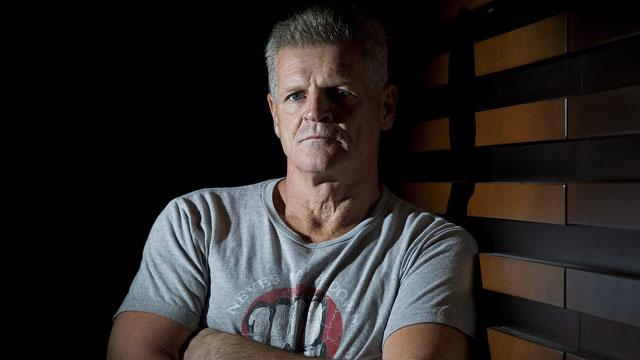

It begins like a bad joke that could end in a very literal punch line.
Two enforcers walk into an elevator.
Chris Nilan was about to exit the National Hockey League when Brad May entered it in 1991. Both men know what it’s like to throw and absorb a fist, both have surpassed 300 penalty minutes in a single season.
But this is a different arena and a different time. An office tower in a bustling NHL city. May, now in the media business, is off to a meeting. Nilan is promoting an incredible feature documentary, The Last Gladiators, that is about to hit theatres and is directed by an Academy Award-winning director, Alex Gibney. Nilan, a recovering heroin addict and the guy who supplanted Maurice Richard in the Montreal Canadiens’ record book for most career penalty minutes, is the star.
In another life, if these guys rubbed shoulders in such close quarters, a shirttail might be yanked from over the top of the head and slung around the neck. Not today.
The two tough customers are happy to accidentally run into each other. They exchange greetings and a promise to tweet at one another.
Chris (Knuckles) Nilan, now 54 and a grandfather twice over, is as vigilant today about his sobriety as he once was about punching out anyone who dared test him or his teammates on the ice.
He runs an anti-bullying program, which he calls “the thing I’m most passionate about right now,” and speaks frequently at schools around Montreal and Ontario to that end. He hocks “No More Bullies” T-shirts on his own website and gives half of the money to the Kids Help Phone.
Most important, he tells his story — a tale that reaches Stanley Cup championship highs and overdose-with-a-bloody-needle-in-his-vein lows.
As violent and intense and exhilarating and improbable as Chris Nilan’s life has been, he says he never once imagined it could be the stuff of cinema. He was too concerned about where he would get his next hit.
Sportsnet.ca: Why should people see The Last Gladiators?
Chris Nilan: People have done hockey movies. Slapshot is fun, it’s a cult movie and it’s cool. Old time. I thought Goon was ridiculous. I despise the word; I hate the name — Goon. (The Last Gladiators) is a window into that life. It’s true and it’s real and it’s raw. It also gives people a sense of hope. No matter what happens to us in our lives, there is hope. And I think the film exudes that in the end. Hopefully people can latch onto it.
One of the stronger themes of The Last Gladiators is loyalty — to family, to teammates, to coaches, to a city. Through all of your struggles, who has been most loyal to you?
Jamie, my girlfriend, has been awesome with me through everything. I’ve had some difficult times in sobriety, and she’s supported me no matter what. I don’t worry about having to tell her anything in my life. There’s no secrets. To me, that’s a sense of freedom. I don’t have to eat anything and stuff anything down inside me. I’m always able to share it with someone who understands, and I was never able to that in my life before. I always had to bury my secrets, what was going on in my life, and I don’t do that anymore. My best friend Jimmy back in Boston — doesn’t matter what I do in my life — loves me unconditionally. I could become a mass murderer, and he’d still love me.
How challenging is sobriety for you these days?
When you get sober, one of the things they try to get you to focus on is to keep everything in the context of a day: try to get through one day at a time. Once I grasped that concept and learned what it meant and how to do that, I’m okay with it. Do I have to be vigilant about my sobriety constantly? Yeah, I do. My outlook on it this time is a whole lot different than it was the last time (in 2001).
The film focuses on Chris Nilan the fighter, but there is a section that celebrates your growth as a hockey player and even a goal scorer. Whom do you credit most for developing your skills?
Jacques Lemaire (who coached the Canadiens from 1984 to 1985) taught me how to work hard but smart. How to focus and narrow it down to the things I should be working on, the things that would make me a better player. He was incredible at that. The thing about Lemaire was, he not only taught me, he played me. I got a lot of confidence from that; he had confidence in me. I was like a project for him. I know he was proud of the outcome. I was too. If there was a guy that really got me over the hump and helped me become a full-time NHL player, it was him.
What was your most memorable goal?
I had a penalty shot at the Forum. It was probably the most exciting. I loved scoring goals. It’s the best feeling, better than winning a fight. There’s no better (feeling) for me on the ice than to score a goal. But that penalty shot at the Forum that night (Feb. 23, 1985) was fun.
Who was it against?
Winnipeg. Brian Hayward. Top net on my backhand.
 (@lukefoxjukebox photo) |
How much, if at all, did enforcers talk to each other about their role in the game?
I didn’t talk to anybody, not really. It was more spontaneous. It wasn’t really planned. You might have an idea of potential guys you might fight that night, but when the game starts, that all gets settled and squared away.
How would you describe the role of the enforcer today as opposed to your era?
You don’t see it as much. I don’t think it’s the same in a lot of ways. Yeah, guys might fight once in a while, but I don’t know if the spontaneity is there as much. I don’t know if it’s used to protect other players as much as it is used to try and change the tempo of a game or two guys just want to beat each other up. It’s hard (to judge); I’m not there. I can watch on TV, but it’s tough if you’re not really there.
Which fight are you most proud of?
All of them. They’re all really difficult. They were all very tough opponents. I never ranked one opponent as tougher than another. I always looked at it as everyone is capable of doing damage to me, and I had to fight a certain way to have success and to last. I didn’t have a fight card; I didn’t rate guys. Did I know who threw what? Who was a righty or a lefty? Yeah. But other than that? No.
You were tenacious, but at six feet tall and about 200 pounds you weren’t the biggest guy on the ice. Technically speaking, what made you so successful as a fighter?
I was a good technical fighter. I had to be. I wasn’t always a wide-open fighter; it would happen at times. But I had to fight smart to last, so I was a good technical fighter, a good second-half fighter. My Max O2 was off the charts. I was always one or two on the team. Maximum oxygen intake. And I smoked! Imagine if I didn’t smoke. It’s hereditary, has a lot to do with your genes. It helped me a lot because as big guys got swung out and tired, I’d get stronger.
What were some of the tricks you picked up to survive?
Tying guys up, putting my head in the right position when you’re fighting a guy that’s 6’4″. Getting your head where he has a hard time hitting you. Switching hands. Throwing uppercuts. Throwing your weak hand when it’s least expected. I was a stronger righty than lefty, but I could throw my left. A lot of people didn’t realize that; they thought I was pure righty. But when you get hit with a left and you don’t think somebody can throw it, it’s not fun.
Mark Napier tells a wonderful story in the film about how he thought he was going to get mangled by the Philadelphia Flyers and then out of nowhere you came to his rescue. How, if at all, did the teammates you stood up for express their gratitude?
I was just happy they picked my gloves up and threw them in the penalty box. That was enough for me.
Enforcers Derek Boogaard, Rick Rypien and Wade Belak all died within four months in 2011. What was your reaction?
Tragic. Life issues get everybody. Not just hockey players or fighters. Lawyers, mailmen, garbage men, doctors — it affects everybody. I look at it more as a life issue as opposed to a result of them fighting in hockey.
What would you say to those who believe their role on the ice played a factor?
I’ll tell you my situation. I believe my drug addiction and alcoholism has as much to do with my formative years, ages one to five, or my teenage years than it has to do with me being a fighter in hockey. Just as much as.
What’s your take on the lockout?
The players should stick together and stand up and do just what they’re doing. The league made mistakes expanding into cities that they shouldn’t have expanded into. They asked the players to help last time, the players accepted a salary cap and said, ‘We’ll grow the league with you.’ They’ve grown the league, and the league is healthy. It’s a $3-billion enterprise, and now they’re going to screw the players again. They’re after them again for more money. They don’t want to honour contracts that they signed. The ownership is ridiculous. Those two contracts in Minnesota (Zach Parise and Ryan Suter’s 13-year, $98-million deals) with all this stuff going on? And now they don’t want to honour them? I don’t buy it. I do think it should be 50/50, though. No more, no less, and away you go.
If you were in the players’ position, would you head overseas?
Yes, no. My last year in ’92, we went on strike there and ended up losing a lot of money. I did. It was my last year of hockey, and it wasn’t fun. I don’t know if I’d go to Europe. I don’t know if they’d have me.
You retell your life story repeatedly at schools and in interviews and at Q&A sessions at film premieres. Is it always therapeutic, or does it get tedious recounting your addictions and mistakes?
It’s easy from the sense that I know myself and I know my story. That’s what people want to hear. If someone can take something out of it, if it helps them, then good on them. Good on me.