
I remember a much respected scout for another NHL team sharing one of his core team-building thoughts with me many years ago. There was very little free agency back then, but there were many player trades. He maintained that two things you developed within for a successful NHL team were your goaltending and your toughness. Spending a mid or late-round pick to draft a player with a tough pedigree remains far easier than trying to figure out your next No. 1 goaltender with a pick in any round.
Witness some of the signature current goaltenders with their NHL teams – Carey Price in Montreal, Martin Brodeur in New Jersey, Henrik Lundqvist in New York, Marc-Andre Fleury in Pittsburgh, Jimmy Howard in Detroit and Jonathan Quick in Los Angeles to name a few.
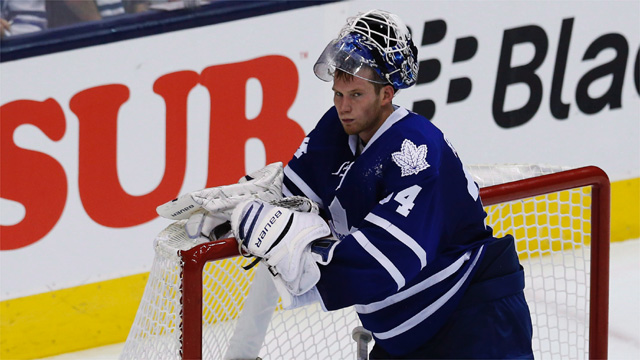
James Reimer stands as the Toronto Maple Leaf exception to the rule, a success in an area in which they have performed poorly for decades. He is a rare goaltender that the Maple Leafs were able to draft and then develop into an NHL (and, for a time, a number one) goaltender. It has been 47 years since the Leafs won their last Stanley Cup in 1967—and although Reimer to date has had a rather brief run as a Leaf goaltender, he already stands as the third best netminder that the Leafs have developed in that period.
With all due respect to the Ken Wregget-Allan Bester period in the 1980’s, only Mike Palmateer (1976 to 1980) and Felix Potvin (1992 to 1998) can be truly deemed Leafs draft picks who then had a “successful” run as the team’s No. 1 goaltender. The legacy of goaltenders drafted by the Leafs over the last 25 years (except for Potvin in the third round—31st overall—in 1990) is a highway littered with poor ability, poor drafting, injury woes, bad luck and, in one case, a horrible trade.
This includes first-round picks – Eric Fichaud (16th overall in 1994) and Tuukka “Ouch” Rask (21st overall in 2005); second-round picks – Francois Larivee (36th overall in 1996); and several third-round picks – Peter Ing (48th overall in 1988), Jamie Hodson (69th overall in 1998), Mikael Tellqvist (70th overall in 2000) and Justin Pogge (90th overall in 2004). All were chosen higher than Reimer was with the 99th pick in the fourth round of the 2006 Entry Draft.
The instant goaltending excellence and that Curtis Joseph and then Ed Belfour brought over a six-year period from 1998 to 2004 seemed to get the Leaf organization away from the notion of developing their own goaltenders from within. Or, one could argue, the vast majority of the ones that they drafted just weren’t good enough to play in the NHL. Still the likes of Vesa Toskala and Andrew Raycroft shared little resemblance to the Joseph-Belfour era. Unlike Joseph and Belfour, and to add insult to injury, Toskala and Raycroft were not added to the Leafs as free agents but were both acquired at a significant cost via player trades.
Reimer also appears, at times, to be the unfair scapegoat for things that go awry in Leaf land. Critical analysis of his performance in that final third period in Game Seven in Boston last year often overshadows the fact that without Reimer’s solid play, it is doubtful the Leafs would have been in the playoffs in the first place. We see that again in this crucial stretch run of the regular season, in his unexpected emergence as the star of what was arguably as big a victory as the Leafs have had this season when they came back to defeat the Los Angeles Kings last Thursday, has given way to some questions about his play in losses in Washington on Sunday and in Detroit on Tuesday. Including Leaf coach Randy Carlyle giving Reimer just an “OK” for his play in Detroit.
Maybe it goes back to minor hockey roots, where we are often hardest on the play of our own kids rather than the play of his teammates. Maybe it is as simple as giving “our kid” Reimer an even break. I think “our kid” has done rather well for himself. And whatever Leaf fans think, it looks like returning to the playoffs is going to be determined in a larger part by Reimer’s play then we might have thought before the Los Angeles game last week.