
Naked Eye vs. Nerdy Eye.
Mainstream media versus the analytics crowd. It’s a battle that’s raged on for the better part of the last couple seasons, neither side passing up an opportunity to fire a potshot at the other. So, let’s have some fun. For the purpose of this column (and because math frightens him), Sportsnet’s Dan Murphy plays the role of the evil mainstream media guy. The old school. While his friend from CanucksArmy.com, Dimitri Filipovic, reps the new school.
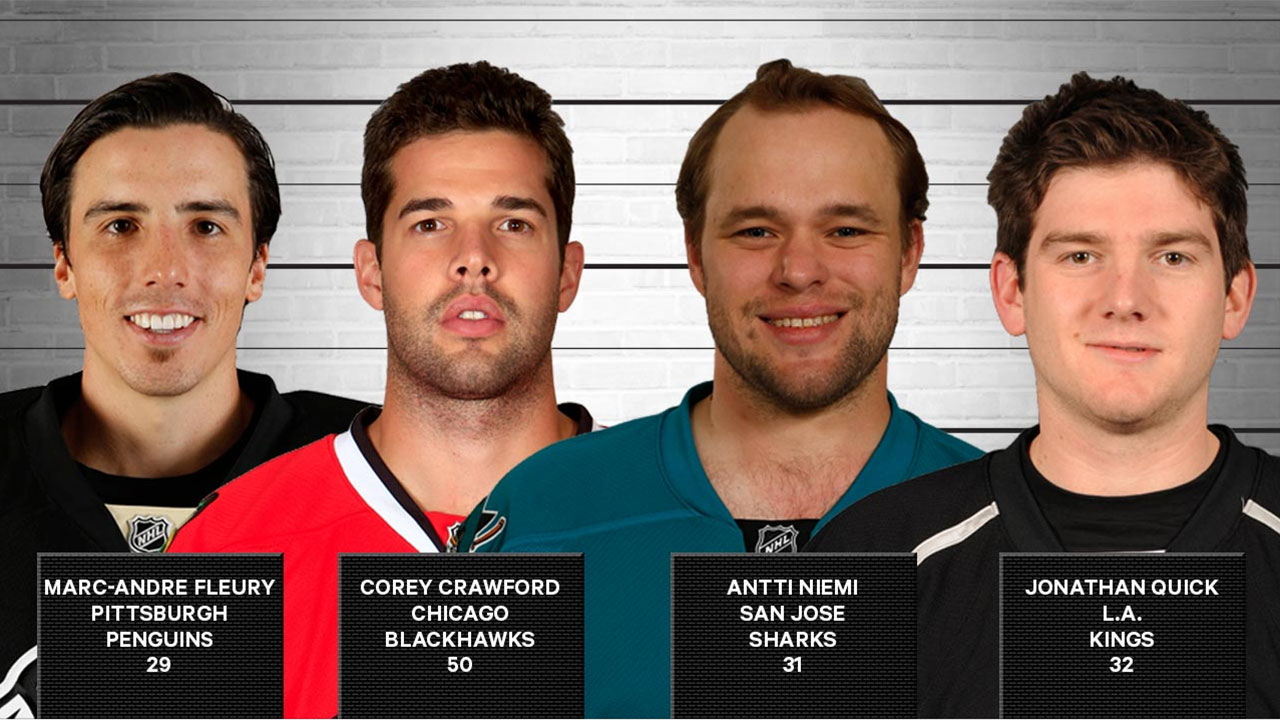
Marc-Andre Fleury, Corey Crawford, Antti Niemi, Jonathan Quick: Of these four goalies, who would you most like to have starting for your team? All these dudes have a Stanley Cup ring. All these dudes have also taken their fair share of heat in the recent past. And before you think this is an easy one, keep in mind that our argument does not include contract dollars. It’s just a matter of “who ya got” if you want to win a big game.
DAN MURPHY, THE NAKED EYE:
What if a cop trotted out these four goalies in a police lineup and instructed you to ID the guy you wanted for your team? What if there was a one-minute time limit on your decision? Look at the faces of Fleury, Crawford, Niemi and Quick, then pick your guy. No numbers in front of you, just memories and ideas of what each guy brings and what each guy lacks.
My gut originally tells me Quick, and perhaps he’d be my final choice if not for all the ridicule he takes from the analytics crowd. Quick gets roasted for being overrated by the numbers guys, and I believe everything I read. Sure, I love how athletic he is, and I love that he’s an intense competitor. But my naked eye tells me that he’s a hothead and, at times, far too aggressive. I’m also not dim enough to not realize that the team he plays behind is pretty darn good defensively. The Kings play a large part in his success.
Marc-Andre Fleury? If it was just a physical position, then maybe. But since being a goalie has a lot to do with how a guy handles things mentally, I can’t in good conscience go with the Flower. There have been just too many bad goals recently for me to trust his confidence.
So I’m down to Niemi and Crawford: two netminders who won the big prize with the Blackhawks. Many readers think Olivier Michaud could’ve won the Cup with that group of players, but we all should know that’s a load of bunk. These guys both came through in the clutch and shouldn’t be punished for playing on a great team (please ignore my punishing Quick for playing behind a great defensive team).
Like many members of the mainstream media, I can be distracted by the big, shiny thing that’s in front of my face. In this instance, that’s the Stanley Cup. Crawford is the last guy to win it and seems like a smart bet to be the next guy to win it. So I’m going with him. I know he’s got his deficiencies. The articles on his glove hand alone could fill a binder that would make the Warren Report look like a short story. Yet somehow he wasn’t exposed enough to stop his team from winning it all last season. And let’s not forget, he won his Cup after facing a lot of criticism because of his flaws, something the other three failed to do. That speaks of character and the ability to overcome.
Finally, in an effort to cheat Filipovic, I went to Kevin Woodley of InGoal Magazine for his thoughts on the topic as I intended to steal them to make my argument. Unfortunately, Woodley included salary to render his decision so I couldn’t use anything as my own. Here’s what Woodley had to say anyway:
“If the goalie comes with his current team and coach, and I’m only worried about winning right now, Jonathan Quick is an easy pick. Without those terms, things get complicated. As the first three games against the San Jose Sharks showed, playing as hyper aggressively as Quick does requires strong defensive support, especially on the rush and back door. Add in the nine years left on his contract and the effects of that athletic style on a body that already required back surgery, and Quick might not make as much sense long-term, especially when you see the numbers his backups posted for a lot less money behind the same stingy defence.
“Antti Niemi and Marc-Andre Fleury only have one season left on cheaper deals and a Stanley Cup on their resumes, providing a tempting opportunity to quickly look for a younger replacement with more upside at half the price. But if we’re talking about keeping a goalie, Niemi has gotten less effective as he got more aggressive in San Jose. And while Fleury is tempting after making significant tactical improvements this season, he still has several stylistic faults that may be tougher to fix.
“So give me Corey Crawford, even with six years left on a contract earned behind that tight defence. It may look clunky at times in those straight pads, but he plays a more balanced positional game and has a nice blend of sound technique and desperate athleticism when needed, all of which should translate and evolve more easily behind any type of team.”
DIMITRI FILIPOVIC, THE NERDY EYE:
I was a little wary about having this discussion. It’s not that I don’t have opinions about these four goaltenders; it’s that I’m not convinced we know nearly enough about evaluating goaltenders in general these days.
Hockey analytics — while they’ve come a long way in terms of the information available, the thought being put into deciphering it, and the public’s willingness to accept it — still have their limitations. One of the more glaring deficiencies in my opinion is the data we have on goaltenders.
Chris Boyle has been doing great work furthering the discussion with his Shot Quality Project, and Kevin Woodley is doing yeoman’s work by thinking critically about the inordinately complex position beyond your grandfather’s narratives such as “this guy is running hot” or “this guy is struggling with confidence.”
There’s no question we still have a ways to go in this field. That said, we can only work with what we’ve got, and that’s save percentage. I’ve charted the performances by the four goaltenders in question over the past five years with regards to this metric, including the NHL average as a reference point:

I enjoyed Neil Payne’s line from an article published at FiveThirtyEight recently: “But herein lies a great paradox: Despite goaltending’s outsize impact on the outcomes of hockey games, it’s extremely hard to say exactly which goalies are truly good or bad at their jobs.”
He went on: “The poor correlation of save percentage from one year to the next also indicates that goalies are extremely volatile commodities. For instance, if a goaltender is above average in a given season, there’s only a 59.2 percent chance he’ll be above average again the following year. And if he’s below average now, don’t worry: there’s a 47.2 percent probability he’ll be above average next season.”
We see some of that in action with the graph above, as the numbers yo-yo back and forth from year to year. Aside from the elite few, though, this’ll be the case with all goaltenders, which means it shouldn’t necessarily be considered an indictment of them. Instead, the key is to limit the basement performance (where the bottom completely falls out and the player implodes), while ideally still not removing the peak upside on the other end of the spectrum.
Based on the latter (and all of the other playoff sideshow anecdotes that accompany him), Fleury falls to the bottom of the list. He’s only topped .920 once in his career (.921 back in 2007-08), hovering around league average in most other years.
There’s no denying Quick was sensational in 2011-12, when his Los Angeles Kings won the Stanley Cup. He started nearly 70 games, stopped nearly 93 percent of the shots he faced, and put up 10 shutouts. He only improved in the postseason that year, posting a sparkling 1.41 GAA and .946 save percentage in those 20 games. The playoff performance was the cherry on top of the sundae, and it ensured he’d be ludicrously overpaid by the team as a result.
Since then, he has come back down to earth. He has stopped only 90.9 percent of the shots he has faced in 86 regular-season starts, which would put him at not only below league average but somewhere around replacement-level. That’s quite the bill to be footing for a player providing that type of production.
Quick, in particular, is almost impossible to evaluate properly with just the eye test. He’s so athletically gifted, he makes a supremely large number of highlight-reel saves, suckering people into believing he’s something that he’s not. Of course, what we can fail to register in the meantime is that he’s in line to make those saves because he’s a gambler who more frequently puts himself out of position. So when he strays too far and is burned by it, we tend to look the other way, attributing it to something other than the root problem. But when he makes that amazing pad save, we fawn all over it. You can’t have it both ways. Hockey is a game constituted of a large number of plays, and we must avoid getting caught up in the select few dazzling ones; it’s the more subtle ones transpiring in between them that makes a goaltender successful over the long haul.
Which leaves us with Crawford and Niemi, Cup champions perceived to be thorns in the side of two great hockey clubs rather than integral contributors. Particularly Niemi, who has blossomed into a reliable goaltender during his years in San Jose, shoring up many of the problems that made him look more of a product of the system than anything else during his time in Chicago. He’s still not the most aesthetically pleasing of the bunch, but the numbers don’t lie.
Crawford needed to answer similar questions after a supremely shaky 2011-12 campaign ended with an ugly playoff showing versus Phoenix in the opening round. And even after bouncing back with a fantastic shortened season the following year, he was bombarded with questions regarding his glove hand throughout the Stanley Cup Final versus Boston. Much like Niemi, he has proven that the best way to silence people is to play well; he was once again solid this past year and is coming off of a series in which he outplayed a more well-regarded counterpart in Ryan Miller.