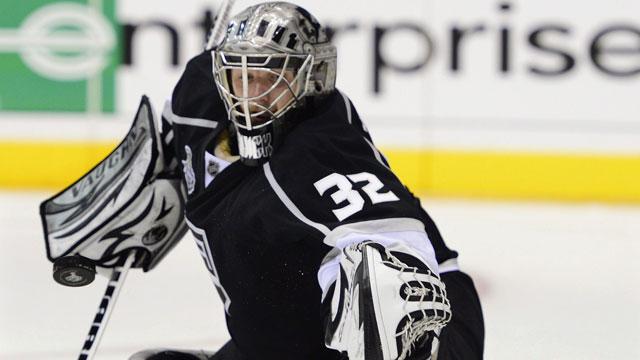

NASHVILLE — A Stanley Cup. A Conn Smythe Trophy. A $58-million contract. Hockey stardom. None of it has changed who Los Angeles Kings goaltender Jonathan Quick is off the ice.
“He’s the same old guy he was last year,” teammate Anze Kopitar said. “He hasn’t changed at all.”
This past off-season, Quick underwent back surgery to repair an inflammatory cyst and a disc fragment. He said he could feel the pain while doing simple everyday things like eating dinner or sitting on a plane or getting in and out of a car. He also “wasn’t too mobile” when he had his day with the Stanley Cup in July, just days before surgery.
The back injury didn’t keep Quick from stealing the show throughout last spring’s Stanley Cup playoffs.
As the No. 8 seed in the Western Conference, the Kings went on a record tear through the playoffs, knocking off Vancouver, St. Louis, Phoenix and New Jersey en route to the franchise’s first Stanley Cup since joining the league in 1967.
With a 1.41 goals-against average and .946 save percentage, Quick was sensational as the Kings compiled an impressive 16-4 record in the playoffs. But they wouldn’t have even made the playoffs if it weren’t for Quick’s regular-season performance.
“I don’t think people realized during the season what he did for our team,” Kopitar said.
Perhaps one of the reasons why Quick needed surgery is because he put the team on his back many times last season. He had to. The Kings struggled to score goals and found themselves in many tight, low-scoring games where Quick was forced to carry the team night in and night out.
“He was pretty much the only guy clicking on all cylinders until the playoffs and then we managed to pick it up and make it easier for him,” Kopitar said.
Quick’s regular-season accomplishments — a second-best 1.95 GAA with 10 shutouts — earned the 27-year-old a nomination for the Vezina Trophy. Although he finished second in Vezina voting and fifth in Hart Trophy voting, Quick was undoubtedly the Kings’ most valuable player.
But don’t tell that to Quick, whose primary and only focus is on the team.
When asked what his coolest moment with the Stanley Cup was, he replied, “When it was a little quieter at guys’ houses with them reading the names of their favorite players (on the Cup).”
If you try to ask Quick about last year’s accomplishments or the notoriety he has gained since winning the Stanley Cup and Conn Smythe, he immediately shifts his sights to his teammates. That’s just who he is.
“He always puts the team first,” Kopitar said. “He’s stayed humble. He’s still working hard every day and that just shows the kind of character that he has.”
Quick’s peers describe him as a “quiet leader” and “easy-going” in the locker room, and that he’s always been that way. Most goaltenders on game nights may try to block out his surroundings to get into a zone, but Kings captain Dustin Brown said it’s the opposite when it comes to Quick.
“He’s actually one of the most laid back goalies I’ve seen. He’s not very superstitious. You can joke with him right before the game and he’s fine with it,” Brown said. “What that does is show how confident he is in our team and our game. Behind the scenes he may be bunkering down and getting ready to go, but he believes in himself and our team.”
Quick grew up in Hamden, Conn., and played his college hockey at University of Massachusetts before arriving to the NHL as a 2005 third-round pick of the Kings. As the team’s emergency netminder, he was even a part of the United States’ silver medal Olympic team back in 2010.
The sentiment remains the same from his peers: he’s never changed one bit.
“That’s what’s great about Quickie — he’s the same kid that came in about five years ago. More importantly, his approach to the game hasn’t changed. He’s a pretty simple person and you know what you’re getting from him,” Brown said.
Quick may be the same person he was back in 2007 when he broke into the NHL, but he has certainly improved in the crease. His three-game cup of coffee in 2007-08 turned into a much bigger role in 2008-09 (44 games), which turned into being the reliable workhorse in the Kings’ cage.
The biggest difference in his game now is the consistency.
“He had those spurts of greatness the first couple years, but now you’re seeing a steady stream of good hockey from the individual,” Brown said of Quick.
Quick’s consistency a season ago is what carried the Kings to the playoffs and beyond. He rarely had a bad night between the pipes — and if he did, he’d make up for it the next night with a clutch performance. In the playoffs, he gave up three goals just twice in 20 games — a staggering accomplishment at that time of year.
“We know he’s going to be there for us at all times making the saves that he’s supposed to make, as well as all the ones where you’re sitting on the bench thinking, ‘How the hell did he save that?'” Kopitar said.
Goaltenders coach Bill Ranford added, “He’s so competitive. He never quits on any pucks and he’ll use any part of his body to stop it.”
Not quitting on pucks and stopping almost everything that came his way last spring has officially put Quick in the national spotlight for years to come — and the same goes for his team. With most of its Cup-winning roster returning, the Kings rightfully entered the 2012-13 campaign as a popular pick among pundits to win the silver chalice again.
In the off-season Quick signed a 10-year, $58-million contract, a month after winning the Conn Smythe as the Kings’ playoff MVP. While it may not be along the same lines as the stars and actors down the road in Hollywood, acquiring all of that fame and fortune can be taxing on some individuals. Not for this easy-going goaltender from small-town Connecticut.
When asked whether he feels any extra pressure after accomplishing all that he did a season ago, Quick simply said, “Nope. I’m just playing hockey.”