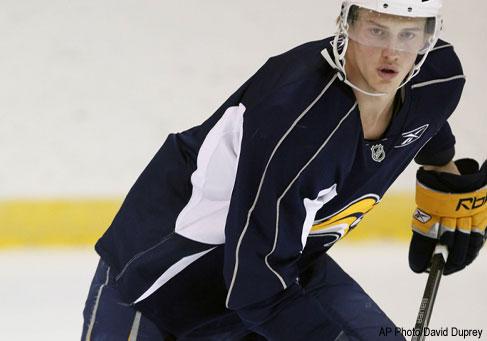

When you looked at the competition, you had to wonder if Buffalo Sabres rookie defenceman Tyler Myers had ever had a hope of being considered as a Calder Trophy winner.
While the 6’8 defenceman stood out early in the rookie race it was more because of his size than anything that was expected to happen on the ice.
Add in the quality of the competition – John Tavares with the New York Islanders, Matt Duchene with the Colorado Avalanche, the well-seasoned Jimmy Howard in goal for the Detroit Red Wings, the equally impressive Tuukka Rask in Boston and Viktor Hedman in Tampa Bay- and the list not only become much longer but also well regarded; much more than the preseason assessments of Myers (who was outside the top ten in his draft class (12th overall) and attempting to break into the NHL at a position that usually takes years of seasoning in the minor leagues to be effective).
But there are always interesting dynamics in a rookie race and Myers, who appeared much wiser than his 19 years when he suited up for his first NHL game, took advantage of some and bent some others to his way in a season where he outpointed all comers (mostly on the strength of 94 first-place votes).
First up he was breaking in with a team that had excellent goaltending in Ryan Miller and a superb commitment to overall team defence as demanded by head coach Lindy Ruff.
Second, he was often paired with veteran Craig Rivet and more often paired with veteran Henrik Tallinder and that experience rubbed off on a kid who was willing to learn. Perhaps most importantly, Ruff, his coach, was a former NHL defenceman and he was willing to both share the secrets a developing player must learn, but also had the patience to allow for Myers to play through his mistakes. Throw in the fact that the Sabres had missed the playoffs for two consecutive seasons and were, as a team, committed to do everything in their collective power to get back to the postseason, including playing hard-nosed defence-first hockey and it amounted to a perfect storm of opportunity for Myers.
He not only took advantage, he performed like a veteran.
That’s not to say Tavares, the No.1 pick overall in the 2009 Entry Draft didn’t do the same during a stellar season with the New York Islanders. Same could be said for Duchene, the third pick overall who was brilliant with the Colorado Avalanche as was Howard with Detroit and Rask, when he finally cracked the lineup with the Bruins and beat Myers and the Sabres in the first round of the playoffs, but opportunity is where you both find and make it and Myers excelled on both fronts.
He not only won a roster spot coming out of camp, but he led all Sabres in ice time per game (23.44). He was second on the team in plus-minus (plus-13) and finished fifth in scoring with 11 goals and 37 assists (48 points). He played all 82 games and proved to be tenacious in all areas of the game tying up opponents, blocking shots and driving the net when the opportunity presented itself in the attacking zone.
This season presents a list of five young players (in no particular order) not named Taylor or Tyler (as in No. 1 pick Taylor Hall and No. 2 pick Tyler). Any one of them might have a chance to match what Myers did when opportunity as well as talent is factored in to the equation; something that worked for Myers and is crucial for most any other rookie who wins this award. Some names may be familiar because they made NHL debuts last season, but the NHL’s definition of a rookie is as follows:
“To be considered a rookie, a player must not have played in 25 or more NHL games in any preceding seasons, nor in six or more NHL games in each of any two preceding seasons. Any player at least 26 years of age (by September 15th of that season) is not considered a rookie.”
1: Jacob Markstrom, G, Florida Panthers
This guy is big (6’3) and quick and though he wasn’t even a first-round pick (31st overall), it’s expected he’ll play a lot for the Panthers. Florida has a star starter in Tomas Vokun, but Vokun could well be trade bait at the deadline as the Panthers are re-organizing (one step beyond re-building) under new GM Dale Tallon, but Tallon won’t make a move in that department until he’s certain his highly-regarded prospect can play at the NHL level. He had a 2.01 goals-against average and a .927 save percentage in Sweden last season. That doesn’t make him an NHL sure thing, but it’s a place to start.
2: Tyler Ennis, F, Buffalo Sabres
It’s next to impossible to have one team bring home the Calder Trophy in consecutive years, but Ennis should at least get noticed. He’s small (a listed 5-9 and 165 pounds), but he’s tough for his size, has great speed and hands and knows where to go to score goals. Ennis was the 26th pick in the 2008 draft, but he had a reputation as a standout performer in junior hockey (two straight 40 goal seasons with Medicine Hat). He also had 65 points in 69 games in a standout season with Portland in the American Hockey League. He had a brief taste with Buffalo last season and performed well (nine points in 10 games) and played in the playoffs scoring one goal and four assists in six games. He’ll get his ice time.
3: John Carlson, D, Washington Capitals
Carlson logged top four minutes in 22-regular season appearances for the Caps last season and is said to be the player who made veteran defenceman Shaone Morrisonn expendable during the offseason. He’s offensive minded which should see him garner points with the offensive powerhouse, but he can handle himself in his own zone and is likely to get plenty of minutes back there. He has a strong first-strike pass which will play well in having the Caps exit its own zone with speed — something they are great at and look to do on a regular basis.
4: P.K. Subban, D, Montreal Canadiens
This guy would have been the talk of Montreal during its surprising playoff run through Washington and Pittsburgh (and against Philadelphia) were it not for goaltender Jaroslav Halak. Subban is quick, smart, creative with the puck and though he made mistakes in the postseason and was inconsistent at time, his talent was on display and it was formidable. The young defenceman is a probable replacement for the inconsistent Marc-Andre Bergeron, which should net him up to 20 minutes per game. He has a physical bent to his game but can rush the puck and make a difference deep in the offensive zone.
5: Jordan Eberle, F, Edmonton Oilers
Sure there are a lot of kids looking to make a mark with the rebuilding Oilers, including Taylor Hall, but Eberle has a resume and it’s a great one. Taken 22nd overall in the 2008 draft, Eberle has since shown himself to be a big game performer both in the World Junior Championships and in the Western Hockey League where he scored 50 goals and 56 assists last season.
Other contenders:
Cody Hodgson, F, Vancouver
Hodgson’s been fighting injuries and the Vancouver forward ranks are tough to crack, but he has talent, creativity and, at 20, he’s ready.
Jeff Skinner, F, Carolina:
Skinner is a centre who at 18 is likely to go back to junior, but as the ‘Canes are rebuilding, the NHL might be a better place for his scoring and puck handling abilities to develop.
Alex Pietrangelo, D, St. Louis:
Pietrangelo was the fourth player taken overall in 2008, but the Blues sent him back to junior twice, he’s ready now.
Oliver Ekman-Larsson, D, Phoenix:
He is mobile with great puck-handling skills and vision.
Brayden Schenn, C, Los Angeles:
Great scoring potential and has a physical element to his game.
Nikita Filatov, F, Columbus:
He bolted to Russia after reported beefs with now fired head coach Ken Hitchcock, but he could be a top-six forward for new coach Scott Arniel and a genuine Calder prospect if he lives up to his talent rating.