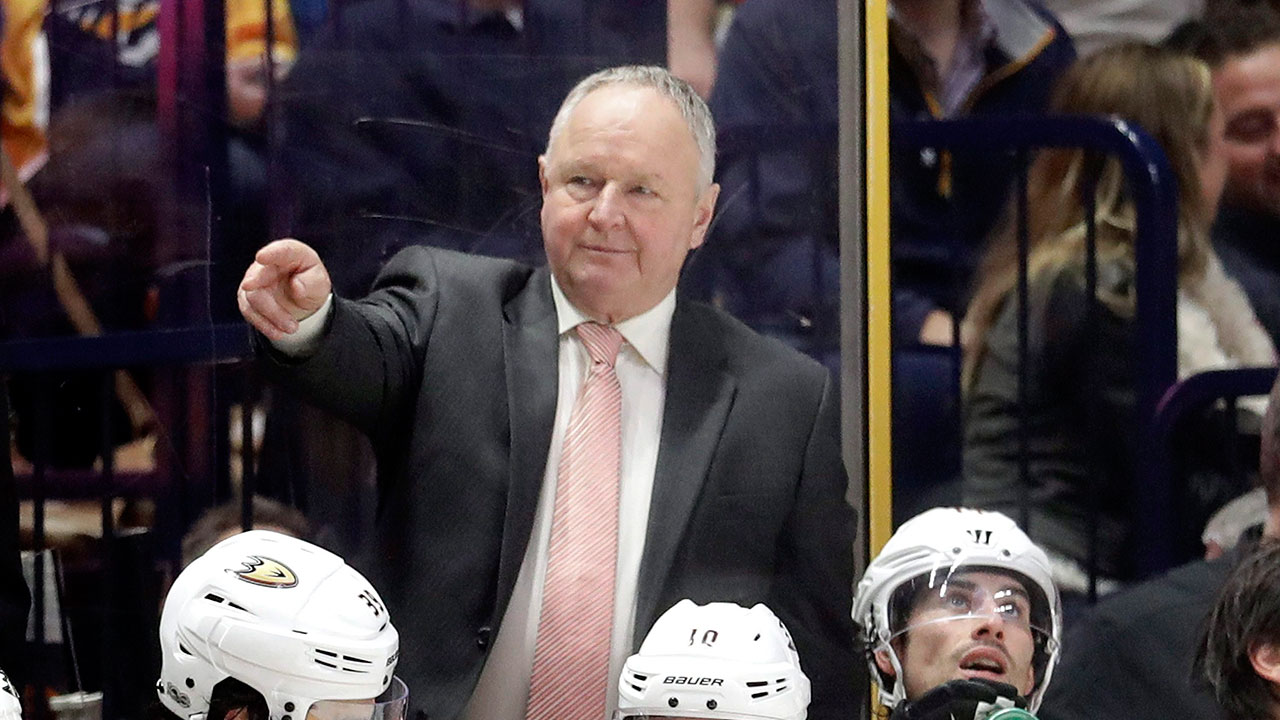

TORONTO – In what may well be his final spin through Toronto as an NHL head coach, Randy Carlyle had all the time you needed.
The man who was fired out of this town four seasons ago (with a winning record, we remind you), when the Maple Leafs’ decision-makers decided to scorch earth and rebuild from the roots, smiled easily, poked fun at a reporter’s shoe shine job, and wondered why he wasn’t getting royalties from AT&T’s “Just OK” ad campaign — a callback to his infamous evaluation of former goalie James Riemer.
As far as morning-skate scrums go? Good one, Randy.
Time, they’ll tell you, heals all wounds. It also sheds necessary perspective.
So even as the hockey lifer pilots an unruly Anaheim Ducks–branded 18-wheeler that appears cliff-bound and patrols the bench of a franchise that, like the Leafs, will be forced to get younger and faster to regain relevance, Carlyle happily, smartly held court for more than 12 minutes all that’s swerved sideways in Anaheim and the three familiar faces he’ll face Monday at Scotiabank Arena: Morgan Rielly, Jake Gardiner and Nazem Kadri.
Of those last remnants of Toronto’s Carlyle Era — which spanned parts of four seasons and peaked with a seven-game Bruins playoff series from which swaths of Leafs Nation are still suffering PTSD — Kadri may have most benefitted from the coach’s tough love.
“Yeah, he can be a bit of a hardass sometimes. I don’t think it’s a bad quality to have in a coach. I think there’s always a fine line, or you’re going to lose some players if you’re consistently not positive. He found a fine line,” said Kadri, caught in a reflective mood.
“He pushed me. Maybe some guys felt a little different. For me, as a head coach, I felt he maybe could’ve tweaked some things, but for me he did some really good things.”
[snippet id=4269123]
Carlyle always appreciated Kardri’s competitive nature, but the ups and downs with the first-round centre were more pronounced. But it was under Carlyle that Kadri grew into a 20-goal man and was forced to learn the defensive necessities of his position.
As young, skilled, affordable D-men, Gardiner and Rielly were logical choices to survive the post-Carlyle roster purge.
Carlyle on Gardiner: “It was a myth that there was some sort of dislike for Jake Gardiner. There was never a dislike for Jake Gardiner. You appreciated the player that he was, and you can appreciate the player that he is now. He’s a guy, I believe, that had to play 300-plus games before you really found out what he is. He’s a player that can control tempo of the game. There’s dynamics to him. He’s got hockey sense, but he is prone every once in a while to make a mistake — as we all are.”
Carlyle on Rielly: “Morgan Rielly is a very slick-skating, strong-skating defenseman. He’s a prototype of today’s NHL defenceman, what everyone’s looking for. They’re looking for mobility. They’re looking for the minute-muncher, the guy that can go back and carry the puck or move the puck effectively. The surprising part for me, specifically, is the offence he’s able to deliver on a consistent basis. He was drafted where he was drafted because of that ability.”
Kadri, however, was a different case.
Then a confident star on the rise with No. 1 centre ambitions, Kadri, you’ll recall, was skating a fine line himself. His future, his niche, in Toronto was less certain.
“It’s a more of a maturing aspect with Nazzy,” Carlyle said. “The one thing we wanted was to teach Naz how to play defence, and he’s found that’s the way he’s most useful — to play a complete game.”
Today, Kadri — now equally capable of shutting down top-six centres as he is creating on the power play — is grateful for the lessons force-fed to him under Carlyle’s watch. He reminds there were good times then, too.
“When things aren’t going well, that’s where the true judge of character comes into play. You find out who belongs and who doesn’t belong. We enjoyed ourselves for the most, but through that tough stretch there, it’s definitely hard to stay positive and have that focus,” Kadri explained.
“He was a little hard on me to start, but I also think he was fair and gave me opportunity as a young guy. I had to earn my stripes, and I think he’s a little old-school with that, not like how it is today. He pushed me in terms of putting me in pressure situations and seeing how I adapt, how I handle it. I think I did a pretty good job of earning that myself, but you still need a head coach to put you in those spots to give you the most success possible, and he did that for me.
“I became an established hockey player under his build.”
As affable as he was before the camera lens Monday, Carlyle “isn’t happy” these days, reports Ducks captain Ryan Getzlaf.
How could he be?
The Ducks were embarrassed 9-3 in Winnipeg Saturday, the bitter cherry on top of a horrid stretch of hockey in which they’ve mustered but two wins in their past 17 outings.
“There’s not a lot of sympathy going on here because I’ve been at the bottom too,” Rielly said.
[snippet id=3816507]
Anaheim’s minus-39 goal differential is the worst in hockey. The Ducks rank 30th in goals scored (120, 59 fewer than the Leafs); operate the third-worst power play (14.4%); sit dead last in shots per game (27.1) while surrendering the third most (34.1); their underlying possession metrics are just as horrid; and their MVP, starter John Gibson, was booed out of the All-Star Game in San Jose despite temporarily playing for the “home” team.
“Everything that can go wrong usually does when things are bad,” Getzlaf said. “This is a new experience for me, to be at this kind of a level for a month span.
“But Randy is doing his job trying to keep level-headed as well as motivating guys to do what they need to do.”
The Ducks closed the doors for a team meeting Sunday, then stormed the ice for an intense, high-tempo practice. Healthy for the first time all season, they’re trying to scramble their way from the cliff’s edge.
“We’re all part of it. We need [Carlyle]; he needs us as a team to play hard. That’s a bit what we talked about yesterday: We need everyone in this room, and that’s the staff included. It’s everybody. We need to lean on each other and be accountable through and through,” Adam Henrique said. “The bottom line is, we have to come out and compete and play harder, everywhere. That’s it.”
The injury bug has eaten its way through the core. Rickard Rakell, Ryan Kesler, Corey Perry, Ondrej Kase, Patrick Eaves, and Cam Fowler have all been touched. But the Ducks’ problems also involve work ethic, a dearth of quality scoring chances, and a lack of speed.
“We’re still in a position to challenge,” Carlyle said, “Crazy enough, with the season that we’ve had, that we’re still three points out of a playoff spot.”
If Anaheim can’t make up that ground, rumours surrounding Carlyle’s fate — noise that got loud enough that GM Bob Murray felt compelled to publicly announce on Jan. 14 the coach’s job is safe, for now — will return with vengeance.
And Carlyle may end up, again, as the last man in change before a true rebuild.
“I don’t know about proud,” Carlyle considered of his T.O. tenure.
“I look at it as, it was a totally different time, a totally different group of players. The overhaul that’s taken place here is something they felt was necessary, and they’ve done a good job of it.”
[relatedlinks]