For the third time in six seasons, the Toronto Maple Leafs will open up their post-season against the Boston Bruins, hoping to finally slay that dragon and give the NHL’s hungriest fan base some playoff success for the first since 2004.
The second half of the season the Bruins had in terms of wins and losses, not to mention the Leafs’ record over that same time, doesn’t exactly fill you with confidence that this is the year the Leafs can finally get over the hump, but as I’ve written recently, the win-loss record can be deceiving, and the Leafs have actually been playing better as the season has gone on.
The Bruins are an excellent team, one of the most challenging opponents the Leafs could have drawn, but they’re also not the Tampa Bay Lightning, so let’s go over the path to victory for the Maple Leafs – what they’ll have to focus on in order to take control of and win their first-round series.
After breaking down each Canadian team and where they rank across the league recently, I think that’s a good place to start to directly compare the Leafs and Bruins in order to see how they match up in several key facets of the game.
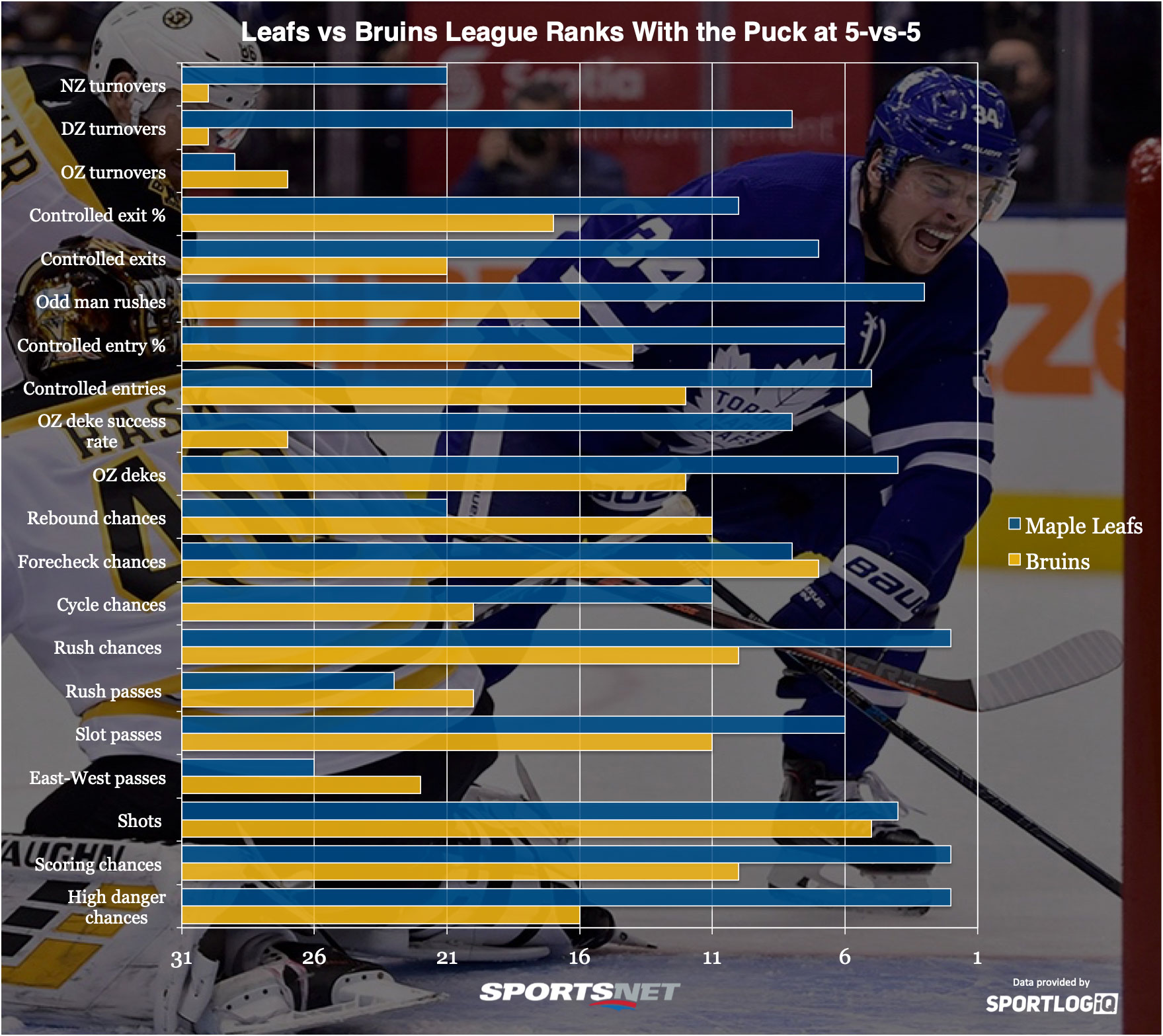
With the puck on their sticks, the Leafs are a significantly more dangerous team than the Bruins, creating far more high danger scoring chances, more scoring chances and a similar number of shots.
Neither team is particularly great at east-west passes in the offensive zone, but the Leafs connect on more slot passes and the Bruins are better at finding each other off the rush.
However, the Leafs turn their opportunities off the rush into chances more often, even though the Bruins remain dangerous there.
The Leafs are far more successful at beating players one-on-one with dekes in the offensive zone, and attempt it more often, and they’re also better at gaining the offensive zone with control, exiting the defensive zone with control and creating odd-man rushes.
Surprisingly, the Leafs are also more careful with the puck than the Bruins are outside of the offensive zone, where Toronto takes more risks.
In the defensive zone, the gap between the two teams in turnovers is massive, with the Leafs really pushing for improvement in that area this season.
The Leafs are one of the NHL’s best offensive teams, so being ahead of the Bruins there isn’t exactly surprising, it’s how far ahead they appear to be that sticks out.
Playing with the puck is only half the game though, so let’s bring in the stats without the puck as well.
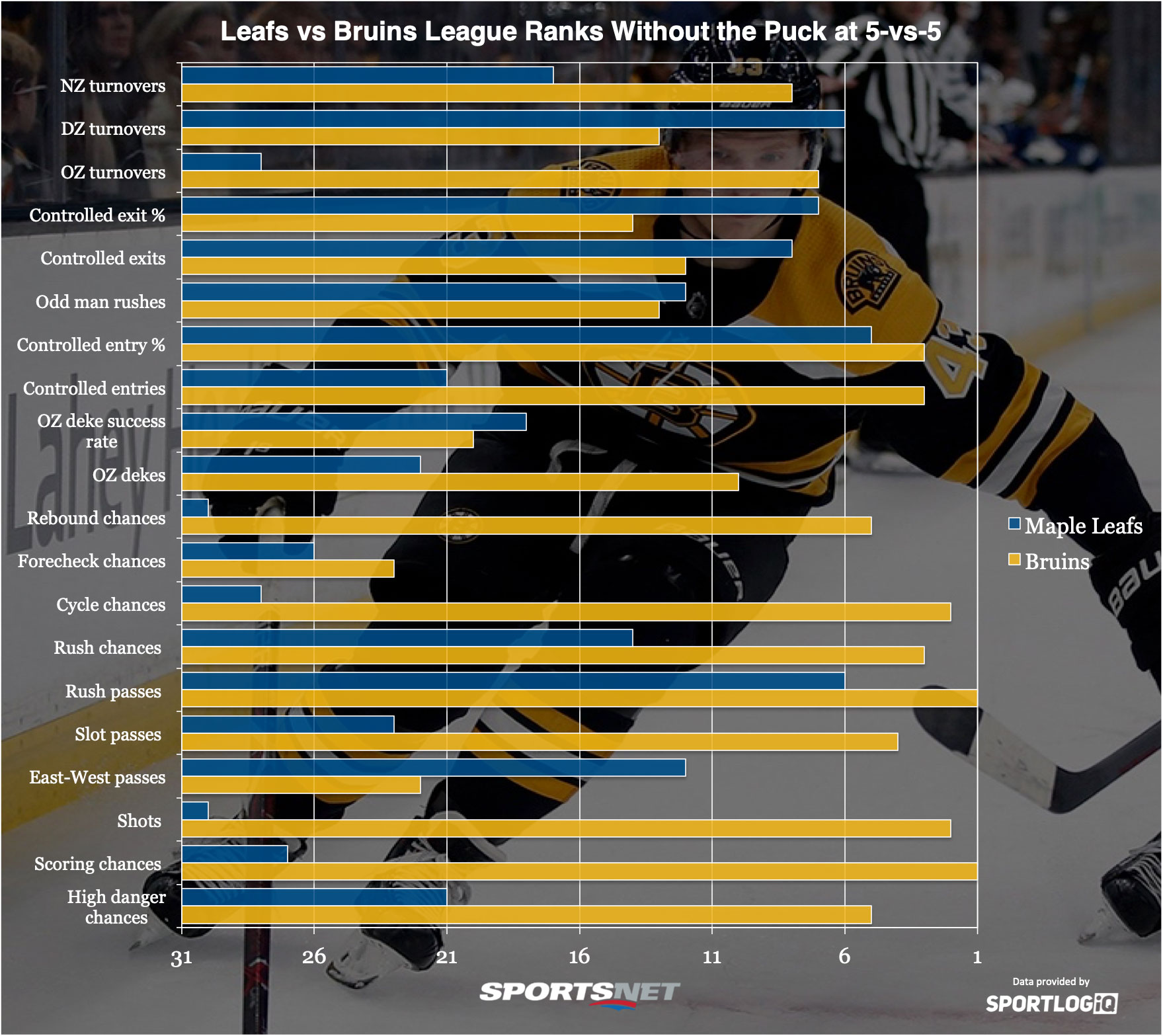
As far as the Leafs rank ahead of the Bruins offensively, Boston blows Toronto out of the water without the puck.
No team has allowed fewer scoring chances at 5-vs-5 than the Bruins have, they barely allow any high danger chances, pre-shot puck movement to the slot is shut down extremely effectively, and no team cuts down rushes like the Bruins do. Zdeno Chara is no longer an elite defenceman in many facets of the game, it’s almost impossible to be when you’re 42-years-old, but off the rush? His slow feet don’t matter much when he has the best stick check in the league and the wingspan of a 747.
The Bruins are also excellent at breaking up cycles. They allow the second-fewest cycle chances against in the NHL, but they do have one area of vulnerability: chances off the forecheck.
The Leafs are also susceptible to strong forechecking pressure, but remember in the breakdown of league ranks with the puck that the Bruins have an extremely high turnover rate in the defensive zone? Combine that with the Leafs being the eighth-most effective team in the NHL at creating chances off the forecheck, and you have a very clear area for Mike Babcock to exploit with one of the league’s most versatile offences.
[snippet id=4558775]
The problem here comes from the fact the Bruins were actually a slightly more effective forechecking team than the Leafs were this season, and the other avenues that the Leafs are so good at using to create offence are rarely available against Boston.
The Leafs are a brilliant team off the rush, create tons of controlled entries, but the Bruins allow the third-fewest rush chances against in the league, the third-least controlled entries overall and force teams to dump the puck in the third-most often.
So are the Leafs stuck focusing only on forechecking to get around the Bruins’ excellent neutral zone defensive structure and phenomenal passing lane coverage on opposing cycles? Not entirely, they’re also going to create a lot of counterattacks.
The Leafs aren’t particularly effective at forcing turnovers during the opponent’s offensive zone possessions, but the Bruins do give the puck up a lot in the offensive zone, and when they do, they allow about a league average number of odd man rushes.
[snippet id=4532907]
Toronto is just as susceptible in that area, but since the return of William Nylander and the addition of Jake Muzzin, their neutral zone defence has significantly improved and cut those opportunities down.
The defensive gap is bigger than the offensive gap between these two teams, which means it’s going to be a tough uphill climb for the Leafs to win this one, with counterattack offence and forechecking likely to play a huge role for the Leafs to pull it off.
For this reason, one player who has to have a great series for the Leafs to win is Zach Hyman. Hyman is a player who I always find a little overrated by Babcock and Leafs fans in general, but his dogged puck-pursuit style is the kind of thing that gives the Bruins fits, and playing with Mitch Marner, who excels at intercepting passes, is going to mean a lot of counter attacking for that line. Because of that line’s importance to creating offence in this series, I would guess that Babcock will attempt to keep it away from Patrice Bergeron, even though it’s likely the line that matches up best against him, you don’t want to get shut down.
Just like last year, the matchup game might fall to Nazem Kadri, who may have had a disappointing offensive year, but should be hungry to play a big role.