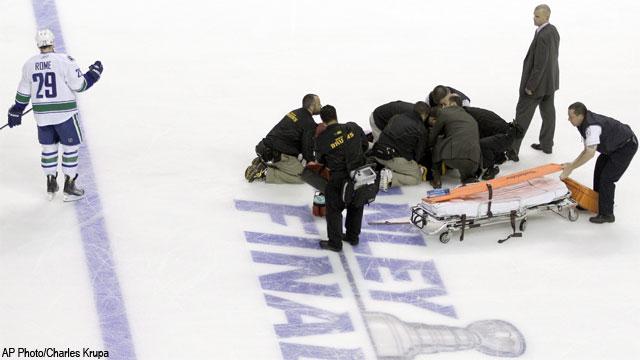

There has been little quantifiable evidence about the power and potential damage of punches that occur during hockey fights.
So, Sportsnet asked Blaine Hoshizaki, one of the world’s leading concussion experts, to reproduce the speed and power of NHL punches and the potential damage they can cause.
Sportsnet also wanted to know what would happen when a bare head falls back directly to the ice. The results are dramatic and send a clear warning of danger.
Hoshizaki’s scientific evidence is startling.
If you get hit with a punch to the jaw by a skilled fighter, you are likely to suffer a concussion and can expect up to 900 pounds of pressure from the impact. As well, there’s a good chance it would be a different kind of concussion than you would receive from a traditional headshot.
And if your helmet comes off during a fight, you are exposing yourself to the possibility of a catastrophic brain injury.
Hoshizaki directs the University of Ottawa’s Neurotrauma Science Impact Lab, which recreates the most dangerous hits in sport to better understand concussions.
The lab gained international prominence for their reconstruction of the two hits Sydney Crosby experienced within five days in January that left the Penguins superstar out of action until last Monday.
Hoshizaki calculated Crosby’s head experienced the equivalent of 850 pounds of pressure from his contact with David Steckel’s shoulder in the 2011 Winter Classic.
The lab prepared two reconstructions of punches: one from a lightweight player (200 pounds) and one from a heavyweight (over 240 pounds).
A lightweight punch from a skilled NHL fighter creates 700-750 pounds of force while a heavyweight blow creates more than 900 pounds of pressure.
“I was quite surprised that the lightweight punch created such high forces,” said Hoshizaki, who chairs the International Standard Committee for ice hockey equipment and currently sits on the Canadian, American and European standard committees for sport equipment. “Those forces were not quite as high as the Crosby reconstruction, but they were close.”
The simulated head form used in the reconstructions has sensors that transmit brain tissue response in 3D imagery. A traditional head shot will show the most tissue damage occurring at the point of impact. A punch to the jaw, however, showed tissue stress in different areas deeper in the brain.
“What is absolutely dramatic is that we’re seeing two mechanisms of concussion which indicates it may be a different type of concussion,” said the associate professor at the School of Human Kinetics.
The Sportsnet study is consistent with Hoshizaki’s hypothesis that there are likely a number of different types of concussions and these concussions are related to what parts of the brain are involved in the injury.
“I don’t think anybody’s ever talked about this,” Hoshizaki said. “We’ll go back now to do the research and publish this.”
The reconstruction of someone falling to the ice surface and hitting their head without a helmet produced impacts that were high enough to result in a catastrophic injury, such as a fractured skull or intracranial bleeds.”
Hoshizaki, who suffered one of his three concussions playing hockey, has some advice:
“When you get into a fight, do not take your helmet off. As macho as it would be to take your helmet off, if you slip and fall and hit your head, there’s a good chance you’ll receive a very serious brain injury.”