
A few weeks ago, in the Hockeycentral viewing room at Sportsnet, analysts Nick Kypreos and Doug MacLean were going through the usual routine of watching every game being played in the National Hockey League that night.
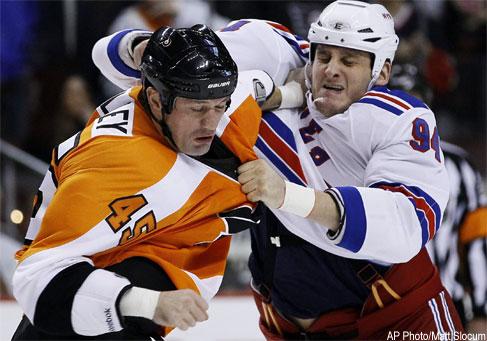
The sound was down on the New York Rangers-Philadelphia Flyers game, but when Ranger Derek Boogaard squared off with Flyers enforcer Jody Shelley, a producer grabbed the remote and turned up the volume.
For perhaps 20 seconds, the 6-foot-7 Boogaard and the 6-foot-3 Shelley rained punches down on each other’s head. As the Hockeycentral group watched, the usual “wows” and “oh mans” emanated around the room, but sitting quietly — watching without a word, his face almost wincing with each blow that landed — was Kypreos.
For eight NHL seasons Kypreos worked as an enforcer, until one night in 1997 when a Ryan VandenBussche punch ended his career.
As the Boogaard-Shelley fight ended and the group went back to work, Kypreos said quietly, to no one in particular, “Man, I can’t believe I used to do that. My head hurts just thinking about it.”
Then, snapping out of a memory perhaps better forgotten, he said more clearly: “It’s a tough way to make a living, boys.”
* * *
It is that; the toughest job in sports. There is no role in any team sport that is similar to that of the enforcer in the NHL.
It is a job that comes with the threat of devastating injury, the stress of preparing — sometimes weeks in advance — for the next big opponent, the pressure to not be embarrassed in front of thousands of screaming fans.
On Tuesday former NHL player Georges Laraque was a guest on a special edition of Hockeycentral Tonight titled “The Toughest Job in Sports” where he discussed life as an enforcer with Kypreos.
One of the topics was premeditated fights that occur during games, of which Laraque has been involved in a few.
“The way the rules are now with the instigator rule and everything, what are you going to do?” Laraque said. “You can’t jump a guy anymore. You’ve got to make sure the guy’s engaging.
“Most of the fights you see in the NHL today, the guys look at each other, they may not say anything but they nod their heads and stuff (and they go).”
Kypreos said there is a lot that goes into a fight that the fan might not know about, such as a personal history between two guys, what might have been said in warm-ups, and so on.
“You want to get your team into it, you want to get the crowd into it,” Kypreos said. “(There are) many different reasons (you’ll have a staged fight).”
* * *
One of the toughest parts of the gig is waiting for that opportunity to play.
“That would probably be the toughest, just the mental aspect,” Edmonton’s Steve MacIntyre said. “You know, coming to the game and you might not get in the game. You might not get the minutes you want. You have to realize you’re here for a reason and you do your job and you do it well.”
Florida’s Darcy Hordichuk agreed. He has two fights so far this season in an average of four minutes and fifty seconds of ice time per game.
“Us fourth-liners, we get our five or six minutes a game and that can be tough sometimes when you’re sitting on the bench and all of a sudden someone runs over one of your guys and you’re expected to fight him whether you like it or not,” Hordichuk said.
That waiting can be stressful. Colorado’s David Koci, who at 6-foot-6 and 238 pounds you would think would have no fear, admits that not knowing if he will fight each game can play on the nerves.
“Of course, I’ve been nervous and lots of guys are nervous,” said Koci. “It’s different than boxers because boxers know they’ll get in a fight. You kind of don’t know but you still have to play hockey and that’s a little bit stressful sometimes.”
Nashville’s Wade Belak, who has more than 100 fights on his record in his 14 seasons, also admits to that stress.
“It’s hard not to be (stressed),” Belak said. “The anticipation of that buildup, you can’t sleep, you’re nervous, don’t want to be embarrassed, especially at home.
“It’s stressful.”
* * *
That stress also translates to the fighters’ family and friends. It’s unlikely moms and dads envisioned their young hockey stars growing up to be enforcers; nine-year-olds dream of being Sidney Crosby, not Derek Boogaard. And it can be even tougher when the fighter is a dad.
“My kids have only been to a couple of my games,” Belak said. “Against Florida I fought Georges Laraque and my youngest was in the crowd crying. I don’t like to see that. It’s tough.”
“My mom absolutely hates it,” said Boston’s Brian McGrattan, who is in his sixth season in the NHL and already has 53 fights in the NHL, according to the website hockeyfights.com. “She can’t watch. My brother and my dad, even my dad gets a little, when he sees me going up against a big guy he gets a bit nervous. My brother loves it, my buddies love it, but my mom can’t watch. She just doesn’t want to see me get hurt.”
That possibility definitely exists when there are players such as Boogaard in the league. He is considered by most players as the NHL’s heavyweight champion, a position of honour held by such luminaries as Dave (The Hammer) Schultz, the late Bob Probert and recently retired Laraque. His fights-per-season have decreased in his six seasons in the NHL, mostly because others don’t want to tangle with him.
“He knows what he’s doing,” Belak said. “He trains for it, which is probably the scariest thing. You have to be smart when fighting him. You have to stay out of his reach.
“He hits hard; has a long reach. He’s just a big human being.”
* * *
Boogaard, for his part, seems unbothered by the whole process, responding to a question on whether he finds the job tough with a playful smile and quip: “No, maybe a stress reliever.”
But he does acknowledge the threat of injury that exists, as do most enforcers. It would be foolish not to. Kypreos’ career ended with a concussive punch, and two years ago, Don Sanderson died after hitting his head on the ice in a fight while playing for the Whitby Dunlops of Ontario’s Major League Hockey circuit.
“There’s no doubt about it, the career of a fighter is a lot shorter than most guys because nowadays the guys are getting bigger and stronger and you get hit a couple of times and you don’t know if you play again,” Hordichuk said.
“People don’t understand the pressure that tough guys are under. It doesn’t matter who you are. It takes one punch to the chin and you’re down in front of 17,000 fans.
“And if you go down too many times and you’re out of a job in this league.”
* * *
Watching a clip of one of Laraque’s fight during Tuesday’s show, Kypreos was dumbfounded when he heard Laraque say, “Good luck” to the other player before a pre-arranged fight.
“Good luck? Are you nuts?” Kypreos said. “I don’t want a guy having good luck against me!”
For Laraque, however, it was just the job and animosity never came before sportsmanship.
“I say that every fight I have,” Laraque said. “I always tell the guy, ‘Good luck.’ That’s just the way I am. I never fight mad.”