
It looked like Todd McLellan had pulled the sword from the stone back in the spring of 2017, when his Edmonton Oilers played their first two playoff series since the 2006 Cup run and seemed poised for annual success as he coached out his five-year contract in Edmonton.
Then the bottom fell out.
Cam Talbot ceased to be a No. 1 goalie, the dressing room chemistry did not weather well a fall-back season in 2017-18 and his general manager — Peter Chiarelli — began a disturbing pattern of transactions that had Oilers fans wondering if he was some kind of double agent in their midst.
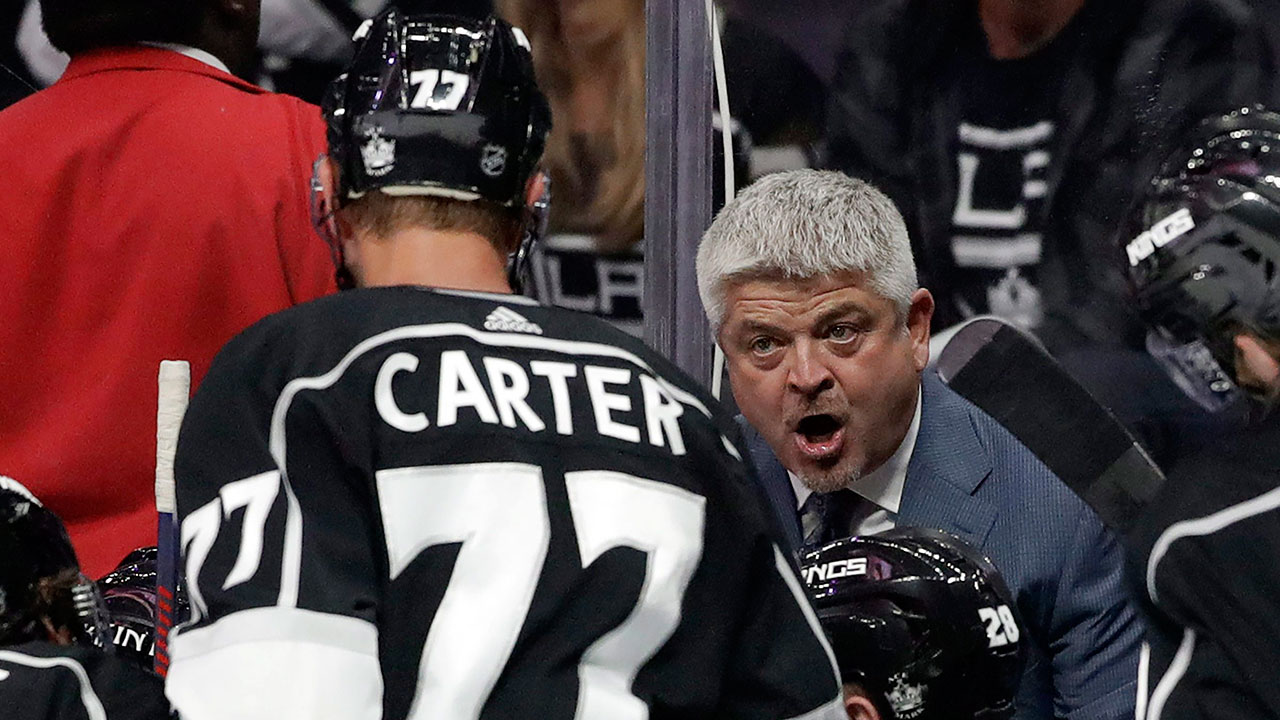
On Saturday, McLellan returns to Rogers Place — in the late game on Hockey Night in Canada, no less — in his latest incarnation as head coach of the Los Angeles Kings. He’s got another project on his hands in L.A., not unlike the Oilers team he took over in the summer of 2015. The Kings are not expected to make the playoffs, and will find their success in intangibles such as growth, or how competitively they play contenders like the Vegas Golden Knights and Calgary Flames.
If McLellan taught Oilers fans one thing, it is that no matter how good the head coach is, he still needs the right mix of players and a functional organization around him to win. And if McLellan learned one thing in Edmonton, it is that…
Well, let’s let him tell you. We caught up with McLellan before he boarded the Kings charter to Edmonton on Friday.
Sportsnet: Tell me about the lifestyle switch. What is Los Angeles like for a Saskatchewan boy who spent the past four seasons in Edmonton?
McLellan: Life has changed immensely. (Wife) Debbie was with me for only about three months in Edmonton … and she now lives full-time with me, which is great. (McLellan’s wife stayed in San Jose because their youngest son was still in high school there). The lifestyle is almost a complete opposite: you get up in the morning, put shorts on and drive to the rink in flip-flops. In Edmonton, during the winter, you bundled up and out you went. It’s a massive city here, and we live in a little bit of a bubble.
[snippet id=4167285]
SN: When you walk into the coffee shop in L.A., do they know who you are?
T.M.: Surprisingly, in our area — Manhattan Beach, Hermosa Beach — there are people who recognize you, because it kind of a Kings hotbed. But once you get outside of that, it is not like it would be in any Canadian city, or certainly in Edmonton.
SN: You entered into a project in Edmonton that you ultimately were not able to finish. This is a project in L.A. too. What are the similarities/differences?
T.M.: Both are projects, but both in a different spot on the evolution line. The Kings, right now, are paying the price for (having won) championships. They moved assets out to win in 2012 and 2014, and they’re not apologizing for that at all. Whereas Edmonton didn’t have those championships. Both teams needed work. You’re not coming into either expecting to win the Stanley Cup. You’d like to, but no one is picking us to.
SN: Looking back on Edmonton, what would you change that might have turned what ultimately was a failure, into a success?
T.M.: I’ve been asked that question a lot. I enjoyed every day I had in Edmonton — I could have stayed there for a long, long time. But the marriage has to be a two-way street, and obviously my partner (GM Peter Chiarelli) didn’t want to stay married. Every day I was there was good. Except for the last day, just because of the way things shook down. I’ll just leave it at that.
(Chiarelli, already planning to dismiss McLellan and having spoken with successor Ken Hitchcock, had McLellan fly with the team to San Jose for a road trip. There he fired McLellan the next morning, and put him on a plane back to Edmonton. It marked a sour, distrustful ending to the relationship, a story that McLellan does not tell, but one we learned elsewhere.)
We built the team up, and then it crumbled back down a little bit. We all need to take responsibility. And when I say “all,” I mean all — not just the coach or the general manager. I’ve accepted my role in it, and I’ve moved on. I’m happy here in L.A.
SN: Did that team recover from the Taylor Hall trade?
T.M.: Well, our best years were post-Taylor trade … Look, any time you take that type of talent and you separate it from a team, you’re going to miss that. Now, with Adam Larsson out, they’re going to miss that — he’s an important part of that team. You know, I don’t know the answer to that question.
[snippet id=4748264]
SN: You had success in San Jose, though not the ultimate success. You had less success in Edmonton, and now enter into a long-term project in L.A., is it critical to your coaching career to win again soon?
T.M.: Depends on the definition of winning. If it’s defined by putting your name on the big silver trophy, there are a lot of us who still haven’t done that as coaches. So, yes to that. Now, I thought it was a big win in Edmonton (in 2017), going to Game 7 in Anaheim. Those are seven playoff wins that didn’t exist for a decade in Edmonton.
In my opinion, I had a poor (2017-18) and 20 games in Edmonton, and I’m not sure the 20 games were that poor either. Here in L.A., we know what we are, where we are on the evolution line. I accepted the responsibility of coming here and putting that in place. Some coaches don’t like that challenge. I’m OK with it.
SN: Is it tempting to hurry a process like the ones in Edmonton or L.A.?
T.M.: It’s like putting a puzzle together. When there are only 20 pieces left in a 1000-piece puzzle, you probably aren’t going to bed. You want to finish. The closer you get to the ultimate goal, the quicker you want to do it — and sometimes that’s a mistake.
You have to understand where you are, and evaluate a certain way. For us, we need some young players to evolve and get comfortable in the league, and we need some older players to get their game back. That is how we’re evaluating our group, (not) purely on points and standings. We want to win 82 games, but the goal is to make surer this train is moving forward.
SN: One last question: What would you say to Oilers fan about the experience you had in their town? Any words for them, as they start down the road on another regime change?
T.M.: I am so thankful I got the opportunity to coach in Canada, but particularly in Edmonton. For me, if I was ever to get adopted by a community, that’s the community I would fit best. Growing up in Saskatoon, there are so many comparisons.
I would just tell the Edmonton fans, just keep being Edmonton fans. Because they are outstanding in their support of that team, and they just need to keep doing what they do.
[relatedlinks]