Leo Komarov is quickly becoming the stick by which Mike Babcock measures all his Maple Leafs. But how many realize exactly what, and how much of it, Komarov brings every night?
When Komarov returned to Toronto in 2014-15, he arrived with a four-year contract at an average annual value of $2.95 million. At the time, many panned the deal as an overpayment for a fourth-liner. But this was a mischaracterization of what he could actually provide to Toronto’s lineup.
Considering that Komarov was largely used in a third- or fourth-line role by Randy Carlyle and Peter Horachek, it is actually quite surprising that he posted 1.48 points per 60 minutes at 5v5 across 104 games prior to Babcock’s arrival. His immediate peers amongst NHL forwards with 1,000-plus 5v5 minutes over that time frame were Shane Doan, Brayden Schenn, Patrik Berglund, Teemu Selanne, Alex Burrows and Daniel Alfredsson. In other words, he was far from a fourth-line plugger who couldn’t score.
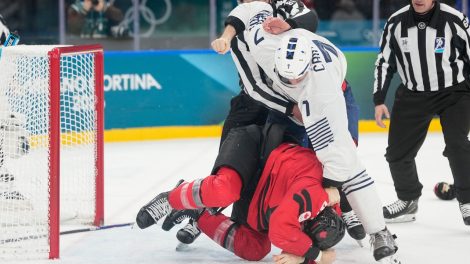
Superficially, Komarov’s key contribution to the stat sheet has always been noted by his physical presence. He was amongst the league leaders in hits in each of his first two years in the NHL. Because of this, he’s been lumped in with other “pest” players who are considered low-skill contributors. Komarov was largely recognized as a physical player who drew penalties, but wouldn’t contribute much else to a winning club.
But now that Komarov is getting top-line minutes and power play time, his performance is earning rave reviews from both his coach and pundits.
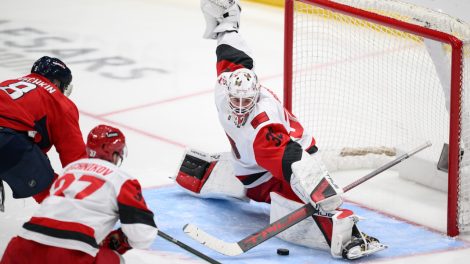
What seems to have escaped notice, though, is just how effective he’s been on defence. Komarov is excellent on the forecheck, cycle game and in applying back-pressure by making use of his speed and willingness to battle physically all over the ice.
If we look at NHL forwards over the past decade, very few have consistently made the defensive impact Komarov has in terms of shot suppression. In each of the three years Komarov has been with the Leafs, the observed shot attempt rate per 60 minutes against his team while he is on the ice is more than five attempts below what we would expect with his usage. He’s continuing that effectiveness this season.
This is actually an amazingly rare accomplishment for players who average more than 10 minutes at 5v5. Only seven NHL players have managed to do this in three or more seasons over the past decade, and Patrice Bergeron and Joe Thornton are the only ones out of those seven who are doing it this season.

The fact Komarov can be mentioned in the same discussion as Bergeron when it comes to defensive impacts should give pause to consider how important Komarov has been to Toronto’s improved possession numbers this season.
At the offensive end, Komarov is unlikely to keep shooting 17 per cent all season. Despite the fact he has 10 goals and Phil Kessel only has seven, I can’t imagine anyone expects Komarov to outscore Kessel by the end of the season.
Komarov’s offensive production to this point should be considered a bonus, because the key contribution he is making – and the one he needs to keep making if the Leafs are to improve – is on the defensive end.
Komarov looks like a long-term fit as the defensive conscience of this Leafs team. If he keeps this level of performance up, he will definitely warrant consideration for the Selke Trophy at the end of the season.