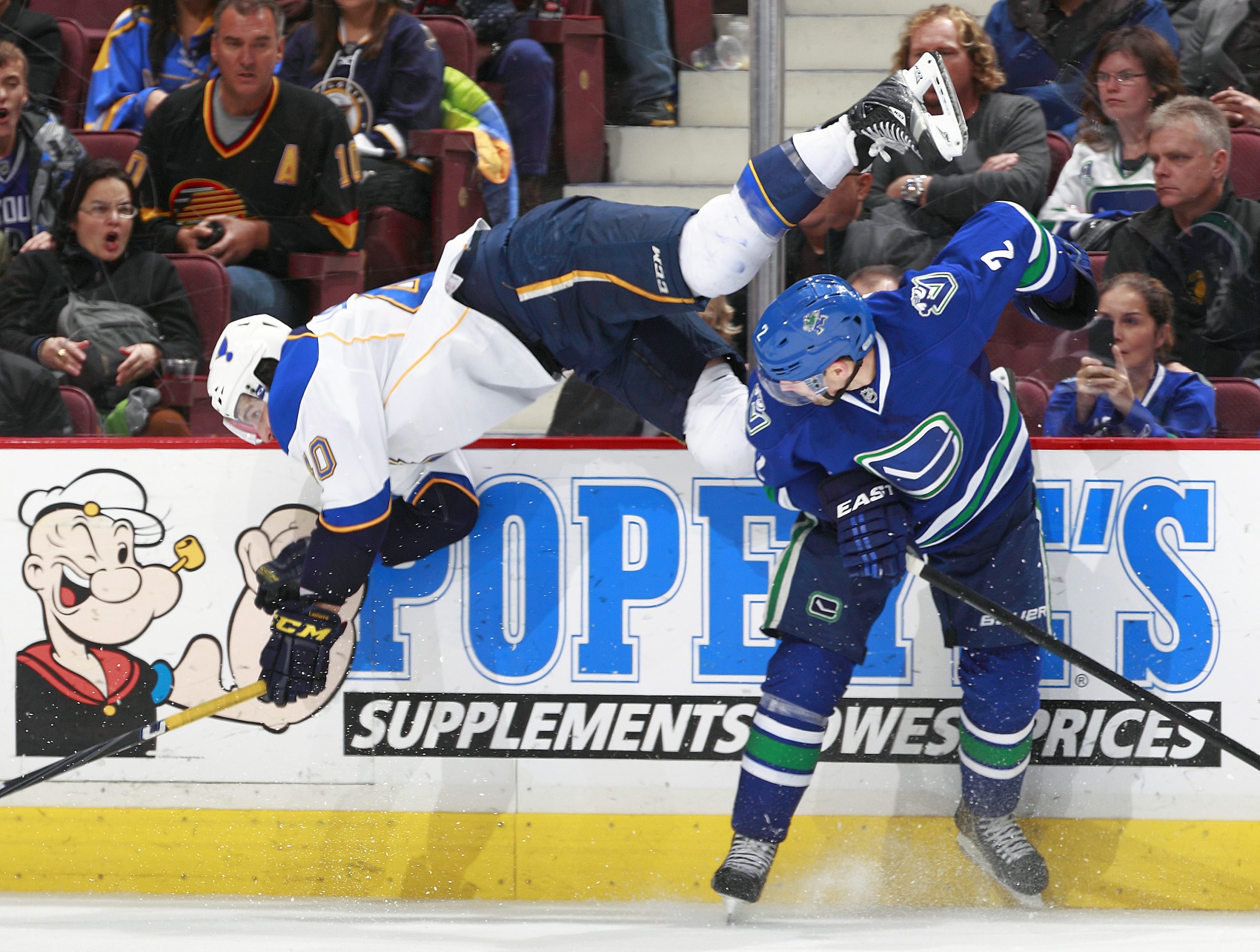

The Vancouver Canucks put their cards on the table Monday night in Los Angeles, and you didn’t have to bug the dressing room to know the theme of head coach John Tortorella’s pregame address.
The goal was to compete physically with the Los Angeles Kings. To punch first, not just punch back, and Vancouver accomplished that. The fact they did not come away with a point from the game? Well, that didn’t seem to matter much.
“One of the most positive losses you can have,” defenceman Kevin Bieksa told traveling Vancouver reporters from the Vancouver Sun and Province after the game. “We were going to make a statement whether they liked it or not. After the first period, they were skating around and saying: ‘What’s up with you guys tonight?’ We obviously got their attention and we’d like to play like this every night.”
Said Tortorella: “I thought we did a real good job as far as deciding that’s our ice also. It’s been a minus in our game. We got squat for points but we crossed a couple of bridges in what needs to be done.”
The Canucks pushed back hard, a fleeting trait that has long marked a criticism of this team. It’s good to see any team go all-in. To collectively say, “We’ve had enough,” then go out there and fight for each other.
That kind of game bonds a team. Whatever your stance on fighting in hockey, that is simply a fact.
Here’s the problem though: In order to play with the Big 3 in California, the Canucks obviously feel they have to play a heavier game. Play the game more like the Los Angles Kings, San Jose Sharks and Anaheim Ducks do.
The question is, can this lineup play that kind of hockey?
Can the Sedins, who had three shots and (obviously) no points in L.A.’s 1-0 win, thrive down the stretch and into the playoffs, in games played the way Tortorella wants the Canucks to play? Does Vancouver’s best defenceman, Alex Edler, become a better player in games played like this? Or does he disappear? Bieksa can handle himself for sure, but what about D-men like Jason Garrison, Chris Tanev and Dan Hamhuis?
Can Tortorella just flip a switch and change this many hockey personalities mid-career?
That’s what I asked myself as I watched the warfare on Monday night, as the Canucks brought everything they had to the Staples Center. Does their size and demeanour dictate that the coach spend too much ice time on players like Tom Sestito, Zack Kassian and Dale Weise, despite the fact that their offensive production is minimal? You still have to score goals to win, a point driven home in Monday’s shutout.
Either way, it is fascinating to see Tortorella’s in-season remake of a club whose Achilles Heel was best exemplified when Brad Marchand speed-bagged Daniel Sedin in the 2011 Stanley Cup final. Skill got Vancouver to that final, but physical dominance tipped the scales for Boston in the end.
Tortorella no doubt watched that from afar, and had likely penned Monday’s pregame speech on a flight some time back in October or November. Then he waited for the right moment, and with Roberto Luongo laid up due to Brown’s outside-the-rule-book play—and an abysmal five of 18 points earned against The Big 3 prior to last night—Torts let loose the game plan and his team responded.
It was fun to watch, but can it last? Is this really how Vancouver solves its issue of being in the Pacific Division with three California teams that are bigger, stronger, and—thus far—more successful than themselves?
Personally, I don’t think the Canucks can play that way every night. Not with this lineup.
Tortorella, Bieksa, Kesler—they’re all correct. Vancouver needs more truculence in their game on a nightly basis. But you can’t rack up 69 PIMs every time you play in California.
Vancouver isn’t built the same way the California teams are, with big rugged, knock-you-down players among their Top 6 forwards. It was that Euro-Swedish, high-skill DNA that led the Canucks to all those Northwest Division titles over the years. You can’t just swap that out because the new coach wants more shots blocked and more punches thrown.
Or maybe you can. Maybe I’m dead wrong.
Maybe this is Vancouver’s only chance of getting past the first round, after losing to L.A. in five and being swept by the Sharks the past two springs.
Maybe when Alex Burrows returns from his broken jaw, he brings some grit with him. Perhaps Kassian figures it out, and becomes a consistent second line winger. Maybe Edler, who has always been one of the more physical Swedes, goes all-in with Tortorella’s style, and Jannik Hansen does too.
If Tortorella’s plan is going to work, it has to be all hands on deck. It must be all about the team; all about every guy pulling on that rope.
And the coach got every inch of that on Monday in L.A., even though Vancouver came away pointless.
“A lot of guys stuck up for each other,” said Kesler, who fought Team USA teammate Dustin Brown in response to Brown having run Luongo the last time these teams met. “We out-battled and out-hit and we dominated them and they got a lucky bounce on a three-on-one (goal). That was a big statement by our team. In the past that team tries to bully you. I felt we were good all game.”
Right now, no one would give the Canucks a prayer in a first-round series against any of The Big 3. So why not try to change that?
They’ve nothing to lose, other than perhaps a few teeth.
Mark Spector is a senior columnist for Sportsnet.ca
Follow me on Twitter.com @SportsnetSpec