CULTURE OF LOVE
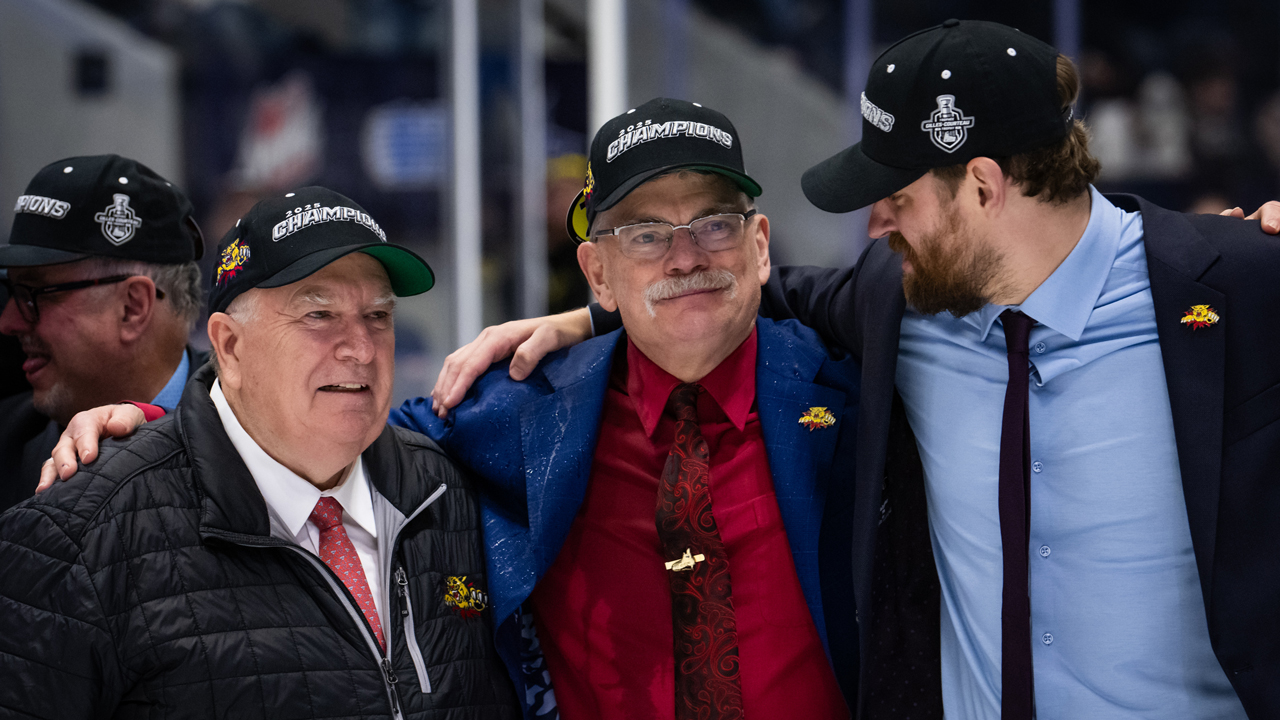
O n the far end of the sheet at the Colisée Financière Sun Life, right outside of the crease, Gardiner and Taylor MacDougall find each other.
It’s mid-May 2025, a rainy afternoon in Rimouski, Que., and just a few minutes earlier, the final seconds ticked off the clock, bringing this Quebec Maritimes Junior Hockey League championship tilt to an end. An 11-minute, three-goal outburst in the second period had allowed the Moncton Wildcats to build up a promising lead. And a third-period answer had come from the Rimouski Oceanic, the home side tallying twice to turn the game into a nail-biter. But Moncton had held on, withstood the late push, outlasted their hosts.

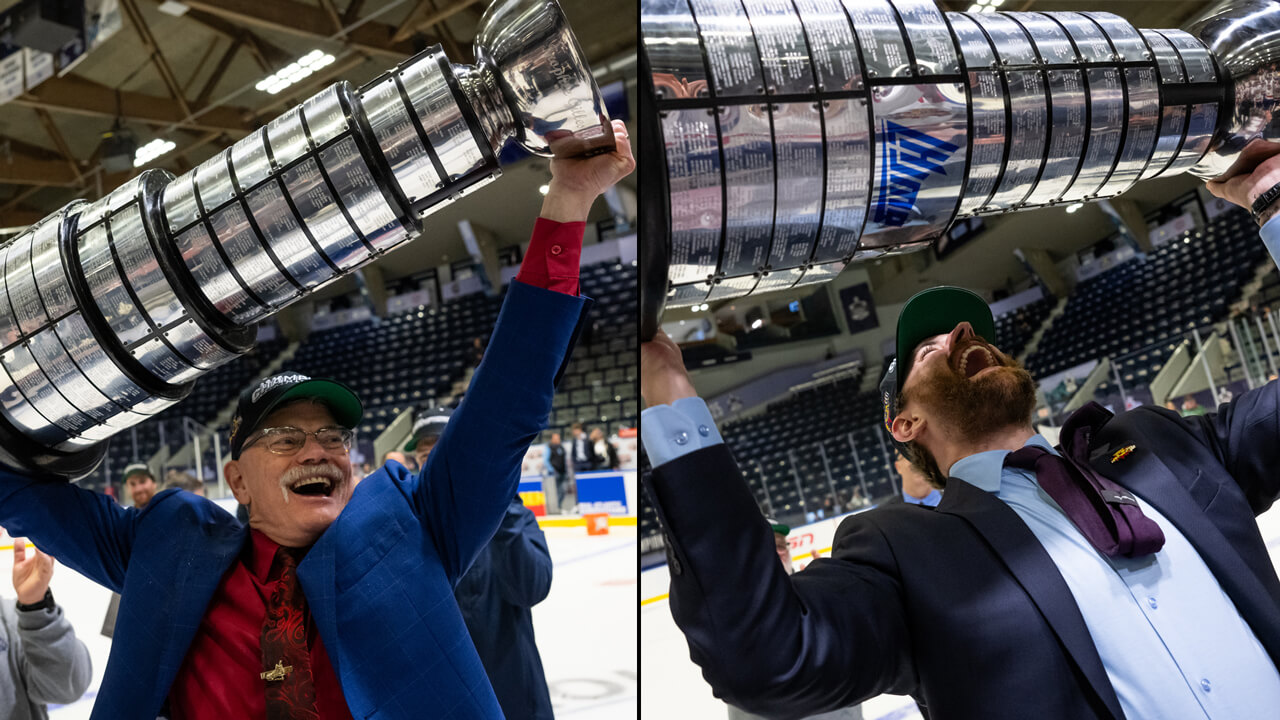
And so the clock had hit double zeroes, crowning Moncton QMJHL champions for the first time in 15 years, and the Wildcats had poured over the boards, thrown gloves and sticks and helmets into the air, letting them fall where they may as they sprinted towards a corner of the rink, a mass of hopping, giddy, triumphant teenagers. Back on the bench, their head coach, Gardiner MacDougall, had raised his arms in celebration, pulled each of his assistant coaches in for a spirited hug, hollering with joy all the while, and then taken to the ice to be with his players.
He’s there, amid the fray, when he spots Taylor — his son, his general manager, and his co-conspirator on this journey up the junior-hockey mountain — headed his way.
Gardiner holds out both arms, his signature, jubilant grin breaking from underneath his signature, walrusine mustache. Taylor closes the distance and embraces his father, a smile plastered on his face, too. They remain there a beat, spinning in a moment of dizzying triumph, both MacDougalls squinting with joy through rectangular-framed glasses. Taylor gives his father a hearty pat on the back. Gardiner moves an arm away only to unload a gleeful fist pump. He tosses out a few more after they break apart.
“You’re just so happy for the group, you know?” the veteran coach says now, reflecting on that title-clinching moment. “And obviously when Taylor came down, to embrace him … yeah, just special. We’re just so fortunate.”
The path to that fortunate moment was a winding one, decades-long. It started with a cross-country journey that took Gardiner from a small village on Prince Edward Island to coaching gigs in Manitoba and Saskatchewan, before a 24-year run with the University of New Brunswick that made him the winningest coach in Canadian university hockey history. Along the way, his son Taylor carved out a life of his own in the game, honed his skill on the other side of the glass. And when an opportunity arrived in 2024 for them both to turn the page, to start a new chapter in Moncton, the MacDougalls came to town, set down roots, and did the one thing they know how to do best — win.
G rowing up on P.E.I. in the ’60s, for Gardiner MacDougall, there was no escaping the game. “It’s a hockey-mad province,” the 66-year-old says. “It was just a small little village called Bedeque. You know, when you’re a young guy, you just hang around the rink as you grow up. … You go to everything at the rinks. You try to be there as much as possible.”
It certainly would’ve been tough for Gardiner to be there any more than he was. In high school, the young hockey-lover played for multiple under-18 squads. When not playing or practising, he returned to the rink to track stats for the senior league, and referee some of the games as well. Eventually, the only role left unexplored was behind the bench, so he started coaching local under-15 teams.
“I wanted to become a physical education teacher — that was my dream when going to university and that,” he says. “And I think that’s just a natural evolution of a physical education teacher, is to be a coach.”
That dream eventually became reality 4,000 kilometres west, in Norway House, Man., where Gardiner got his first opportunity as a P.E. teacher. And it was during that stint, while teaching gymnastics, that fate steered him back to the hockey world.
“I really enjoyed teaching gymnastics to the kids. I had about a two-month unit on it, and the last month, we brought in a trampoline,” he remembers. “I had done something on the trampoline with my neck. I woke up the next day and my neck was really, really stiff.”
He’d been asked to join a senior provincial hockey squad ahead of the team’s playoffs. He was determined to make the game, neck injury or not.
“I went the next day and I remember being in so much pain — that was really the last organized hockey I’d ever play,” he remembers. “I ended up having a pinched nerve in my neck, ended up losing about 20-25 pounds. I really couldn’t do anything for three or four months — so I started coaching.”
Gardiner returned to the bench for Norway House’s senior squad, and soon enough, discovered he might just have a knack for the coaching game. “We ended up winning the championship,” he says.
He was hooked and redirected his focus, applying for a gig as the hockey program coordinator for a school division in Cranberry Portage, Man. He reached out to fellow Prince Edward Islander, Doug MacLean — then an assistant coach for the NHL’s St. Louis Blues — and lobbied to help run MacLean’s summer hockey camp back home. Before he knew it, between his work in Manitoba and his work back on P.E.I. with MacLean, Gardiner was immersed.
“I probably coached three or four different teams, probably coached 150-200 games a year with all the different teams, but you get a passion for it,” he says. “And I think the biggest thing was, you make a difference with the players.”
After a four-year run in Manitoba, he moved on to the Saskatchewan Junior Hockey League in 1990, where he worked his way up the coaching ladder before returning to Manitoba in ‘96 as a head coach in the province’s own junior hockey league. Then in 2000, Gardiner found the landing spot that would house all the behind-the-bench passion he could muster for the next two decades: the University of New Brunswick.
“I mean, getting the job was like my NHL,” he says of earning the head coach role for UNB’s men’s hockey program. “It was my third time applying for it — I didn’t get it the first two times.”
Despite all the hardware he’d win later, it was a rocky start for the rookie head coach. The squad Gardiner took over for that 2000-01 season had gone to the national final the year earlier, falling just short of a title. The new coach was told he didn’t need to do much recruiting — the team was ready to pick up where they’d left off.
“I think we started maybe 2-5-1,” he says with a chuckle. “We lost our first couple of games on the road. Then I remember the University of Moncton came in and I watched the warmup. I went back to my office and I looked at the schedule, and I said, ‘Geez, these guys are good — I may not win a game in this league.’”
He did, of course — 490 regular-season victories in all, the most by any coach in Canadian university hockey history. Punctuated by a final season that saw his UNB team go 43-0, winning every single game they played across the regular season, playoffs, and exhibition tilts. And then there were the championships, the coach’s nine national titles leaving him tied for the most of any Canadian university hockey coach.
And yet, it’s not the wins or the rings or the medals he cherishes most from his two-and-a-half-decade run in Fredericton. It’s everything that came off the ice.
“It wasn’t the start we wanted but it certainly ended up being an unbelievable destination,” he says. “At UNB, the motto was, ‘Make a significant difference.’ Your philosophy is to serve the players and try to make a difference in their lives — in hockey, but also as people.
“I had the chance to raise our family, both my kids, to live in Fredericton, and to make an impact for 24 years. It was unbelievable.”
G iven his father’s undeniable affinity for the sport, there was little chance of Taylor escaping the game, either. Growing up as the son of a coach then still making his name in Manitoba and Saskatchewan, there was little separating hockey life from non-hockey life for the MacDougalls back then.
“A lot of my earliest memories are associated with the game,” Taylor says. “You know, I obviously grew up in a house where hockey was very prevalent. I kind of took to it and took an interest in it from a young age. And a lot those earliest memories are either on a scouting trip with GMac, or the classic: on an outdoor rink.”
At 16, Taylor set out to find his own path in the sport, heading to Newfoundland in 2006 to join the QMJHL’s St. John’s Fog Devils. He remembers most the impact of that transition, from life at home to life in a new city, of a billet family instead of his own, new teammates instead of old friends.
“At the time, you don’t realize it, but it is such a young age to be going through those life experiences,” he says. “That first week where you’re like, ‘Okay, I’m staying, I’m doing this,’ you know? That’s something that stands out.”
Still, like his father before him, he caught the bug. He fell in love with junior hockey, with Newfoundland, with all of it.
“Getting a chance to experience the culture in a place like St. John’s and also play out of the facilities we were able to, it was very cool and pretty special,” he says. “Just getting the opportunity to live a number of great experiences, to have some great teammates that you make lifelong bonds with.”
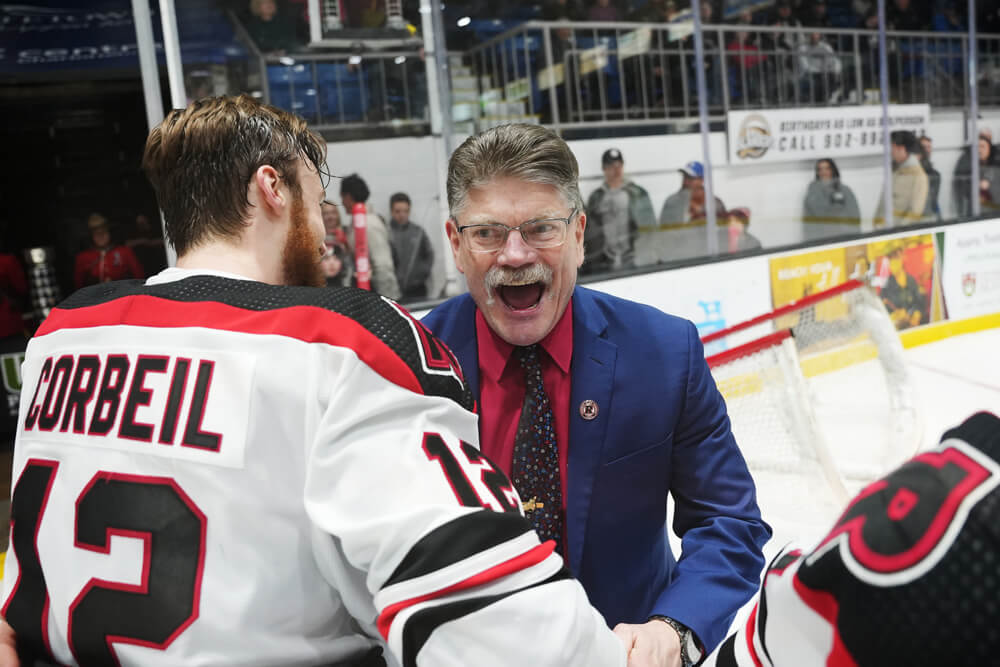
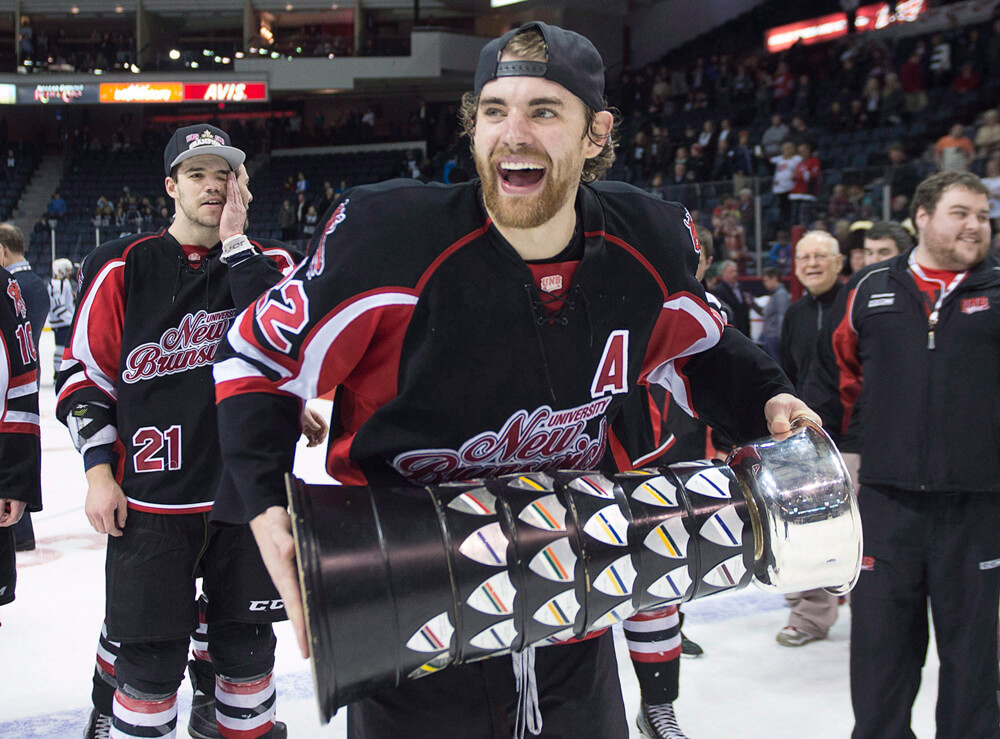
A franchise relocation eventually granted Taylor the experience of playing in Montreal — the Fog Devils becoming the Montreal Juniors in 2008 — before a trade sent him to Cape Breton for his final two years in the QMJHL. And in 2011, after his junior career came to a close, Taylor chose to stick nearby for his next chapter, signing on with the University of New Brunswick.
“There were a variety of factors that played into it. I had missed the majority of my overage season with a surgery, so that limited whether I was seriously going to consider not going to university and trying to chase the pro thing — I guess injury and probably talent limited that,” he says. “When I went to UNB, I prioritized having the opportunity to win a championship. I hadn’t gotten to do that in junior. I’d gotten a chance to play on really good teams but hadn’t really got to experience that feeling of playing in a championship final and ultimately winning your last game of the season.”


Of course, joining UNB meant embracing the potential awkwardness of being coached by his father, then more than a decade into his hallowed run at the university.
“Obviously with that came juggling the father-son thing. I gave it some thought,” Taylor says. “But it was a place that was really special to me, that I had grown very close to [when I was] growing up.”
Gardiner was thrilled.
“It was really special to have him be part of the program,” the coach says. “And it wasn’t easy, because we had a really, really good team. Even the preparation he did when he came — I know he went to all the senior captains and made sure they were comfortable with him coming. He took the initiative with that, becoming part of the team.”
Becoming a player under his father’s tutelage was an eye-opening experience for Taylor, seeing firsthand the coaching style that had garnered three national titles to that point. He gained a new appreciation for his dad’s approach, for his unshakeable fervor.
“You see how passionate he is — you know, I had a pretty good idea of how passionate he was, but what you see playing for him is just how authentic and enthusiastic he is every day,” Taylor says. “How he loves the day-to-day process and treats every day as an opportunity to get better. He walks that. You see it as a player — you see how much he cares about the program, you see how much he cares about his players. And, you know, I think that’s pretty infectious.”
In the pair’s second season together, in 2012-13, and in Taylor’s final campaign at UNB, in 2015-16, they claimed two more national championships for the family trophy cabinet. Still, once again for Gardiner, ever the proud dad, the off-ice accomplishments stuck with him just as much as the on-ice.
“It was a very proud moment to have him as a part of our team. To win a couple of national championships with him was really special,” he says. “Especially for what he accomplished academically while at UNB. You know, his business degree is a four-year program, the law program is a three-year program, that’s seven years total — and he was able to get both his business and his law degrees in five years, while playing varsity hockey, which I think is a tremendous achievement.”
In the end, it was those academic accomplishments that forged Taylor’s path ahead, more than his championship rings. After his tenure at UNB and a brief run in the pros, the younger MacDougall turned his attention to the front office, working as legal counsel for Roy Sports Group, an agency with clients like NHLers Brandon Hagel, Joseph Woll, and Brent Burns.
He started building his name on the management side, handling the agency’s legal work and dabbling in scouting and recruitment, too. It was, in a sense, a natural progression for the 28-year-old — during his playing days, he’d been one of Gardiner’s best recruiters, the coach says, directing more than a few junior teammates and opponents towards UNB.
“You know, the longer you play, the more apparent it becomes that you should be looking at alternative avenues to stay in the game, if that’s what you want,” Taylor says. “I have a passion for hockey — I grew up around it, I love being in the rink, I love just having an opportunity to watch it. I knew I wanted to be involved in the game.”
T wo days before Gardiner was set to board a plane for Finland, tabbed to lead Canada into the 2024 under-18 world championship, he got a call from Wildcats owner Robert Irving with an offer to take over Moncton’s bench.
“It was one of those lifetime opportunities — it wasn’t really planned, just the way it worked out,” Gardiner says. “It was a great honour, but it was a big decision. I said, ‘Mr. Irving, I can’t make this in two days.’”
Still, he met with the owner, walked through the facilities in Moncton, discussed Irving’s philosophy for the club, what he was looking for in a new leader. Gardiner was intrigued. There was only one issue: Irving wanted him to be coach and GM.
“I was more interested in the coaching,” he says. “I called Taylor and I said, ‘You know, we’re going to have to find a GM as well.’ And he indicated that he’d have interest in that.
“I said, ‘Oh. Well, okay.’”
By this time, Taylor had spent half a decade with Roy Sports Group. It was time for the next step, and Moncton seemed a perfect fit.
“Essentially growing up in New Brunswick, being from New Brunswick, having an opportunity to work in hockey in New Brunswick, those jobs are very finite,” Taylor says. “When one becomes available, you’re very fortunate to be able to consider it.”
“I called Mr. Irving and said, ‘We have a candidate,’” Gardiner says. “He asked me his name. I said, ‘Well, he’ll call you tomorrow.’ I was already in Finland. So, Taylor went down and met him and hit it off really well with him. They had several talks while I was gone.”
Of course, there was still the matter of Gardiner’s own future, of whether he could truly leave the program he’d spent the past 24 years building into a Canadian university juggernaut.
“I had to make a big decision, you know, leaving UNB. It’s a huge, huge part of our family’s life, of everything, a lot of what I achieved,” he says. “It wasn’t an easy decision. But probably, you know, just the right time. Rob [Hennigar] had been my associate coach, it was a great opportunity for him to step in as head coach. And the Wildcats was such a great challenge. … It just kind of worked out. I retired from UNB for 22 hours, and then we took the job in Moncton.
“You know, it’s just one of those special lifetime challenges that you get to do with your son. When he took the GM job, I said, ‘Listen, if you can find good players, I think I can coach good players.’”
M oncton’s new era began in mid-August 2024. The MacDougalls arrived and went to work.
“It was invigorating, because it was a whole new challenge,” Gardiner says. “You know, putting the team together, we were fortunate to have a good nucleus from the previous team. They had been well-coached. But we knew we’d have to make some changes and make some additions.”
Before sorting out the squad, Gardiner and Taylor had their own partnership to figure out, the father-son duo having to discover the rhythm of their new working relationship as coach and general manager.
“It’s not without its wrinkles, but at the same time, we’ve been talking hockey together for a long time,” Taylor says. “So, it wasn’t bad.”
“I mean, he knew the legal way better than I did, because of his role as a player agent,” adds Gardiner. “He represented a lot of players in the league, and he knew a lot about the teams and a lot of the coaches and the general managers. So, it was refreshing.”
For both of them, the most pivotal first step was establishing the type of culture they had seen thrive at UNB.
“We were lucky to put a really good coaching staff together. We all just got along really well,” Gardiner says. “With our players, we tried to create a culture of love — love for the game, love for your teammates, love for the organization. And the coaching staff had a love of making a difference with the players, and a love of being around one another, and getting better, you know?
“I think that really helped. Everyone was united and going the right way. Which you need to be, because there’s a lot of really good opponents in our league.”
It took only a handful of games to find out just how good those opponents were. The MacDougalls’ squad won their first game of the season, 3-0 over the Saint John Sea Dogs, then won again, 6-3 over the Charlottetown Islanders — then they dropped their first two games at home in front of the Wildcats faithful.
“We lost our home opener — the first time I’d ever lost a home opener in 35 years,” Gardiner says. “But our group continued to get better. And that was our whole thing — we continued to improve through the Fall. We made some acquisitions at the trade deadline that proved really valuable, we got some momentum going.”
It was a couple months in that the MacDougalls started to get a sense something special might be afoot.
“As we got into November, you started seeing improvements. You started seeing guys handle situations in a different way than they would have handled them in September, October. You could see the group maturing,” Taylor remembers. “And then in late January, the group went on a pretty good run, went through a tough schedule, and was successful.
“But it was more just the demeanor of the group that I thought shifted, continued to mature. When we got on the other side of that block in the schedule, I remember thinking, ‘You know, that was pretty good. We probably have a real chance at it.’”
“The culture was getting better, the players were playing better, and it was a really good family atmosphere that we had in the dressing room,” adds Gardiner. “And the belief, you know?”
By February, Moncton was rolling. The club won eight of 10 that month, then nine straight in March to close out the regular season.
“We had momentum, and then we got into the playoffs,” Gardiner says.
After building over the course of the campaign, honing their approach, learning from their stumbles, they rolled into the post-season a well-oiled machine, able to withstand even the toughest battles. “Our first round was four one-goal games,” Gardiner says. “It’s a fine line. We were fortunate to sweep but we had a really good opponent [in Quebec]. And next round, the same thing — Baie-Comeau was another really good team. We found a way. And then Rouyn-Noranda, who we hadn’t beaten in the regular season — we ended up winning four straight. But they were games that could go either way.
“You know, we were the master of the one-goal wins in the playoffs. But we found a way.”
Then came Rimouski in the final, the two top-ranked clubs in the league facing off. The Wildcats took Game 1 at home, then Game 2, then handed Rimouski a 6-4 drubbing in their own building to take a commanding 3-0 series lead. But the Oceanic pushed back, winning Game 4 in dominant fashion and taking Game 5 in Moncton, too, dousing the Wildcats’ attempt to clinch the title in front of their own Avenir Centre crowd.
And so arrived Game 6, in mid-May. That rainy afternoon in Rimouski.
“It was a great crowd,” Gardiner remembers. “It was a holiday in Quebec, afternoon game. It was special. A great environment for our league, you know? You got the two top teams, you got a packed house. It’s a hockey hotbed, Rimouski. It was a great background for a championship performance.”
The two clubs went scoreless through a nervy opening period. In the middle frame, though, Moncton broke the game open, Gabe Smith scoring twice and Loke Johansson adding another. But the tilt ultimately played out like a microcosm of the series, the Wildcats’ 3-0 lead melting into 3-1, then 3-2.
In the final minutes of the third period, with their season on the line, the MacDougalls saw the fruits of their labour over the course of the campaign come to bear.
“I just thought our group had a quiet confidence about them in really close moments,” Taylor says. “That third period wound up being closer than we probably wanted it to — but also, the group had shown an ability to be successful in those close moments.”
“As it came down to it, it’s a close game — I just saw some things,” Gardiner adds. “You know, guys grew.”
The final seconds ticked away. The Wildcats sent the puck skittering back towards Rimouski’s zone. The clock hit zero. And the gloves, sticks, and helmets flew.
“It was a pretty good blur,” Taylor says of the moment the title was clinched. “As you’re watching it, obviously emotion takes over. But I just remember, about three seconds left, the puck got out into the neutral zone. I remember thinking, ‘Alright, this is happening.’”
A few minutes later, he was down on the ice with his father.
“It’s awesome. We’re really lucky to have gotten to experience that,” the younger MacDougall says. “Him and I, but our entire staff, too. And our owner, who cares so much, and gives the organization so much — for him to get to experience winning a championship like that, you know, that was as special as anything else.”
For Gardiner, after four decades as a coach, countless hard-fought games won, an absurd number of trophies secured, this particular title stood apart from the rest. Not because of what it added to his own legacy in the game, but because of what it meant for his son’s.
“The joy of winning the championship in Taylor’s first year as GM, it’s an amazing accomplishment — you just realize how much he put into it,” the ever-proud father says. “A special moment, a lifetime moment, that very few people would ever get to experience.
“To share that with your son is really gratifying.”