By: Gare Joyce and Ryan Dixon
Justin Williams can’t see Anže Kopitar from the boards near the New Jersey blueline, not with Devils blueliner Bryce Salvador and forward Dainius Zubrus descending on him, so he does all he can. He throws the puck into a couple of acres of open ice, right down the middle of the sheet, and hopes that his powerful centre can find it. The Prudential Center goes quiet when Kopitar picks up the puck without breaking stride and bears in alone on Martin Brodeur. The goaltender bites a little on the backhand and then pushes hard to his right when Kopitar pulls it over the other way. Stretched out flat, Brodeur spreads his legs and lifts his right foot, betting that Kopitar will try to raise it over him. But the ice is soft, and the puck is rolling. Kopitar slides it under the Devils’ netminder and then jumps into the Plexiglas as the arena falls silent.
Even for those who won’t race to judgment, this is the point when it must seem inevitable that Kopitar, Williams and the rest of the Los Angeles Kings will win the Stanley Cup. It isn’t simply that they’ve already made short work of the Western Conference’s top three seeds, or that this goal in overtime has given the Kings a road win in the opening game of a fourth consecutive series. It’s not because it’s their ninth straight road victory, or even that they’ve yet to trail in a series. No, it’s how it happens that seals the deal. The Devils have been defensively responsible in these playoffs, and in overtime you’d think they’d go about their work more cautiously than a police bomb squad. You just don’t expect to see a breakaway against New Jersey, especially in overtime, especially in the Stanley Cup Final.
At every turn, the Kings have done whatever it takes. Against Vancouver it was a series winner on a pure sniper’s goal in overtime by Jarret Stoll, he of six goals in 78 games in the regular season. Against St. Louis it was an almost mystical performance by Jonathan Quick, who just a couple of years ago wasn’t even considered the best goaltending prospect in the organization. Against Phoenix it was physical punishment by the big bodies up front—notably two rookies, Jordan Nolan and Dwight King, and Dustin Penner, a veteran and owner of a Cup ring from Anaheim’s 2007 championship win.
Through the first three rounds, people still asked: “Who are these guys?” NHL.com sent a reporter to profile Kings captain Dustin Brown. The reporter did an in-depth interview at a game-day skate. Unfortunately, he had mistaken Trevor Lewis for Brown. Even in their own market, sportscasters butcher the Kings’ names, and highlight shows use the logo of the NBA’s Sacramento Kings. It’s easy to see how the Kings came into the post-season under the radar: an eighth seed that only secured a playoff berth in the last days of the season; a West Coast team with late games that were only partial scores by bedtime in the east; a cast of less-than-big names who scored the fewest goals of any team on this year’s playoff grid.
If the hockey world was slow to come around to the idea of the Cup going to Los Angeles for the first time, the Kings seemed to be comfortable with it early on. If they were playing under a strain, they hid it completely. After one practice during the conference final, Mike Richards was talking with reporters about “camaraderie” in the room, boilerplate stuff, when he was interrupted by the grunting and groaning of two teammates wrestling off to the side. When a reporter asked the centre if he’d “care to rephrase that,” laughs filled the room. Other teams have gone into the post-season with game faces on 24/7, yet the Kings seemed able to turn it on when they had to, but be no more serious than necessary—with the exception of Quick, who hid beneath a hoodie and cast his eyes downward whenever he was off the ice.
The regular season is a range of peaks and a series of valleys. The playoffs, however, stand in sharp contrast. In the run to the Cup not everything has to go perfectly, but very little can go very wrong. Not everything went right for the Kings over the winter, but theirs was also a campaign of gathering momentum. And from the first game of the playoffs onward, their best-laid plans and bold personnel moves reaped rewards.
Meanwhile, almost all the other teams went into the post-season seeming more likely to emerge as winners. The story of the playoffs is the story of 15 Cups lost before one is won. And these 15 stories are a window into the state of the game. All you need to know about the NHL circa 2012 was captured in the past nine weeks.
You’d have to be a historian to believe in NHL dynasties. The last nine seasons have produced nine different champions. Over that stretch, only three teams have made two appearances in the final. So it shouldn’t have surprised anyone that perennial contenders fell by the wayside these playoffs. It was, however, a shock that so many didn’t make it out of the first round.
Pittsburgh was the choice of many to come out of the Eastern Conference. The Penguins had registered 18 wins in their final 23 regular season games and Evgeni Malkin was as good all season as he had been when he earned the Conn Smythe Trophy in Pittsburgh’s run to the Cup three years ago. But expectations in Pittsburgh, as ever, were hitched to Sidney Crosby. The Penguins captain returned to the lineup late in the season and looked as dynamic as ever, quelling talk that post-concussion syndrome would either end or impair his career. It fell to Crosby to write the Penguins’ story in their first-round series against Philadelphia. He did, but it wasn’t the story he, or most other close observers, had envisioned.
At the morning skate before game one, the Penguins seemed confident, maybe even cocky. Reporters descended on the players when they came off the ice. They went to Matt Cooke, the grinding winger, and asked him about the Flyers’ physical toughness. “That’s history,” Cooke said, wiping his skate blade with a ham actor’s menace. “They’re not that tough.”
Crosby downplayed pre-series trash talk. “Nobody remembers what’s said,” he told reporters. “Everyone always remembers who wins the series.” He did say that he and Malkin might go into the series with “a little more hunger just because we missed the previous playoffs.”
Crosby never looked hungrier than he did when the puck was dropped that night. Less than four minutes in, he fought through Flyers defenceman Braydon Coburn and put the puck past goaltender Ilya Bryzgalov for a 1–0 lead. Crosby seemed to be at the height of his game. Through deeds, not words, he was making the promise of a long spring filled with sublime hockey.
It unravelled in a hurry. The Penguins blew a 3–0 lead in that opener and lost the first three games, each one a little more decisively. It was Crosby who melted down in game three. He has always been image-conscious, the dedicated student of the desiccated quote. But the series turned him snappish, even petulant. He touched off a melee by pushing Jakub Voráček’s glove away from him, and when asked about it post-game, he said: “I don’t like him. Why? Because I don’t like him. I don’t like any guy on their team.”
The words came back to haunt him in game six. Flyer Claude Giroux was one Crosby didn’t like. The two, in fact, had dropped the gloves in that third-game melee. Giroux took his place across from Crosby for the opening shift and a few seconds later hit him with a clean check that left Pittsburgh’s superstar sliding on his pants. And when Giroux then scored a spectacular goal on that same shift, it was the second half of a message delivered to Crosby: If you haven’t been keeping track during your convalescence, some things have changed. The team freighted with the heaviest expectations was out of the dance, leaving the post-season without two of its brightest stars. It turned out to be a recurring theme.
Like Pittsburgh, Vancouver was many people’s choice to be champion. Like Pittsburgh, the Canucks had two towering talents, the Sedins: Henrik, winner of the Hart Trophy two years ago, and Daniel, a finalist last season. They also had regular-season success as winners of the Presidents’ Trophy. Maybe their collapse could have been foreseen this spring, a carry-over from two squandered opportunities to clinch the Cup last year. But there were no maybes about the availability of a reliable scapegoat. Roberto Luongo had filled that role before and he might again someday, though at the end of the series, it seemed it would have to be somewhere other than Vancouver.
If you were to put together a retrospective of Luongo’s time in Vancouver, highlight-reel saves would only occasionally interrupt the string of heartbreaks. The second-last awful sequence would be drawn from game two against Los Angeles. It began on a Canucks power play with centre Ryan Kesler making an errant pass. Defenceman Dan Hamhuis dived to corral it at the blueline, but he couldn’t prevent it from finding the stick of Kings captain Dustin Brown. It was up to Luongo. Again. Brown drove in on goal, swiftly drew the puck to his backhand and whipped it past the goalie on the stick side. The goal gave the Kings a 2–1 lead, one that stood up at the end of the night. It also gave L.A. their second road win to open the series.
Luongo wasn’t solely at fault for Vancouver falling behind to L.A., but Canucks coach Alain Vigneault turned to Cory Schneider for game three, and the duration of the series. Vigneault had gone with Schneider before, but it had always been understood that the crease was ultimately Luongo’s domain. No longer. Said assistant coach Rick Bowness of Vigneault’s decision to start Schneider in game four: “That’s probably the most difficult decision Alain’s had to make in our tenure here…because of the amount of respect we have for Roberto, not only as a goalie and as a professional, but as a man.”
Still, it should have surprised no one—least of all Luongo. His status had been waning for a while, his role reduced, partially to keep him fresh for the playoffs, partially because Schneider deserved his share of the crease. “It’s an adjustment for him, not only physically, but also emotionally,” said Willie Mitchell, a Canuck for four years before he joined the Kings two seasons ago.
The last awful sequence in Luongo’s Canucks career retrospective played out back in Vancouver during game five. Another turnover—this time it was Hamhuis who coughed up the puck at the Vancouver blueline. And it was Jarret Stoll who wired a shot past Schneider for the series winner, abruptly snuffing out Canada’s only real hope at a Cup. Once an Olympic hero in the same arena, Luongo watched from the bench. Other stars in the league were going to be forced to answer pointed questions about their long-term futures with their clubs, but Luongo, alone among them, had 10 years left on his contract.
Days later, as Vancouver players cleared out their lockers, reporters asked Luongo about next year. He had worn a Canucks cap during the series but a generic brown lid afterwards. “If I’m here in the future, then great,” he told the reporters. “If I’m not, that’s good, also.” For three years, Vancouver fans had complained that Luongo hadn’t been there when it had really counted. Soon, it seemed, he wasn’t going to be there ever again.
If Luongo was Vancouver’s millstone, Chicago had been its nemesis. In 2009 and ’10, the favoured Canucks had lost to the young Hawks in the second round, culminating in Chicago’s run to the Cup two seasons ago. But teams that soar to the final one year find it much harder to get back. In the two seasons since they drank champagne, the Blackhawks have had to rebuild on the fly, a financial fact of life in the NHL’s salary cap era.
Chicago was trailing the Coyotes three games to one, and at the morning skate on the day of game five, Jonathan Toews rounded up his club. “Captain Serious” didn’t earn his nickname by taking losses lightly. His message to his Hawks teammates: They were still in the elite, still capable of beating anyone. And that night, in the fifth consecutive overtime game of the series, Toews rang a perfect shot off the post and past Coyotes goalie Mike Smith to keep the Blackhawks’ hopes alive.
But as it turned out, Toews was only able to extend Chicago’s season so far. His immense individual efforts reminded the world that he’s the same captain, but it’s a different team—one that has had to bid farewell to talented players because of a cap squeeze. Those looking at it in hindsight and from the outside described it best. “When you win, you don’t want to break up, but they didn’t really have a choice,” said Kings winger Colin Fraser, a member of that 2010 championship Hawks club. “I look at the roster and I don’t even know half the guys, really, and it’s only been two years.”
After Chicago’s season-ending loss to Phoenix in game six, Toews was “Captain Seriously Disappointed.” His playoff effort this year came after missing the last 22 regular-season games due to a concussion. But it still hadn’t been enough. The glow in Chicago had morphed into a glower, and nowhere was that more apparent than on the face of the franchise.
Like Toews for the Blackhawks, Brad Marchand has been the face of the Boston Bruins, but he’s not their best player. Not even close. Yet you always notice the left-winger. A chirp here, a cheap shot there, and just when he gets under opponents’ skin, he’ll chip in with a crucial goal. Coach Claude Julien never had to light a fire under Marchand. His problem was reining him in. In the Bruins’ first-round series with Washington, though, he saw more lethargy than anarchy from his designated agitator.
Julien bumped Marchand down in the lineup from his usual post beside Patrice Bergeron to send a message that the team needed more. But it wasn’t just Marchand. The Bruins seemed to be sleepwalking too often, letting seventh-seeded Washington, a supposedly soft-hearted bunch who had barely scraped into the playoffs, stick around.
If turnover was the problem in Chicago, the issue for their successors in Boston was the wear and tear on a mostly unchanged corps of front-line players. The mantra heading into game seven was that the Bruins had been here before—too many times before, as it turned out. It was the team’s seventh game seven in the past four seasons. When Joel Ward scored the overtime winner for Washington, Boston became the 13th straight team that failed to repeat as Cup champs. Every game of the series was decided by a single goal, a stark reminder of how unforgiving the margins are. That exacts a huge toll on both body and mind, and so it did with the Bruins. “Even getting into these playoffs, it seems like just yesterday we’d gone through it,” Julien said after the series. “The whole year has been a mental challenge for our guys.”
In Detroit, one player decided he wasn’t up for that challenge anymore, not after skating into the playoff crucible in each of his 20 NHL campaigns.
The Red Wings were down 2–1 to the Nashville Predators on the scoreboard and 3–1 in the series. Only five seconds remained in regulation, and they were going to be played with the crowd at Bridgestone Arena generating 120 decibels of white noise. Nicklas Lidström stood back at the left point, bent at the waist with his skates spread wide, waiting for the puck to be dropped. It was his 263rd playoff game. Added to his 1,564 regular-season games (all with Detroit), four Cups and an Olympic gold medal. Half his body of work might have qualified him for the Hockey Hall of Fame. He had been in every situation hockey has to offer—every situation but this one, and he would only ever be in it once.
The puck dropped, the horn blew and Lidström bowed his head. If management held out hope of one more season from its captain, that hope would have evaporated with a hard look at him as he leaned against the boards in front of the Detroit bench and waited for the handshake line to form. A few weeks later, Lidström sat in front of cameras and laid it out. “My drive and motivation are not where they need to be,” he said. It was a retirement announcement that sounded more like an apology.
For Lidström, this moment on the ice in Nashville wasn’t self-pity. He knew that his team this season was farther away from championship contention than any he had played for since he went to the Cup final for the first time in 1995. With his head hanging, he knew his retirement would leave them farther still.
Original Six teams are still the NHL’s most important franchises, and the Wings have been arguably the most important of them in the past 15 years. They’ll seem a lot less important if they tumble out of the playoffs for a few seasons. Maybe that wasn’t what Lidström had on his mind at the time, but he knew it better than anyone.
San Jose joining Detroit and the heavyweights on the sidelines after the first round didn’t really rate as a surprise. For so many years, they have been a powerhouse on paper and fallen short in the spring. The crash-and-burn loss to St. Louis in five games was just apace with the Sharks’ recent history. What broke from history and expectations were the extended springs of Florida and Ottawa. The Panthers had not made the playoffs in a league-record 10 seasons. But as the Southeast Division champions, they were in against sixth-seeded New Jersey, and though they lost game six in overtime in Newark, they had a chance at home to take the franchise beyond round one for only the second time since opening for business in 1993. It had been a season of stretching everything to the limit: clinching a playoff spot in game No. 81 and the division title on the last day of the season. Coach Kevin Dineen saw his team as a bunch that won the hard way.
And they almost did again. The Panthers rallied from a 2–0 deficit to force the game into overtime. After a scoreless fourth period, the players looked spent, sitting in the dressing room as the clock on the wall approached midnight. Not long after, Devils rookie Adam Henrique beat José Théodore through the five-hole and the battle was lost, the campaign over.
In the press box, reporters wrote the postscripts to Florida’s season. They wrote that the Panthers had overachieved under first-year coach Dineen. That even getting into the playoffs, into game seven, was a moral victory. That a lot of pieces were in place, many salvaged from the salary-cap meltdown in Chicago where Panthers GM Dale Tallon previously worked. Everyone was trying to put a positive spin on things. At least everyone outside Florida’s dressing room.
The room was not silent when Dineen walked in, just wordless. Players were at their stalls staring at the floor and gritting their teeth. Getting so close had made it so much tougher. Dineen said nothing. It wasn’t that he didn’t know what to say. He had played almost 1,200 NHL games in his career and gone to the second round of the playoffs only twice. “There’s nothing you can say in that situation,” Dineen says. “We had a mix on our roster, players in Florida for the first time, vets like Ed Jovanovski and José and Stephen Weiss, who’s spent his entire career with the Panthers. What the young players learn and the older guys already know is that the playoffs are hard. I saw that in their faces. They didn’t need me to say a thing.”
Weiss will have to wait for his 10th season to get another shot at a series win. Meanwhile, one player in Ottawa had a chance to lift his team into the second round in his very first game. Another Senator had a chance to do the same in what was nearly his last.
The best-dressed guys at Paul MacLean’s press conference were the members of a Swedish television crew, who could have easily passed for a boy band. They waited beside the podium where the Senators coach stood in his sweats, his face hidden behind a moustache borrowed from an industrial pushbroom.
The Swedish reporter jumped the queue. “We’re in a bit of a hurry due to the time difference, can we start with one question?” he asked. “Will you let Silfverberg play tonight?”
Big laughs. Jakub Silfverberg’s season in the Swedish Elite League had ended only a few days before, and the morning’s practice had been just his second with the club. “We’re considering it, yes,” the coach said. “We have to decide between Silfverberg and Alfredsson. We’re in a bit of a quandary right now.”
More laughs. Everyone assumed the coach was pulling the Swedes’ chains. MacLean is no slave to orthodoxy,
but putting Silfverberg in after a game five win that left the eighth seed a victory away from upsetting the Eastern Conference–champion Rangers? Nobody could see it. MacLean was being straight about Alfredsson—the captain had skated with the team that morning and said he was symptom-free after missing three games with a concussion.
But it turned out MacLean was pulling everyone’s chain.
Before game six, Alfredsson’s two sons Hugo and Loui had skated a lap tracked by a spotlight in a dark, roaring arena. They were going to get a chance to see their father play that night. They were going to hear the chants of “Alfie! Alfie! Alfie!” at the 11:11 mark, the precise time when the fans traditionally shout their appreciation for the captain. But they were also going to get a glimpse of Silfverberg, the Swedish league’s leading scorer, and their father’s heir apparent, on the first line beside Jason Spezza and Milan Michálek.
Despite a scoring chance on his first shift, Silfverberg didn’t have much impact and Alfredsson had none at all, looking less than 100 percent healthy. MacLean gave the league’s longest-serving captain only an occasional shift in the final 10 minutes. Completely out of character, a frustrated Alfredsson broke his stick sitting on the bench, spraying shards on his teammates. “I should have handled myself better,” he said sheepishly after the game.
Maybe he was thinking of Hugo and Loui watching. As a player, though, Alfredsson had earned a pocketful of free passes, ones he’d never have to trade on if this turned out to be the last game he ever plays in Ottawa, which looked ever more possible after a game-seven loss three nights later in New York. That defeat ended hopes for a parade on this side of the border and made clear just how far the seven Canadian NHL teams are from winning the country’s first Cup since 1993.
Conventional wisdom holds that some of the most dramatic moments occur in the first round, eclipsing the second round. But in a strange twist for two top contenders this spring, after contentious first rounds, greater fireworks would appear in round two with their most talented players unavailable when they needed them most.
In terms of flash, Nashville Predators GM David Poile falls somewhere between a mortician and a chartered accountant. This made him well-suited to handle an announcement the day before game three of his team’s conference semifinal with Phoenix. Poile gathered reporters to deliver some very bad news about his soon-to-be departed squad, a bitter lesson about accountability: The team had suspended forwards Alexander Radulov and Andrei Kostitsyn. “Both these players violated a team rule,” he said. “This has been nothing more than a distraction to our hockey team.” Reporters wanted details, but Poile gave them none. “Everyone has the same team rules,” he said. “What they did was unacceptable.”
Poile thought he had done the right thing for the club a few weeks before when he welcomed Radulov back into the fold after his Kontinental Hockey League season, a move that few saw coming given that Radulov had bailed out on Nashville and a valid contract four years before. After being the busiest GM at the trading deadline, the usually conservative Poile thought Radulov would be the final and most important piece for a serious Cup run. For that he was willing to overlook the past transgression. He may also have underestimated the fragile nature of team chemistry.
However, it was a glorious honeymoon. Radulov looked like a good fit as the regular season wound down and on into Nashville’s first-round victory over Detroit. It started to go sideways in Phoenix when the second round opened: a few bad shifts, and questions of effort and blown assignments in the first two games, both Nashville losses. After the second loss, the team rules were breached.
It was first suspected to be a violation of the “dry island” approach in the playoffs (though friends of Radulov say he’s not really a drinker). It could have been a curfew violation, but if that was the case, the punishment was heavy-handed. In the end, the reason remained within the team, and didn’t matter. Poile said nothing more, but his expression was an admission that he had erred in bringing back Radulov.
The Predators split games three and four without Radulov and Kostitsyn. Both were in the lineup in Phoenix for game five, Nashville’s last. Still, it seemed the Predators’ season effectively ended with the suspensions. “I hope there’s some remorse for what they did,” Poile said. If Radulov and Kostitsyn had none, Poile, who would say during the Cup final that he was done with the former, had regret and remorse enough for both of them.
In Philadelphia, the Flyers will move on with Claude Giroux next year and beyond, but he was, like Radulov, out of the lineup at the worst possible time.
It had been a breakthrough season for the versatile 24-year-old forward, who led the team with 93 points in the regular season and 17 through the Flyers’ first 10 playoff games. Going into the second round, he ranked as the Conn Smythe front-runner. Yet Giroux could only watch from the press box when the Flyers faced elimination for the first and, as it turned out, only time in game five against New Jersey.
After game four, the league had called Giroux for a hearing about a shoulder he laid into Dainius Zubrus. Giroux knew that Brendan Shanahan would question him about targeting the Devils centre’s head, and he pleaded his case publicly before the hearing. “My elbow was down,” he said. “I didn’t jump. I’m a pretty honest player. I’m not a dirty player. I’m not out there to hurt anybody. I was just trying to finish a hit.” He fully expected Shanahan to see it his way. Maybe a jury of citizens or peers would have. Brendan Shanahan didn’t. Calling the shot “reckless,” he suspended Giroux for a game even though Zubrus seemed no worse for wear, and Giroux had never been slapped down with league discipline before.
Dangerous hits and puzzling rulings from the league’s headquarters became everyday topics of discussion during the post-season. You stayed up for late games and then awaited the results of hearings the next day. Events were set in motion by a vicious hit that Nashville’s Shea Weber laid on Detroit’s Henrik Zetterberg in game one of their first-round series. Shanahan chose not to suspend the Predators stud defenceman, only handing him a $2,500 fine. It was both a precedent and an omen. Dangerous play seemed to have either minor consequences or none at all.
The players’ frustration mounted. In the St. Louis–San Jose opening-round series, the Sharks’ T.J. Galiardi slammed Blues veteran Andy McDonald into the half-boards and was assessed a two-minute charging minor. No head-shot call. No league review or discipline. Asked about the non-call, McDonald, who’s missed substantial chunks of his career because of concussions, offered up compelling evidence: his cracked helmet.
At the post-season’s end, it was impossible to find consistency between Galiardi’s and Weber’s escapes and Raffi Torres’ 25-game ban for his egregious takeout blow on Chicago’s Marian Hossa. Giroux’s place in the continuum was hard to pinpoint—others had gotten away with worse and been punished for less.
Giroux should have known better than to take liberties with an opponent. The Flyers had played almost the whole season without their captain, Chris Pronger. The franchise defenceman was down with post-concussion syndrome, so severely affected by the symptoms that even watching a game became an ordeal. It seemed doubtful he’d ever attempt a comeback and risk another even more devastating injury.
The regular season was rife with players sidelined with concussions, and that had people decrying the lack of respect in hockey. But the acceptable violence of the game—acceptable for the players and coaches if not the league—reached near-Gothic levels in the post-season, and Giroux’s shot on Zubrus illustrated it too well—if you don’t come up to the line and occasionally cross it, you aren’t trying hard enough.
The chief complaint registered against the stars in Washington was that they feared to tread that line. Or even get close enough to see it. So the Capitals brought back one of their former players, Dale Hunter, as coach, to coax them to compete as hard as he had and with the same occasional disregard for etiquette. When he found the defensive commitment of stars Alex Ovechkin and Alexander Semin did not meet his standards, Hunter eschewed the notion that elite players need to be coddled and kept them on the bench when Washington led. Some thought Hunter was working with old stereotypes, questioning his Russian players’ commitment, while others saw him as just giving his team its best chance to win. Hunter leaned on the grunts, guys like Jay Beagle. He was on the ice when it mattered most, taking crucial faceoffs and sacrificing his body for the cause. On nights when Ovechkin and Semin were playing 12 or 13 minutes, there was Beagle, logging nearly 20.
He wouldn’t stop giving of himself until Hunter and head trainer Greg Smith summoned him back to the dressing room from the tunnel before warm-up in game six. His heart was in the right place, but the bones in his left foot weren’t, thanks to a shot-block in game five. Along the way, Ovechkin seemed genuine while toeing the company line about the ice time Hunter gave role players like Beagle, but you knew it had to hurt.
The Caps dropped game seven to the Rangers by a goal, but when it was over, they were talking about a metamorphosis. “This is the best team I’ve been on,” said defenceman Karl Alzner. “We could yell at each other. Guys grew tremendously. We became better players and people. We’re still working out the kinks. We’ll get better.” If the Capitals do, it will be without the coach who found the edge in their lineup. Hunter announced that he wouldn’t be back with the team. Many in the game feel like he gave his successor and management an effective template to work with.
The Conference finals featured just one of the league’s regular-season powerhouses, the No. 1 seed in the East, the New York Rangers. The rest of the field was comprised of humbler franchises, but none more so than the Phoenix Coyotes, a team in its fourth decade, second city and umpteenth financial crisis, and one that had never made it this far. Over the years, the NHL has had a host of embarrassments, so many that the commissioner could keep a straight face and project a business-as-usual manner when the league was forced to step in and run the Coyotes during the past couple of years.
You’d think that if anyone could get a fair shake from the NHL it would be Phoenix. And yet, at the end of its season, the Coyotes were complaining about the unfairness of it all.
It looked like Mike Smith was ready to fire his stick at the referees, but he settled for a gentle toss in their direction, a symbolic gesture to let them know how disgusted he was with their work in the game that ended his team’s Cinderella run. “If Raffi Torres gets 25 games for his hit during the play, this guy should be done forever,” the netminder said in reaction to what he—and many Coyotes—felt was a late knee-on-knee hit by Kings captain Dustin Brown on Phoenix defenceman Michal Rozsival. Brown’s hit occurred during the last sequence of overtime in game five, before Dustin Penner’s goal ended the West final.
The indignation did not blind the Coyotes to reality, however. Smith and his teammates eventually conceded that the referees didn’t decide the series. The Kings were more than they could handle. As a club, the Coyotes had gone as far as they could go. As a franchise in Phoenix, despite the recent hope of a new ownership group, it might yet be the same story.
You don’t have to be too cynical to imagine those working in the league offices were silently praying that the franchise closest to Madison Avenue would find a way to make it into the Cup final. Then again, you could make a case that, of the four teams in the conference finals, the Rangers were the ugliest.
Your chances of getting more than a one-word answer out of head coach John Tortorella are about as long as getting a weak wrister from the point onto the Rangers’ goal. In their own ways, Tortorella and his crew are masters of the shutdown—the coach with a bad attitude, his players with a willingness to slide or dive or stand in front of pucks fired on their net.
Champions are remembered for excellence in certain aspects of the game. The Rangers wanted to carve out a special place in history. They wanted to be the first champs whose chief claim to excellence would be the undignified art of eating rubber.
Tortorella expounded on shot-blocking in one of his more expansive moments early in the post-season. “Blocking shots is playing defence,” he said. “You have to play defence to win.”
Spend time with the Rangers and you can smell the testosterone, the coupling of Tortorella’s belligerence and his players’ belief that every bruise and welt is a badge of honour. The coach has cultivated a macho ethic that is a hockey version of Jackass.
The open question: Does shot-blocking make for good hockey, or is it a bane on the game, neutralizing skill and suppressing scoring? Statistics will show that other teams have blocked more shots and that numbers are trending up dramatically across the league. But no other team has adopted shot-blocking as its identity.
Fans at Madison Square Garden seem to have learned to love it, but they also realized that the Rangers lacked a high-powered offence (Marián Gáborík being the only Ranger among the league’s top 30 scorers this season) and that their chances rested on a tight defensive game and all-world goaltender Henrik Lundqvist. Tortorella’s soldiers took it to another level in the playoffs, with their three lead blueliners, Dan Girardi, Marc Staal and Ryan McDonagh, averaging seven and a half blocked shots a game. “Everybody is doing it and no one is really thinking about it,” Girardi said.
Just the threat of having a shot blocked spooked opponents. In the third period of game seven against Washington, the Capitals pinned the Rangers in their own zone for what seemed like minutes on end. Every time the puck went back to Capital Mike Green at the point, he’d wind up halfway, see the shooting lane filled by Rangers ready to take one for the team and, frustrated, look to pass. The prospect of getting his shot blocked had given him a case of the yips.
In the Eastern Conference final, the white knights against the shot-blocking scourge were the New Jersey Devils, the team that did more than any other to popularize the neutral-zone trap, once perceived as a blight on the game. It didn’t look promising early on. In the first game, a New York win, Lundqvist stopped 21 shots, which was five less than his teammates blunted. But increasingly over the next five games, the Devils’ forecheck forced turnovers, and they found enough goals in transition to spare the game a champion whose chief talent was nullifying play. The Rangers lost, and Tortorella’s identity crisis is the game’s gain.
Steve Bernier is trying to get at something he just can’t quite access. It’s not because the francophone is speaking his second language or because he’s unsure of his thoughts. He’s just experiencing that frustration of trying to explain something that’s omnipresent and intangible all at once. As he works to find the words after a practice the day before game two of the Cup final, Bernier begins scratching at a voluminous beard, flicking beads of sweat every which way. That action gets him started down the path he was searching for, trying to put his finger on why the tone of the Devils organization is distinct from any he’s previously experienced. “I know it’s a little detail, but you’ve always got to be shaved. And a good haircut; it’s handling yourself professionally,” says Bernier, before addressing the obvious inconsistency. “It’s playoffs now, it’s different.”
Bernier anticipates the skepticism, but swears this stuff matters. If attention to detail becomes ingrained in all aspects of an athlete’s existence, his performance will be enhanced. Yes, you must sweat the small stuff. “I know for myself, it’s going to help you do them on the ice, too,” says Bernier—just one of many role players poured into the Jersey template over the years—of the little things. “Maybe it’s mental, but I like the way it is around here.”
How it is around there starts at the top with GM-president-CEO Lou Lamoriello. For a man who measures success in Cup rings, things haven’t been going the way he’d like for a long time now, not since the Devils last won a championship in 2003. New Jersey used to be to the NHL playoffs what the letter “C” is to multiple choice exams—if you didn’t have a clear answer in your mind to the question of who would win the Cup, scratch out “Devils” and go about your day. Jersey’s title in ’03 was its third in nine seasons, and just weeks after they celebrated it, the Devils’ way of doing things was on display again when the club drafted an overlooked Zach Parise 17th overall. But Parise has become the face of the Devils’ post-lockout disappointment in an era where their playoff results have taken a dive—even if expectations haven’t—because of an eroding talent base. If he leaves as an unrestricted free agent this summer, Parise will further accentuate the break with the past, when stars used to stay through the prime of their careers because playing in Jersey meant a crack at the Cup year after year.
In truth, the Devils’ way of doing things has had to be as malleable as any manifesto that spans multiple generations. Seeing Lamoriello ink Ilya Kovalchuk to a free-agent contract that contravened the collective bargaining agreement was, at first blush, like seeing a man of the cloth renounce his faith, or Brett Hull stop using the one-timer. Lou’s Rules always seemed to coincide with the league’s way of doing things, never veering into actions that could be tagged desperate, let alone distasteful. But Lamoriello—who runs a team still sorting out big financial questions—knew the Devils’ way could still coax the most from people, whether it’s a fourth-liner like Bernier or an enigmatic Russian with a reputation for being one-dimensional, like Kovalchuk. “It’s all about how the team plays and what you’re supposed to do on the team,” says New Jersey backup Johan Hedberg of Kovalchuk, whom he’s seen mature as a person and player since the two played together in Atlanta. “He’s been a very big part of this team, scoring some big goals, killing penalties, and maybe people didn’t expect that from him.”
Kovalchuk’s sublime talent raged in round two when, after missing the second game of the series versus Philadelphia with a “lower body” ailment that plagued him throughout the post-season, he roared back like a fighter jet in game three, notching three points to propel the Devils to the first of three straight victories over an Eastern favourite.
The way Parise darted through holes in the conference final, he looked like a running back the New York Giants would court. His five points through games four and five after the Devils fell behind the hated Rangers showed everyone why coach Peter DeBoer regularly refers to him as the heartbeat of the team.
But Bernier and Hedberg wouldn’t be in a position to talk about the success of the Jersey Way if it wasn’t for 22-year-old Adam Henrique, whose overtime heroics clinched series in rounds one and three. That put the Devils back on the big stage, and the way Henrique handles himself makes you believe—regardless of what happens with other players—they can stay there. After the team opened the Cup final with consecutive 2–1 overtime defeats, a guy used to grinning after extra-time results is showing resolve in defeat. He’s enveloped by reporters, standing in the middle of the Jersey dressing room. He shuffles to meet the probes, however predictable and uncomfortable, head on, like a pro, saying the right things. Maybe the series is getting away from them, but the Devils’ way will carry on.
It’s hard to imagine a team that could stand in sharper contrast to New Jersey than Los Angeles. The cultures inside the rooms are as different as Newark and the City of Angels. If the Devils are Tom Landry’s Cowboys, then the Kings are Al Davis’s Raiders. The dichotomy is plain: the company men versus the free spirits, “the system is bigger than any man” versus “just win baby.”
In New Jersey it issues from the top, Lamoriello being the GM For Life. In Los Angeles it is simply a matter of circumstance; up until this spring, Dean Lombardi was the GM For Now Anyway. The conventional wisdom at the beginning of this year was that, after missing the playoffs last year, Lombardi’s team had to make a run for him to hold on to his job. With that as his driving force, he could make bold moves that other GMs might consider too risky. He didn’t have to think about the long run. If he didn’t turn it around, there was no long run for him.
Lombardi’s biggest moves were for Mike Richards and Jeff Carter, two players who fell out of favour in Philadelphia last spring not long after signing long-term contracts that seemed to confirm their status as franchise cornerstones. Several factors played into Flyers GM Paul Holmgren’s decision to move the pair last summer, and freeing up cap room had to be one of them. There was, however, more to it than that. Philadelphia coach Peter Laviolette instituted a team temperance vow—“the dry island”—for the duration of Philadelphia’s playoffs last spring. Richards and Carter, key figures in the Flyers’ run to the final in 2010, opted out, and at least a couple of their teammates suggested that their lifestyle was, if not Party Central, at the very least more than occasionally wet. Having his coach’s back lest it be seen as an insurrection, Holmgren dealt the night crawlers—Richards to Los Angeles and Carter to Columbus. And when Carter bombed in an injury-plagued half-season with the Blue Jackets, Lombardi was able to reunite him with Richards, sending defenceman Jack Johnson to Columbus in a straight trade.
Though Richards, Carter and Dustin Penner constitute the Kings’ second line, they proved to be nearly as valuable as the first unit with Anže Kopitar, Dustin Brown and Justin Williams. It was the lack of second-line scoring that allowed teams to focus on the top line in past seasons. Richards offers a needed edge and the massive Penner an intimidation factor that complements the first unit. Beyond that, Richards has imposed his personality on the Kings like he did with the Flyers. The usual sights in the playoff run include Richards swearing a blue streak whenever a puck rolls on him while attempting a one-timer in a practice, or making faces and playing gags on Drew Doughty behind his back. The best indicator of Richards’ ’tude came in a video segment that he, Carter and Jarret Stoll made during the playoffs, one that showed viewers how they spent their off-days. Hosting his teammates at his house, Stoll asked if they wanted something to drink. When Richards and Carter said they did, Stoll fetched them two squeeze bottles from his refrigerator. “When we relax, we give it 110 percent,” Carter said. The message to the Flyers couldn’t have been more direct if they had sent it to the office fax.
Brown and Penner managed to rehabilitate their reps over the course of the season; in Penner’s case probably in a handful of shifts. Rumours had Brown on the block at the trading deadline, not exactly where you’d want your captain. Even though Carter calls him “our best player in the playoffs,” Brown still gets questions about the rumours on off-days during the final and rolls his eyes, as if to say it will never die. Penner’s season (seven goals, 17 points in 65 games) seemed a waste, especially at a $4.25-million cap hit. And yet, in the playoffs, Penner has struck fear into opposing defencemen. It just might be that his hard physical game is impossible to sustain over the long haul, but in the sprint to the end he can still be as effective as when he was a one-man wrecking crew for Anaheim’s championship team in 2007.
Another reclamation project improbably working out is coach Darryl Sutter, who was working on his farm when Lombardi called him to come in mid-season to replace the fired Terry Murray. He still seems like a fish out of water, still has trouble finding his way through the tangle of freeways to the arena. His hockey values are seemingly part of his genetic coding, so it’s dubious to suggest that he has changed that much. And yet, while he had coached with a heavy hand for Lombardi in San Jose and later in taking Calgary to a Cup final in 2004, Sutter is a cheerleader and back-slapper with this Kings team. He never had a centre like Kopitar or Richards in Calgary, never mind a matching set. He’s still taciturn and uncooperative at the league-mandated press conference, but it’s cover. The closer he gets to the Cup, having never raised it as a player or coach or executive, the less he can suppress his excitement behind the bench.
From his seat on the Devils bench, Johan Hedberg has a clean line of sight on Martin Brodeur. He also has an informed appreciation of the future Hockey Hall of Famer and holder of a long list of NHL goaltending records. Hedberg is, after all, Brodeur’s insurance policy. He, better than almost anyone, understands Brodeur’s hybrid style, one often based on swift improvisation and intuition. Hedberg has seen it hundreds of times before, in games, in practice, on tape, from the other end of the ice and from other benches when he was with other teams playing the Devils. Others in the New Jersey lineup or in the organization have seen Brodeur play more often—after all, the night the Devils beat Florida in double overtime in game seven marked the 20th anniversary of Brodeur’s playoff debut with the club. Still, it takes a goalie to know a goalie, and one moment, one save, in game five against Los Angeles is something Hedberg hasn’t seen before and it makes him sit up and take notice.
Brodeur ventures well out of his net to clear the puck, a routine play until he is bumped. As he scrambles to get back to his net, Drew Doughty launches a long-range wrister that Brodeur calmly backhands while still 15 feet from the front of his crease.
Brodeur will face 25 shots in the game. He stones Jarret Stoll on a clean breakaway. The Devils go on to win 2–1, and Brodeur is the deserving first star. For the fourth time in the series, he has given up a single goal in regulation.
It’s not the stop on Stoll’s breakaway that Hedberg dwells on after the game. Not the body of work in the playoffs or over the years. Not the fact that the Kings couldn’t rattle him even when Jeff Carter jerseyed him in a scrum. No, it’s that single stop on Doughty. “That’s Marty,” he says. “The guy can do anything.”
Even considering his arsenal of previous achievements, that statement might never have been easier to embrace than in the spring of 2012. In the past, Brodeur’s accomplishments were the work of a gifted goalie with a great sense of timing toiling behind a bulletproof defence. The numbers this year may not have been as gaudy as some of those previous post-season forays, but they were posted with Scott Stevens and Scott Niedermayer in the rafters and nobody quite like them on the blueline. With all those miles behind him, Brodeur would have been justified in combatting any mid-life crisis with a sports car. Instead, he has slammed the stick shift into fifth gear and is chasing his first Conn Smythe Trophy. No wonder there’s been a growing feeling throughout the post-season that we’ll see Brodeur back on the ice for one more year.
He turned 40 during the second-round series against the Flyers, and then in the Eastern Conference final he outduelled the man regarded by most as the best goalie in the game today, the Rangers’ Henrik Lundqvist. It was revenge, if served very cold, for the heartbreaking game-seven loss to the Stanley Cup–bound Blueshirts in 1994.
After Brodeur has gotten the best of Jonathan Quick in game five of the final, he labours a bit on his way to the post-game podium, looking like he’s dragging at least half the combined weight of all the rubber that ever got past him. Along the way, arena staff stare and smile, offering the occasional, “Good job Marty.”
After Brodeur has patiently and affably fielded questions in English, francophone reporters from Montreal approach him in the hall. The Canadiens are long gone and so are the rest of the Canadian teams. Brodeur has been speaking to reporters from Quebec—and specifically his hometown of Montreal—since before he even made the NHL because some of them were acquaintances of his father, Denis, the Habs’ official photographer for many years. Covering a final with Brodeur in a lead role fills the void left by the absence of the team they usually cover. “You people keep telling me I’m old,” he says in French. “Now I’m finally starting to feel it.”
That’s what makes not showing it all the more incredible.
Like so many championship teams usually are at this stage—and like the Devils have been for 20 years—the Kings are built from the back, where you’ll find their brightest talent and defining player, respectively: defenceman Drew Doughty and goaltender Jonathan Quick.
The pair were hardly unknowns. Doughty played big minutes on the Canadian Olympic team a couple of years ago at age 20 and was a Norris finalist. Quick is up for the Vezina this year and has established himself as the front-runner to be the U.S. Olympic team’s starter should the NHL go to Sochi in 2014. Doughty’s and Quick’s personalities and stories are so different that it’s hard to imagine they play the same game, never mind that they’d have their names on the Stanley Cup together.
Doughty has been a prodigy since he first skated onto the scene with Guelph in the Ontario Hockey League. The London, Ont., native is a quirky character—boyish, goofy, walking around with a pinch-me expression, like a kid who can’t believe that his parents have finally taken him to Disneyland. “When you have a guy like that, especially a superstar, it helps relax everybody [and] makes coming to the rink enjoyable,” Mike Richards says. “He always has a good day.”
At least he did until this fall when a contract dispute kept Doughty on the sidelines. When he did finally rejoin the team after signing an eight-year, $56-million deal, Doughty played the worst hockey of his career. In retrospect, he admits that the pressure got to him. Though he won’t say as much, so too did the hard-grinding X’s and O’s approach of coach Terry Murray. Doughty’s rebound later in the season coincided with Murray’s pink slip and Sutter’s hiring. “I think the expectations that are put on him, they’re not real,” Sutter says. “You take a little bit of that off by just minimizing what they have to do on the ice. I think it helps.”
That’s not to say Sutter put Doughty into cruise control, just that he didn’t over-manage him. “I know in order for our team to be successful, I’ve got to be the best defenceman on the ice,” Doughty says. “Even though I put that pressure on myself, I’m having fun.”
On a single shift in game two, Doughty looks like the best defenceman on any sheet of ice. On a power play in a scoreless game he makes a hairpin turn retrieving the puck and goes end to end through two Devils, even dipping around a teammate who’s skating off on a line change. Maybe Mike Green in Washington would be capable of that play, but no others come to mind.
Quick’s gifts weren’t as obvious as early as Doughty’s. His progress came slowly, including time in the East Coast Hockey League. The Kings knocking off the Canucks in the first round represented his victory over the goalie who had overshadowed him on the New England prep scene, Cory Schneider. The better known and more charismatic Lundqvist rates as the Vezina favourite, but Quick’s performances against St. Louis and Phoenix showed the folly of voting on these awards before the playoffs. Through game five of the final, he’s at the front of the line of candidates for the Conn Smythe Trophy.
How he was feeling through this run is unclear. His mask hides his face on the ice. Off the ice it’s the hood of his sweatshirt, a baseball cap pulled over his brow and his chin close to his chest. He needs only to don sunglasses to look like a finalist at the World Series of Poker. He seems utterly incapable of putting thoughts and feelings into words. The most pressure-filled position in the game seems to be his only comfort zone in the playoff grind.
It’s only when the Kings are within a game of the ultimate prize that he seems to break down. He mishandles the puck in game five, banking it off the boards right onto the stick of Zach Parise beside a yawning crease, gifting the opening goal. He can hardly be blamed for the winning goal, credited to Devils defenceman Bryce Salvador, though his shot caromed once or twice on the edge of the crease.
Doughty’s struggle isn’t captured in a single play, but rather in the same play over and over in game five. When the Kings are pressing for a late goal to send the game into overtime, the puck comes back to him several times, but, like Mike Green against the Rangers, he can’t find a shooting lane.
The Kings skate off the ice and enter the dressing room. Quick still has his team within a game of the Cup and yet is looking to restore his teammates’ confidence in him and his own in himself, a position eerily like Roberto Luongo’s a year before. Quick started with a greater margin for error thanks to L.A.’s wins in the first three games, but after game five he and the Kings are exactly where Luongo and the Canucks were last spring, in the driver’s seat, but skidding.
As soon as Doughty sees reporters, he utters a profanity and, with an ice bag pressed to his shoulder, leaves the room. For once, it’s not a good day.
Quick sits at his stall and reporters crowd him. He’s asked about the Kings finally being tested after what might look like a not-so-bumpy run to 15 wins in search of a 16th. “We felt we were tested pretty hard in the first, second and third round,’’ Quick says. “You look at all the games; three out of every four wins that we had in each series were one-goal games. So if you don’t think we were tested in those series, you should be doing a different sport.’’
The last team to lose the Cup this spring, New Jersey, does in fact lose it with a bang. A hit. As it happens, it’s one of the Devils, fourth-liner Steve Bernier, who delivers the hit and, on the receiving end, it’s a player who’ll soon have two Stanley Cup rings, Kings defenceman Rob Scuderi.
Midway through the first period in game six, the puck is dumped into the New Jersey end of the rink and is behind Quick’s net. Scuderi retreats to pick it up and Bernier gives chase. Scuderi clears it away and Bernier takes out the defenceman, a hard hit from behind into the boards. Scuderi is stretched out on the ice and bleeding while his teammates race up the ice on a delayed penalty call.
It’s not a goal. It’s not a save. It’s a play that is at first jeered and then cheered. It’s a play that is discussed by the referees before their call is made. And it’s still a play that tipped the balance. New Jersey’s comeback from the deepest hole in hockey has ended just a little over halfway. It lasted two games and 10 minutes.
Bernier is handed a five-minute major and kicked out of the game. Scuderi gets up slowly and is helped to the dressing room while his blood is scraped off the ice. He’ll miss the rest of the first period but will return to the Los Angeles bench at the start of the second. At that point the score will be Los Angeles 3, New Jersey 0.
It doesn’t seem fitting that New Jersey’s season would end with a hit. Their forecheck pushed them past Florida and gave the Flyers and Rangers fits, but that forecheck featured a couple of Devils forwards constantly buzzing and harassing defencemen going back to retrieve loose pucks, not a lone hand looking to mete out physical punishment. But this season and this spring have been rife with awful moments on plays like this one: a dangerous hit, a lack of respect, a player unable to get up. Thankfully, Scuderi is able to get back on his skates. The Devils will cry foul about the penalty, but it’s wrong-minded. Bernier’s was a bad hit, one with both intent and blood. At the very least, its reckless nature does not reflect the attention to detail he knows his organization preaches. Five minutes doesn’t require two ears and a tail. But then again, criteria for such calls, calls on the ice, calls in the front office, seemingly vary with the weather. They are like umpires’ strike zones or the scoring of judges at beauty pageants and boxing title bouts. That’s just hockey today. Players are left guessing, officials and executives, too.
Given what happens after that, though, if Bernier had been handed only a double minor or even a minor, you have to think that Los Angeles was going to prevail anyway.
It turns out that the game’s won on the power play that comes out of Bernier’s major. The first goal goes to Dustin Brown, who, though so strong through the first three rounds, has gone scoreless for nine games. It’s a smart pass dressed up as a shot by Doughty that Brown deflects on Brodeur’s doorstep. The second goal goes to Jeff Carter. He takes advantage of some confusion on the Devils’ penalty kill and a screened Brodeur. The third is nothing so artful: Dwight King, the raw but powerful rookie winger drives the net and fellow grinder Trevor Lewis cleans up a loose puck.
Those who love drama say that at this point the next goal is crucial. It’s immaterial. It’s done. The Cup belongs to the Kings.
The final score: Los Angeles 6, New Jersey 1.
The Kings are curious champions. At the end of the season they are a very different team than the one at the start. Back in training camp, they didn’t have Doughty on hand and players new to the room, most notably Richards, were trying to find their way. With Darryl Sutter, the Kings aren’t the first team to win the Cup after switching coaches in mid-season, and they won’t be the last—when you have so much turnover in the league, one new man on the scene is bound to have things roll his way every once in a while. Either way, he’s the right call—going into game six against the Devils he changes nothing, believing that his team had done enough to win all five games played. Among deadline deals, Lombardi’s bagging of Carter, who had the overtime winner in game two and scored a pair in the clinching game, might go down with Bill Torrey’s landing Butch Goring for the Islanders all those years ago.
And yet, they might be important champions. Southern California is a hotbed of age-group hockey, arguably the best in the U.S. today. That’s a by-product, perhaps indirect and however delayed, of a previous pass that the Kings franchise made at the Cup final, in 1993 with Wayne Gretzky and a flashier cast than that of the team whose players’ names will be engraved on the Cup this year. And a championship team in L.A., the second-largest media market in the league, can only be good for business, whether with broadcast numbers or marketing traction.
Yet, in 1994, when the home team in the largest media market, New York, raised the Cup, momentum that the league might have gained was squandered by a lockout. It looks like history is going to repeat itself. That didn’t take away from the drama and accomplishment of the Rangers’ run, and it shouldn’t from the Los Angeles Kings’. It won’t be the team’s loss and certainly not the players’, just the league’s. But labour issues are news for the day to day. The Kings were playing for something more lasting. And a team that loses only four games in nine gruelling weeks has earned its place in history.
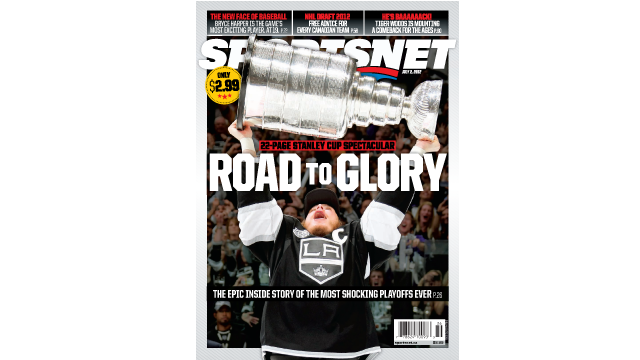
This article originally appeared in Sportsnet magazine.