By Dave Zarum
Sportsnet magazine
The tweet was the final straw. “Should I stay or should I go?” Chris Bosh wrote to his Twitter followers on May 1, 2010, just two weeks after the final game of the 2009-10 campaign.
For seven seasons, Bosh had been the Toronto Raptors’ marquee attraction, earning six all-star appearances; becoming the team’s all-time leader in points, rebounds, blocks and minutes played; and leading the Raps to the playoffs twice in the wake of the Vince Carter era. But after a full season of wavering over whether or not to ink a new contract, enough was finally enough.
And the media let him know it.
“Should you stay or should you go? How about get the hell out?” Michael Grange wrote in The Globe and Mail. “Vince Carter didn’t gleefully Twitter his way out of town like CB-Foregone,” added Globe columnist Jeff Blair. No, Vince didn’t “Twitter his way out of town.” Instead, he sulked and no-dunked his way into a trade for Eric and Aaron Williams (who contributed 2.7 points and 1.8 rebounds per game while in Toronto — combined). But nevertheless, the narrative began: Chris Bosh was a villain, another Vince Carter, another turncoat in the mould of every other star to don the Raptors’ purple. He received showers of boos upon his return with the Miami Heat, the same boos Damon Stoudamire, Tracy McGrady and Carter had heard years earlier.
Was it fair? Doesn’t matter. The thinking at the time was simple: Bosh could have stayed in Toronto and he chose not to. For a fan base that had been burned before, his departure reopened old wounds. And when Bosh showed up on stage in South Beach in the summer of 2010, flanking LeBron James and Dwyane Wade, he might as well have poured salt all over them. But when does the statute of limitations on hating a former franchise star expire? With Bosh finally realizing his potential and playing a key role on a championship contender, now is as good a time as any.
Few people can gauge Bosh’s impact on the Raptors franchise better than Sam Mitchell, who coached the club for five seasons from 2004 to ’08. “I wouldn’t be mad at Chris,” Mitchell says. “People forget that Chris Bosh re-signed [in 2006] without any fanfare. He never asked for a trade, he played hurt, he played sick, he gave the Raptors everything he had to give. He made a decision based on wanting to win a championship. He played by the rules, and I don’t think fans should be upset about that. If people are going to be mad, be mad at how things have fallen in the NBA.”

Bosh with Raptors. (Getty/Ron Turenne)
The landscape of today’s NBA rewards players who jump from team to team via free agency with massive contracts and a better shot at winning a title. Bosh watched the Celtics (with three future Hall of Famers and Rajon Rondo) and Lakers (with Kobe Bryant and Pau Gasol) reach the NBA Finals for a second time in 2010 and saw the writing on the wall: to contend for a title in this league, a team needs more than one star.
In his final year in Toronto, Bosh put up huge numbers (24 points and 10.8 rebounds per game, top 10 in both categories) on a team that featured Hedo Turkoglu, Marco Belinelli and Sonny Weems in big roles. He was forced to be the face of the franchise, billed as an elite player along the lines of James and Wade. He wasn’t. But spend enough time in NBA purgatory, like the Raps have, and fans and front office alike can talk themselves into just about anything.
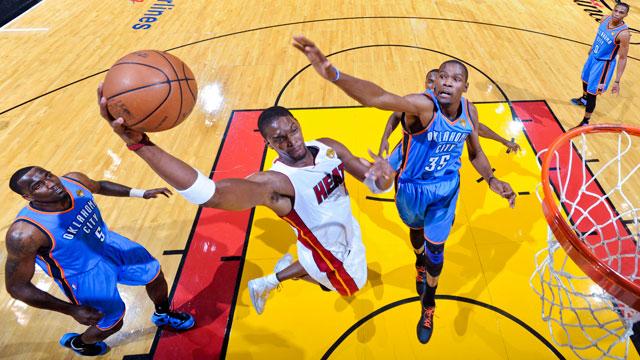
“Realistically, was he a franchise guy?” asks long-time Raptors analyst Jack Armstrong. “No. And I think deep down he realized that; he didn’t go to Miami to be the No. 1 guy.” Far from it. On the Heat, Bosh has excelled in a supporting role, happy to be the forgotten man on screen and rolls — something he couldn’t have dreamed of Toronto — and sinking open jumpers like he did in game seven of the Eastern Conference Finals. But, when he’s called upon, he can still supply the offence Raptors fans remember him for — Bosh averaged 24 points a night in the 13 games Dwyane Wade lost to injury this season, and the Heat went 12-1 during that stretch.
But watching him succeed on basketball’s biggest stage still seems to sting Raptors fans, as if his jumping ship was a personal slight — something that couldn’t be farther from the truth. That the Raptors skidded to a 22-60 record in their first season without him only made it worse, even if the lion’s share of the blame belongs to president and GM Bryan Colangelo and his front office for not putting the team in a position to compete in the short-term. To get next to nothing for a departing all-star when you know he’s on his way out of town is unacceptable in fans’ eyes. “[Bosh’s leaving] had nothing to do with Toronto,” says Mitchell. “What was being done to keep him here? I can understand fans in Toronto being upset, but they need to direct their anger in another direction. I’ll leave it at that.”
Adds Armstrong: “Did Chris handle it well at the end? No. He tried to rationalize why he left instead of taking the high road, but he had a great experience in Toronto and he gave the fans everything he could.”
That he’s now giving everything he can for the Miami Heat on basketball’s biggest stage isn’t reason enough to hate him. Any player in his position would have done the same. If you believe otherwise, you’re fooling yourself. As a fan, that you once had a connection, that he was your hometown hero and that he played hard in Toronto should be reason enough to want him to succeed. It’s like watching your son or daughter graduate from college and find a killer job in the workforce. You don’t boo them when they come back for Thanksgiving dinner.