By Dave Zarum
NASCAR fans dig crashes. And in a sport in which drivers barrel around a 1.2-mile track at 200 mph, battling for the lead while careening within inches of each other, there’s no shortage. There have been more than 6,000 wrecks since 2003, when NASCAR began keeping crash stats as part of an attempt to improve driver safety standards. “The Earnhardt tragedy really prompted a renewed effort,” says Tom Gideon, NASCAR’s director of safety, research and development, referring to Dale Earnhardt, Sr.’s fatal crash during the Daytona 500 in 2001.
A $10-million research facility was built in 2002, resulting in the Car of Tomorrow (with improved head and neck restraints and larger windows) and the SAFER (Steel and Foam Energy Reduction) wall barrier. Now drivers meet at Daytona every January to learn what to do in a worst-case scenario. “We drill them on safety in terms of driver exit and they’re told to practise,” says Gideon.
FREEZE THE FIELD: When there’s an accident, a yellow flag is thrown, meaning drivers must slow to a crawl and aren’t allowed to improve their position. Introduced only in 2002, this rule is meant to limit secondary crashes and help emergency vehicles reach the scene. Previously, emergency staff-of which there are roughly 100 at every race-often refused to go on the track, says Gideon, until the drivers were back at the start/finish line.
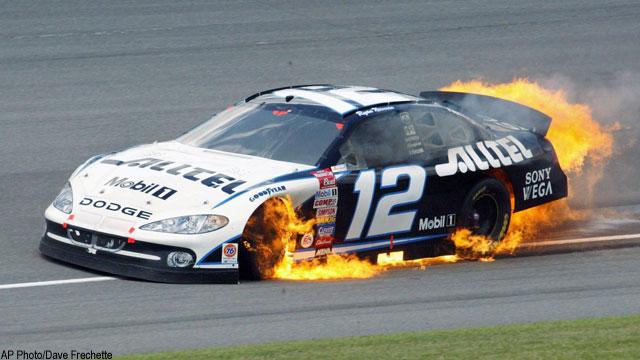
DON’T JUST BAIL: “Stay in the car until the traffic is gone,” says Gideon. “Don’t just jump out.” Fire trucks and EMTs are situated at every turn. “In many cases, when you’re on fire, you have the ability to drive to the fire truck. So you’ll see a guy who’s on fire will drive up in close proximity before he even gets out.” Meanwhile, the Car of Tomorrow is equipped with a 10-lb. fire extinguisher near the fuel tank that goes off when the temperature hits 286 °F.
DROP THE WINDOW: When the car finally comes to a stop, drivers should immediately release the left-side nylon window net, designed to stop debris flying in and keep drivers’ arms contained during the crash. “That tells everybody in the stadium and up in the tower that you’re OK,” says Gideon. “Or at least conscious.”
KEEP YOUR COOL: Now drivers should bail. If they can’t, wait for the cavalry-the army of firefighters and EMTs-to arrive. EMTs take the driver to the infield care centre to decide if he can return to the race. Meanwhile, the crew begins work on getting the car back in shape. Most important: Don’t panic. Drivers can always reach for the 5-lb. fire extinguisher behind their seat. But “drivers are pretty good at staying calm,” says Gideon. They go into each race accepting that a wreck is a distinct possibility. “It’s like knowing where the elevator is in your office,” he adds. It’s just part of the job.
3.9 million ft/lb
Kinetic energy generated by a stock car travelling 180 mph. Catapult a 150-lb. man with the same amount of energy, and he’ll fly five miles.